










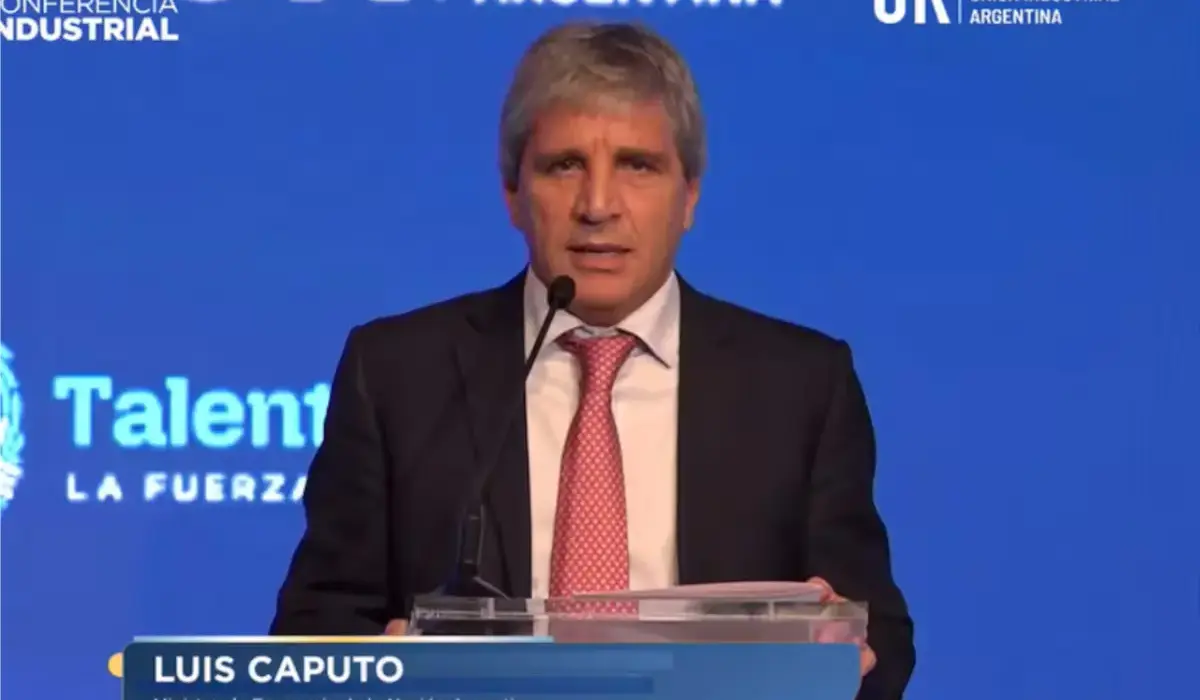
Economy Minister Luis Caputo staunchly defended the Argentine government’s sweeping economic program on Tuesday, addressing business leaders at the opening of the annual Conference of the Argentine Industrial Union (UIA) in Buenos Aires. His remarks came against the backdrop of a challenging economic reality for the domestic manufacturing sector, which is currently navigating a historic contraction that has placed severe strain on industrial activity nationwide.
Speaking before an audience of prominent industrialists and corporate executives at the Golden Center in Parque Norte, Caputo outlined the administration’s strategy for restoring national competitiveness. He asserted that achieving sustainable growth and boosting productivity in Argentina does not rely on artificial monetary adjustments, but rather on structural changes centered on sweeping tax cuts, the systematic reduction of state regulations, and the lowering of overall financial costs for enterprises.
The minister’s defense of the administration’s trajectory arrives at a critical juncture for Argentina’s industrial fabric. Recent data underscores the severity of the ongoing manufacturing downturn. According to a comprehensive report published by the consultancy firm Audemus, which utilized official United Nations data, Argentina recorded the second-worst industrial decline in the world between 2023 and 2025—a period coinciding with the administration of President Javier Milei. During this timeframe, the nation’s manufacturing sector contracted by 7.9%, a drop surpassed globally only by Hungary.
The crisis within the sector has manifested in stark monthly figures as well. Earlier in July, Argentine industrial activity plummeted to levels previously witnessed only during the depths of the COVID-19 pandemic, registering a year-on-year decline of 4.9% according to sector indicators. Despite these sobering statistics, Caputo firmly ruled out resorting to a currency devaluation as a quick fix to boost the competitiveness of Argentine exports and domestic production.
"That is not lowering the ‘Argentine cost,’" Caputo stated during his address, directly challenging critics who advocate for a weaker peso to stimulate the industrial sector. Using the widely recognized domestic term costo argentino—which refers to the historically high cost of doing business in the country—the economy minister warned against measures that he argues offer only an illusion of relief while inflicting severe long-term damage on the population. "It is impoverishing wage earners. When I hear some colleagues talk about this, I see a concerning economic myopia," he argued.
Instead of currency devaluation, Caputo reiterated that the administration is committed to structural measures designed to permanently lower the costs of doing business. He detailed a slate of reforms that include cutting federal and provincial taxes, dismantling burdensome bureaucratic regulations, lowering financial costs for businesses, and investing in critical infrastructure to streamline logistics and supply chains across the vast South American nation.
Addressing immediate concerns from the business community, the economy minister announced a series of targeted measures aimed at alleviating the severe financial and tax pressures currently weighing on companies, with a particular focus on small and medium-sized enterprises (SMEs). Among the relief initiatives unveiled by the minister are the extension of upcoming tax compliance deadlines and the temporary suspension of tax-related asset seizures by the Revenue and Customs Collection Agency (ARCA). These short-term concessions are designed to provide breathing room for companies struggling with liquidity while the broader macroeconomic reforms take root.
‘The Right Path’
Turning to the broader philosophy guiding the current administration, the economy ministry head emphasized the absolute necessity of consolidating the fundamental shift in the economic model introduced by President Javier Milei. He argued that restoring strict macroeconomic stability and long-term predictability are non-negotiable prerequisites for attracting foreign and domestic investment and achieving sustained economic growth.
"I think it is important to emphasize where we are coming from, and I believe the vast majority do not want to go back," Caputo told the gathered business leaders. "We are coming from a model that clearly was not the right path. The data confirms this."
In his assessment of the country’s economic history, Caputo painted a grim picture of the years preceding the current administration. He asserted that Argentina had endured more than 14 years of systemic stagnation in both employment creation and overall economic activity before President Milei assumed office in late 2023. According to the minister, this prolonged period of stagnation was the direct result of an unsustainable economic system characterized by chronic fiscal deficits, rampant monetary issuance, heavy debt accumulation, restrictive foreign exchange controls, and a severe scarcity of productive credit for businesses.
Caputo maintained that this previous model institutionalized severe financial distortions and forced the national economy to remain largely closed to international trade and investment, ultimately generating profoundly negative consequences for both domestic production and workers’ real incomes. To reinforce his argument regarding the volatility and failure of past economic management, the minister pointed to the period between July 2022 and December 2023, during which official figures show that industrial activity suffered an 11% contraction.
RIGI
Elaborating on the architecture of the government’s economic strategy, Caputo explained that the current stabilization and growth program rests upon three foundational pillars: the restoration and preservation of strict macroeconomic stability, the structural reduction of Argentina’s historically high operating costs, and the gradual, systematic extension of the favorable conditions established under the Large Investment Incentive Regime, widely known by its Spanish acronym RIGI.
The minister outlined the administration’s long-term vision for the RIGI, explaining that the ultimate objective is not to maintain it as an isolated or exclusive framework for select mega-projects, but rather to use it as a catalyst for a broader national transformation. The government aims to create the necessary conditions for the entire Argentine economy to eventually converge toward the investment-friendly framework established by the regime, ensuring that all productive sectors can eventually benefit from a predictable and secure regulatory environment.
"The idea is not for it to remain a special regime forever, but for the entire economy to converge toward the RIGI," Caputo told the audience, signaling the administration’s ambition to permanently overhaul the legal and financial conditions governing national and international capital allocation in the country.