



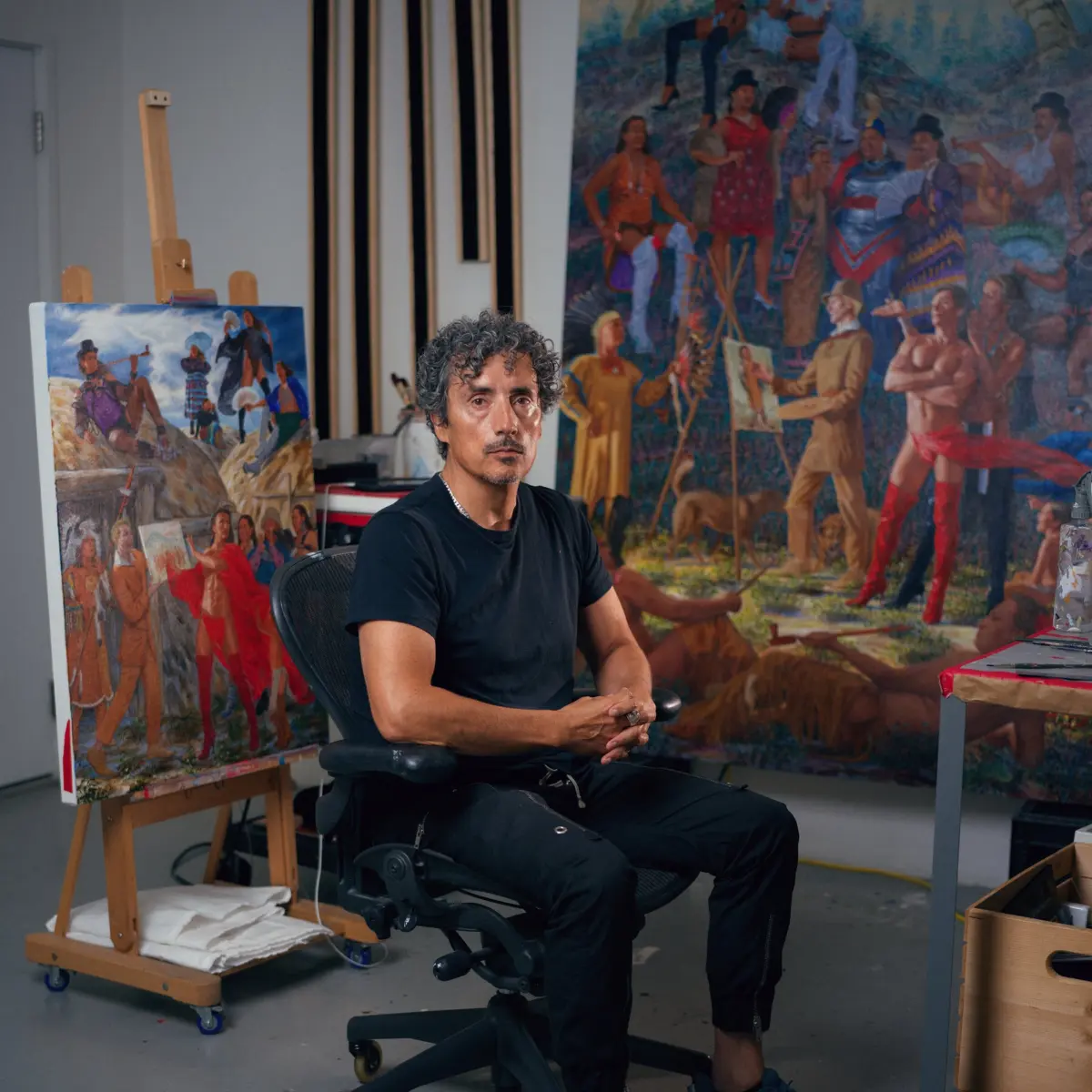






The artist Kent Monkman has a mischievous, gender-fluid, often scantily clad alter ego, and he doesn’t mind being upstaged by her. She was hard to miss in the two gigantic paintings he did for the Metropolitan Museum of Art’s Great Hall in 2019, captivating visitors who walked through the iconic spaces of the historic institution.
Who was this trickster goddess in stilettos and not much else? Why did she seem so acutely aware of viewers watching her from outside the frames, breaking the traditional fourth wall of historical Western art?
Monkman is more than happy to seduce his audiences into asking these deep questions, leaving them to ponder the complex layers of history, colonization, and representation. The Cree, two-spirit artist has gained a massive following in museums across North America because of his rare ability to draw viewers in with romantic, slightly askew landscapes that subvert traditional narratives. He seeks to both unsettle and entertain his audiences; after all, an alternative pronunciation of his alter ego’s name, Miss Chief Eagle Testickle, is a clever play on the phrase “Mischief Egotistical.”
In November, Monkman’s subversive approach to these historical landscapes and ethnographic portraiture will appear in an institution that has rarely, if ever, shown such transgressive, contemporary work: the Frick Collection. Housed in a Gilded Age coal tycoon’s magnificent mansion on the Upper East Side of Manhattan, the Frick is an institution whose permanent collection usually veers toward the masterworks of Rembrandt, Bellini, Titian, and Velázquez.
Monkman’s upcoming exhibition, titled “Officer and Laughing Girl,” is directly inspired by a 17th-century Johannes Vermeer painting of the same name that holds a permanent and cherished place in the museum’s collection. The exhibition will include a suite of provocative, newly commissioned paintings in which Miss Chief sits face to face with white authority figures through the centuries, bridging historical gaps and challenging the colonial gaze.
The exhibition arrives at a notably fraught moment in contemporary American culture and politics. It comes at a time when nationalist ideas, such as the historical concept of manifest destiny, are returning with renewed vigor to mainstream public discourse, and when public debates over geography, history, and sovereignty continue to stir controversy.
Monkman is breaking significant ground as the first Native artist to have a dedicated solo exhibition at the Frick Collection. His suite of commissioned paintings started as a collaborative book project in 2023 with the museum’s chief curator, Aimee Ng. Ng encouraged Monkman to closely examine and creatively engage with Vermeer’s celebrated canvas, “Officer and Laughing Girl,” which depicts a seated officer in a broad-brimmed hat conversing with a smiling young woman illuminated by a casement window.
Monkman has effectively turned the classic Dutch canvas into a time machine, borrowing the intimate composition for a tense, centuries-long standoff between Indigenous groups and successive waves of European and American settlers. In Monkman’s hands, the historical players shift and expand.
The Dutch colonizers are present in the frame. The fur trappers who pushed deep into the North American interior for economic dominance are also here. Even General George Custer makes an appearance, weighed down by the historical baggage of his military career, with a striking portrait of his formidable nemesis, the Lakota leader Sitting Bull, hanging pointedly in the background.
Bringing the historical narrative crashing into the contemporary era, the final painting of the ambitious series includes a bald tech executive with an uncanny, striking resemblance to Jeff Bezos, bridging the historical extraction of wealth and resources by fur trappers and colonial empires with the modern-day corporate titans of Silicon Valley and global capitalism.
Through these works, Monkman continues a career-long project of inserting Indigenous presence, agency, and sexuality into the grand canon of art history—a canon that has historically marginalized, stereotyped, or entirely erased Native peoples. By utilizing the visual language of 17th-century Dutch genre painting, 19th-century romantic landscape art, and academic history painting, Monkman turns the tools of the colonizer back onto themselves.
The inclusion of these works within the hushed, wood-paneled galleries of the Frick Collection represents a major institutional shift. It signals a growing willingness among historic house museums and traditional fine arts institutions to confront their own Eurocentric foundations and engage with contemporary Indigenous critiques of history and power.
As visitors prepare to step into the Frick this November to view “Officer and Laughing Girl,” they will encounter more than just a clever artistic appropriation of a Dutch master. They will be invited into a profound visual dialogue about who gets to tell the story of the Americas, how historical power dynamics are visually constructed, and what happens when the subject of the painting looks back at the viewer with intelligence, irony, and unwavering confidence.