









The brutal murder of 52-year-old rural teacher Nancy Godoy has sent profound shockwaves throughout Argentina, igniting widespread grief, anger, and national scrutiny regarding the safety of educators working in isolated regions. On Thursday, judicial authorities released a harrowing autopsy report revealing that Godoy suffered an “extremely violent death,” prompting investigators to treat the case definitively as a femicide. Five suspects have been arrested in connection with the crime, though investigators continue to grapple with fundamental questions surrounding the precise context, timeline, and motivations behind her horrific killing.
The tragic discovery of Godoy’s body has also intensified an already grim national conversation surrounding gender-based violence. According to data compiled by the prominent Argentine feminist organization Mumala, Godoy’s death marks the 239th femicide recorded in the country this year alone. This devastating statistic highlights a horrifying systemic trend: on average, a woman is murdered in a context of gender-based violence once every 30 hours in Argentina.
Godoy’s remains were discovered on Wednesday, bringing a heartbreaking end to a grueling 21-day search following her disappearance. The sequence of events leading up to her death began on October 6, when she embarked on the long and arduous journey from her home in the Corrientes department of Esquina to El Malezal, a deeply isolated rural area. Godoy was employed there as a teacher and substitute principal at public Rural School No. 626. The institution is uniquely situated deep inside a private ranch utilized for hunting tourism, known as El Curupí.
The last verified communication from the teacher occurred on the night of October 7, when she transmitted a text message to her son confirming that she had successfully completed the hazardous journey and arrived safely at the school. However, because of the profound isolation of the area and the lack of reliable infrastructure, her family did not immediately realize the full extent of the danger.
Prior to her disappearance, Godoy had expressed severe concerns regarding the conditions of her workplace. In August, she formally filed a complaint before education authorities, documenting that Rural School No. 626 was in an appallingly deteriorated state. Upon her initial arrival at the post, she reported finding the building completely filthy, lacking running water, and entirely devoid of functioning bathrooms.
Furthermore, the remote school facility was heavily infested with rats and bats, presenting a public health hazard that she described as “completely abandoned.” In her grievance, Godoy also asserted that the previous teacher in charge had visited the site only on a sporadic basis. Operating with a tiny enrollment of just eight students, Godoy was forced to undertake the arduous task of cleaning and rehabilitating the building largely by herself, with the occasional assistance of the mother of one of the local children.
The logistical challenges of her position were immense. The school was situated several hours away from her permanent residence, a commute that notably included a grueling one-and-a-half-hour horseback ride across difficult terrain. To fulfill her instructional duties throughout the standard school week, Godoy was required to sleep on-site, making absences from immediate contact for several days entirely normal. Compounding these daily hardships was the region’s notoriously poor cellular phone signal, which regularly isolated residents and workers from the outside world.
In her administrative complaint submitted to education authorities, Godoy had additionally noted that due to the uninhabitable and hazardous conditions of the school building itself during certain times, she occasionally had to sleep at the nearby home of a local resident named Rosa Leguizamón, who lived in proximity to the school grounds.

It was not until a week after their last contact—specifically on October 14—that Godoy’s sons grew deeply alarmed by her silence and absence of communication. Recognizing that something was fundamentally wrong, they promptly filed an official police report, initiating a coordinated search operation that spanned more than two weeks across the difficult terrain of Corrientes.
What Did the Autopsy Say?
The extensive search came to a devastating conclusion on Wednesday when search teams located Godoy’s body partially submerged in a wetland area situated inside a field approximately 2.5 kilometers away from the school. Nearby, investigators recovered her cellular phone and a bag that appeared to belong to her, providing crucial physical evidence for the unfolding criminal inquiry.
As forensic experts examined the remains, investigators began looking into the disturbing possibility that Godoy was sexually assaulted prior to or during her murder. However, due to the significant amount of time that had elapsed between her death and the eventual discovery of her body, the official autopsy was unable to definitively confirm whether a sexual assault had taken place.
The released autopsy report detailed a scene of unimaginable brutality. According to the findings, Godoy suffered severe mutilations and “multiple stab wounds,” alongside distinct defensive marks indicating that she fought desperately for her life. Furthermore, forensic analysts noted that some of the catastrophic wounds inflicted upon her body appeared to have occurred postmortem, underscoring the extreme malice of the perpetrators.
Who Are the Five Suspects?
The local judicial investigation has moved swiftly to apprehend individuals linked to the ranch and the surrounding community. Two days after the initial search and investigation commenced, police arrested Ernesto Bordón, a worker employed at Ranch El Curupí. Bordón initially offered conflicting statements to authorities, at one point claiming the woman had been killed before subsequently backtracking on his assertion, which led to his formal arrest and a charge of perjury.
As the inquiry deepened, attention quickly shifted to other figures connected to the private property. Irineo Zarza, a 34-year-old foreman at the El Curupí ranch, and Felipe Sandoval, a 55-year-old who also serves as a foreman at the ranch, emerged as the primary accused individuals in the heinous crime.
In addition to the ranch employees, police executed further arrests targeting locals who interacted closely with the victim. Among them was Rosa Leguizamón—the local woman who frequently hosted Godoy and was documented as one of the last people to claim she saw the teacher alive—alongside her romantic partner, Nahuel Rojas. Leguizamón, Rojas, Zarza, and Sandoval are all formally accused of direct involvement in the murder of the rural educator.
During the execution of search warrants, investigators uncovered suspicious evidence pointing toward the suspects. Authorities recovered clothing that potentially belonged to the teacher inside Leguizamón and Rojas’s residence. Additionally, police discovered various other personal objects and burnt pieces of clothing near a modest shack close to the school where Zarza was known to sleep, though forensic teams are still working to officially confirm whether these charred items belonged to the victim.
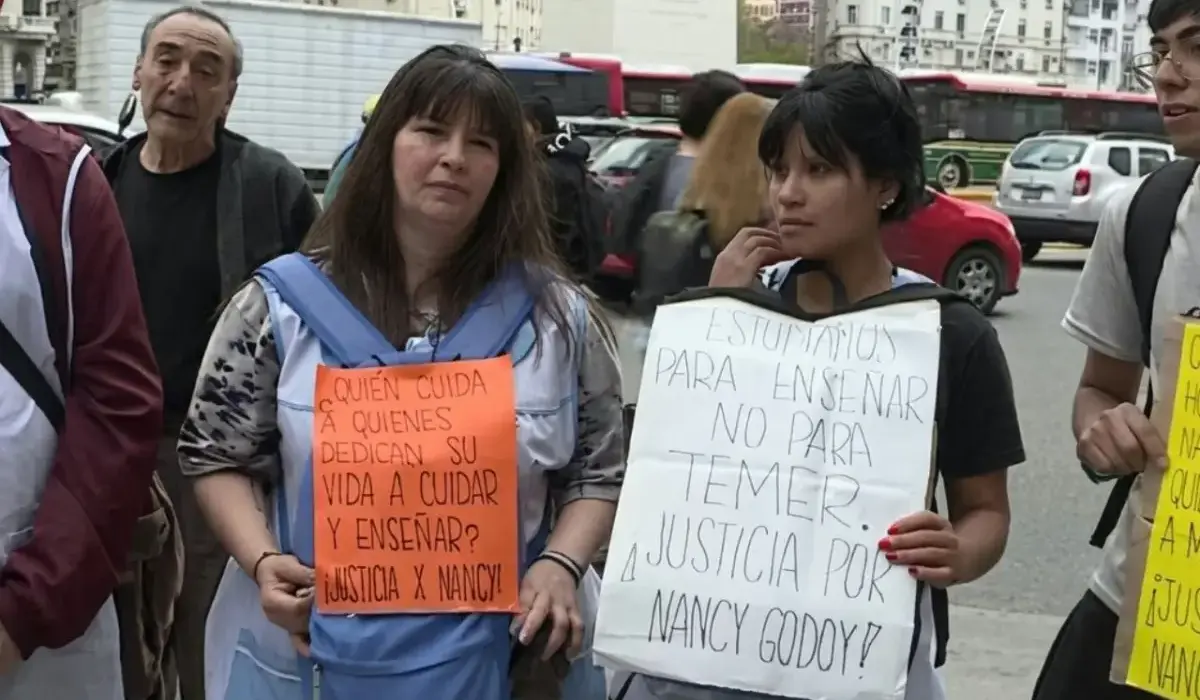
The tragedy has since sparked widespread demonstrations, drawing educators, labor unions, and citizens into the streets to demand systemic protection and accountability. Protesters in Buenos Aires and other regions have raised signs asking pointed questions about institutional negligence, reading, “Who is taking care of those who dedicate their lives to teaching?” and “We study to teach, not to fear. Justice for Nancy Godoy!”