











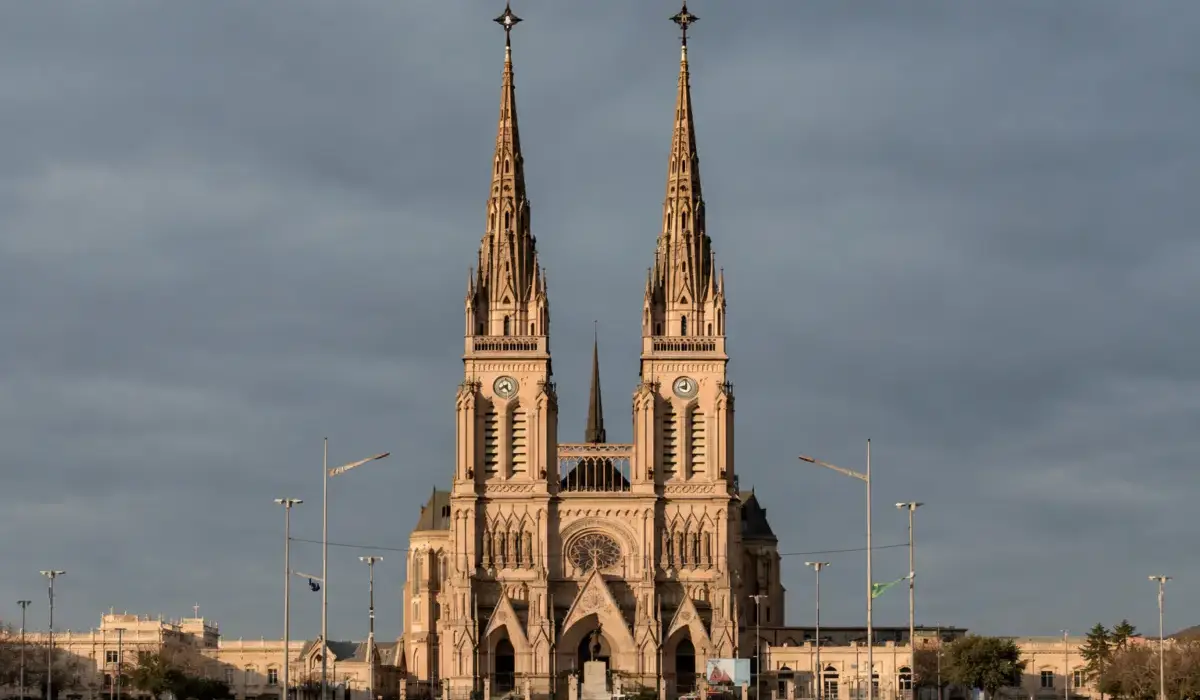
The Basilica of Our Lady of Luján, standing as one of Argentina’s most spiritually significant Catholic shrines, is preparing to take center stage on the global map when Pope Leo XIV arrives to celebrate a landmark mass there on November 11. The upcoming service will form a central highlight of the pontiff’s highly anticipated first apostolic visit to Argentina, drawing intense international attention to the historic sanctuary located just outside the nation’s capital.
According to the official itinerary released by the Vatican, Pope Leo XIV is scheduled to touch down in Argentina on November 8 and remain in the country through November 11. During his four-day stay, the pontiff will participate in a series of high-profile events, religious festivities, and gatherings in Buenos Aires and Córdoba before continuing onward to Peru to complete the remainder of his broader South American journey.
The Vatican has officially confirmed that the Pope will make the journey to Luján—situated approximately 68 kilometers from Buenos Aires City—on the final morning of his Argentine itinerary. The papal mass is scheduled to begin at 10 a.m. and will be held in the expansive open square directly in front of the basilica. Organizers and local authorities anticipate that the historic service will draw millions of the faithful from across Argentina and neighboring nations, turning the surrounding Pampas landscape into a vast gathering space for the Catholic community.
This upcoming visit carries profound spiritual and cultural significance for the South American nation. The Basilica of Our Lady of Luján houses the venerated image of the Virgin of Luján, who is revered as the patron saint of Argentina and stands as an enduring emblem of the country’s deep-rooted Catholic identity. For generations, millions of Catholic faithful have undertaken journeys to the shrine to seek solace, offer prayers, and demonstrate their devotion, with the grand annual pilgrimage serving as the crowning spiritual event on the national calendar.
Foreign Minister Pablo Quirno elaborated on the strategic reasoning behind the inclusion of Luján during an official press conference held in August, shortly after the papal itinerary was formally confirmed to the public.
"It was a matter of significance to the Catholic community," Quirno explained to reporters. "Papal visits generally include the national capital and other locations. Luján was chosen for its significance to all Argentines, due to the Basilica of Our Lady of Luján, and Córdoba for the prominence of the Catholic community there. Furthermore, it is centrally located in the country and accessible from other areas."
A Focus of Devotion
The rich history and foundational mythology of the basilica trace their roots back to the early 17th century, anchoring the site firmly in Argentine folklore and religious heritage. According to traditional accounts, two statuettes of the Virgin Mary were commissioned by a wealthy landowner residing in northern Argentina. In the year 1630, the sacred images were being transported southward on a traditional ox-driven cart, traveling along the long route from Buenos Aires to Santiago del Estero.

Upon reaching an area close to the banks of the Luján River, the oxen abruptly halted and refused to move any further. Drovers replaced the animals with fresh oxen, yet the new beasts remained completely immobile until one of the statuettes was unloaded from the cart.
The dramatic delay was immediately interpreted by the travelers and local settlers as a clear divine sign: the Virgin Mary wished to remain in that specific geographic location rather than complete the journey north. Years later, a local woman purchased the sacred image and housed it within her private chapel, but the following morning, the statue reportedly vanished and mysteriously returned to its original discovery site by the river.
Eventually, the image was transferred in a solemn religious procession to Luján, where a succession of modest chapels and larger churches were constructed over the decades to accommodate the rapidly growing number of pilgrims. The construction of the magnificent neo-Gothic basilica that stands today officially began in 1890, and the monumental building was finally inaugurated and blessed in 1910.
The massive structure represents one of the finest and most ambitious examples of neo-Gothic architecture found anywhere in South America. Architects and designers drew heavy inspiration from the great medieval Gothic cathedrals of France, channeling the grand stylistic elements seen in renowned structures such as Notre-Dame de Paris, Chartres, Reims, and Amiens.
The building successfully merges the immense scale of medieval European cathedrals with intricate sculptural details, vibrant colorful stained-glass windows, and a richly appointed interior. Classic medieval Gothic motifs, including an emphasized verticality that draws the eye upward, delicate stonework ornamentation, and the profound spiritual symbolism of natural light filtering through stained glass, are woven throughout the design.
Perhaps the most visually arresting feature of the building is its pair of soaring twin towers, each stretching approximately 106 meters into the sky. Crowned by slender spires and monumental crosses, these towers are visible from a considerable distance across the relatively flat expanse of the Pampas landscape, granting the basilica a dramatic, almost ethereal silhouette against the horizon.
In recognition of its architectural splendor and immense spiritual importance, Pope Pius XI officially granted the sanctuary the prestigious title of minor basilica in 1930, although final construction touches on the complex were not fully completed until 1935.

Despite the vast scale of the surrounding cathedral, the small statuette that sparked the entire tradition centuries ago—measuring approximately 38 centimeters in height—remains the central focus of intense veneration and devotion to this day.
A Place in Argentine History
Beyond its architectural grandeur and foundational legends, Luján has become synonymous with the powerful tradition of the pilgrimage in Argentine culture. Every year, enormous crowds of the faithful undertake an arduous journey, walking between 12 and 18 hours on foot from Buenos Aires to the shrine. Many participants complete the trek through challenging weather conditions and physical exhaustion, demonstrating the enduring strength and resilience of the national tradition.
The scale of this devotion was clearly visible in the weeks leading up to the papal announcement, when the annual pilgrimage drew an estimated 2.7 million people, according to official figures released by the Buenos Aires provincial government.
Pope Leo XIV’s upcoming visit will also etch another chapter into the modern historical resonance of the sanctuary, marking only the second time a reigning pontiff has visited the Luján shrine. Saint John Paul II broke new ground in 1982 by becoming the first pope to visit the sacred site, celebrating a historic mass before a massive crowd estimated at over one million people. That momentous visit occurred during the height of the Malvinas War between Argentina and the United Kingdom, providing a powerful message of peace, comfort, and spiritual hope to a deeply distressed and fractured nation.
The country’s profound emotional and cultural connection to the Virgin of Luján has also found expression in other iconic national moments. Notably, the Argentine national football team traveled to the basilica on July 4, 1986, to fulfill a sacred vow of thanks to the patron saint of Argentina, arriving just days after defeating West Germany to claim victory in the World Cup final in Mexico.