











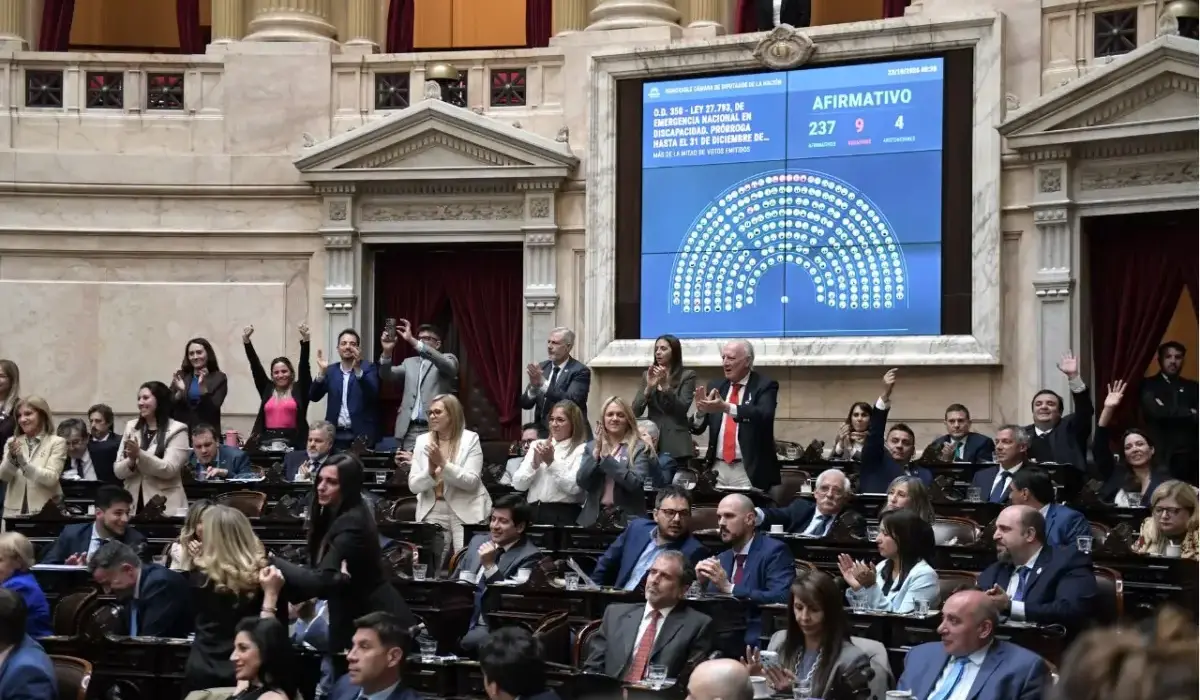
The administration of President Javier Milei secured a pair of crucial legislative triumphs during a marathon Lower House session that stretched into the early hours of Thursday. Lawmakers ultimately approved a ruling party initiative designed to restructure and secure permanent funding for disability services, alongside a contentious measure focused on private property protections and the controversial regulation of foreign land ownership.
Meanwhile, a broader legislative push addressing Argentina’s mounting household debt crisis stalled on the chamber floor. The package of proposals aimed at giving struggling families mechanisms to refinance their debts was ultimately sent back to committee without a vote. The opposition had championed a bill allowing families direct refinancing options, while the ruling party, La Libertad Avanza (LLA), countered with its own alternative. The LLA-backed version steered clear of immediate financial relief measures, focusing instead on increasing transparency and accessibility within credit information databases.
The late-night voting marathon highlighted the ongoing legislative maneuverings and political compromises required in a deeply divided congress where the executive branch must frequently navigate fragile alliances to advance its broader economic and structural agenda.
Private Property Reform and the Foreign Land Debate
The Private Property Inviolability Law secured final approval in the lower chamber with 124 votes in favor, 119 against, and six abstentions. Initially drafted by the Milei administration and cleared by the Senate back in August, the measure had previously attracted intense political and public scrutiny. In its original form, the bill proposed the outright elimination of the Land Law, a foundational statute that imposes strict legal limitations on the maximum amount of agricultural and rural land foreign nationals can acquire within Argentine territory.
When the bill progressed through the Senate, that specific proposal was dropped from the text due to a lack of sufficient political support to ensure its passage. However, the underlying controversy regarding foreign land acquisition has been a persistent battleground for the Milei administration.
In December 2023, shortly after taking office, President Milei attempted to sweep away the restrictions of the 2011 Land Law via an expansive emergency decree aimed at deregulation and eliminating caps on foreign property ownership. That executive action was quickly challenged in the courts, and the judiciary blocked the implementation of the decree, allowing the historical restrictions to remain in place.
The legal tug-of-war took another turn in late September when the restrictions were briefly lifted for a nine-day window after the Supreme Court overturned the initial blocking ruling. That brief window galvanized opposition lawmakers in the Chamber of Deputies, who promptly moved to formally repeal Milei’s 2023 decree—a motion that the Senate had already rejected.
Before the political standoff could escalate further, the Supreme Court reinstated the restrictions in a subsequent ruling. Facing this judicial reality, the LLA leadership altered its legislative strategy. To secure the passage of the Private Property bill, the ruling party integrated the existing limits on foreign land purchases directly into the text of the legislation.
Because of this late alteration, the bill must now return to the Senate, which is required to approve the modifications introduced by the deputies before it can officially be signed into law. If the Senate concurs, the specific section of the 2023 presidential decree that sought to permanently strike down the Land Law will officially be rendered null and void.
Beyond the land ownership debate, the newly approved version of the Private Property law introduces significant changes to domestic property dynamics. It tightens the legal boundaries governing state expropriations, raising the threshold of proof required for the government to legally demonstrate that a given expropriation genuinely serves the public interest.
Furthermore, the legislation introduces what proponents term "express evictions" targeting tenants who fall behind on their rental obligations. Under the new framework, renters would be granted a strict ten-day window to settle overdue rent balances following a missed payment. If the debt remains unpaid after this period, landlords would be empowered to pursue tenant removal through an expedited judicial process. This marks a sharp departure from the current system, where traditional court-ordered eviction proceedings can routinely drag on for months or even years, creating significant friction in the rental market.
Securing Permanent Disability Funding
In addition to property reforms, the Lower House addressed the politically sensitive issue of disability services financing. A provision introduced directly by LLA managed to bridge the gap between the ruling party’s legislative allies and the fragmented opposition, securing widespread approval. The measure establishes a permanent framework for disability funding, which still requires final confirmation from the Senate to officially become law.
If fully enacted, the new legislation will replace the temporary emergency regime currently governing the sector, which is scheduled to expire on December 31 and provides supplementary financial support for disability services. Just a week prior to Thursday’s session, opposition blocs had attempted to pass a bill extending the emergency regime for another year, but that legislative effort collapsed after failing to reach a quorum on the chamber floor.
The underlying disability emergency law had a turbulent political history, having originally been passed by Congress in September 2025. President Milei promptly vetoed the measure, setting off a confrontation that ended when Congress successfully overrode his veto to reinstate the legislation. Although Milei ultimately enacted the law as required, his administration initially delayed compliance until a formal court order compelled the executive branch to implement the funding allocations.
The compromise bill approved in the early hours of Thursday ultimately passed by an overwhelming margin of 237 votes in favor, nine against, and four abstentions. While the text closely mirrors the structure of the expiring emergency law, its defining characteristic is that it converts the temporary funding streams into permanent statutory obligations.
The opposition ultimately decided to throw its weight behind the LLA-sponsored bill out of strategic necessity. Recognizing that there was insufficient backing in the chamber to successfully extend the temporary emergency regime for another twelve-month period, lawmakers grew concerned that any alternative measure would simply face another presidential veto from Milei.
Despite the broad numerical consensus in the chamber, the compromise was not without its domestic critics. Deputy Marcela Pagano, a former member of La Libertad Avanza who has since distanced herself from the ruling party, voiced skepticism regarding the government’s motives. Pagano stated publicly that she "doesn’t trust" the newly approved bill, pointing to Milei’s history of vetoing the previous emergency legislation. She argued that the sudden legislative pivot on social funding was driven by political optics rather than a shift in policy, claiming the real motivation was an attempt to "win the pope’s favor" ahead of Pope Leo XIV’s widely anticipated upcoming visit to Argentina scheduled for November.