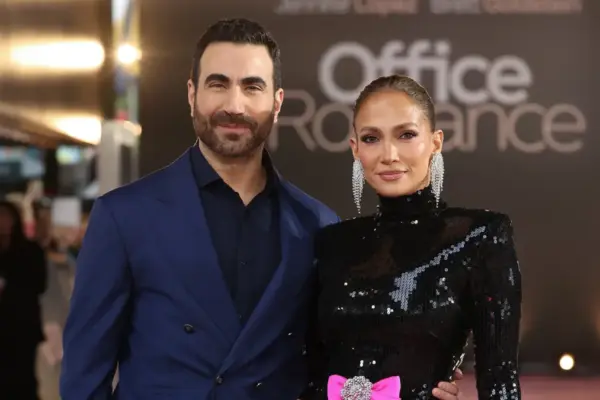









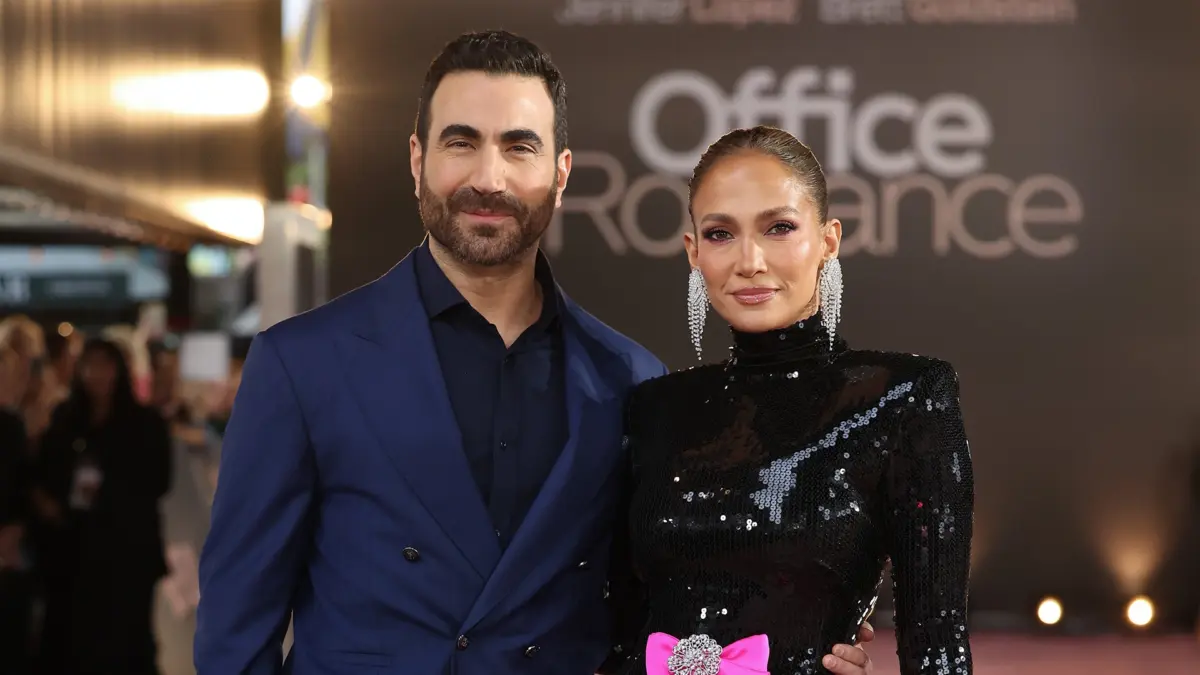
When Jennifer Lopez and Brett Goldstein shared the screen in the Netflix romantic comedy Office Romance, their undeniable on-screen chemistry immediately sparked widespread speculation. Throughout the film’s press tour earlier this year, rumors circulated that the two co-stars had translated their romantic connection into a real-life relationship, captivating fans and media outlets alike.
Back in June, the duo appeared on NBC’s Today show to address the swirling rumors. During the segment, Goldstein admitted that he had written the film specifically with Lopez in mind. Show host Savannah Guthrie highlighted the palpable romance between them, noting that Lopez had previously referred to Goldstein as her “best kisser” among all her co-stars during an appearance on Andy Cohen’s Watch What Happens Live. Despite exchanging knowing smirks and nervous giggles, both actors firmly denied they were dating.
While their denials were met with widespread skepticism—with many comparing the intense promotional buzz to the famous real-life rumors that followed Bradley Cooper and Lady Gaga after A Star Is Born—the whirlwind press tour eventually wound down, and the film was released to audiences.
Now, months after those initial denials and the film’s debut, reports indicate that the speculation may have had some truth to it after all. According to Page Six, Lopez and Goldstein are reportedly casually dating. The rumors gained fresh momentum after the pair were recently spotted leaving a Los Angeles party together in the same car. To date, neither Lopez, Goldstein, nor their respective representatives have issued any official confirmation regarding their relationship status. Nevertheless, the internet has already embraced the narrative, treating the sighting as the beginning of a full-blown celebrity romance.
If the reports are true and Lopez and Goldstein are indeed exploring a connection, the reaction highlights a persistent double standard in how society views the romantic lives of public figures, particularly women. The immediate rush to decode a new relationship as a lifelong commitment reveals a deep-seated cultural expectation that women must treat every single romance as a march toward marriage.
This pressure disproportionately affects women, and Latinas especially, regardless of age. Society rarely places the same burden on men. Lopez, who is 57 years old, has lived a full and public life, navigating four marriages and divorces while raising two children. Having experienced multiple chapters of life, she has undoubtedly gathered profound self-awareness along the way. That is not to suggest Goldstein is or isn’t the right match for her, but the rapid assumption that a casual date must instantly transform into something serious overlooks the simpler reality of modern dating. For all anyone knows, the two could simply be enjoying each other’s company and getting to know one another. The fact that Lopez’s high-profile divorce from Ben Affleck remains fresh in the public consciousness does not mean that Goldstein is obligated to become her next husband.
Our culture frequently treats a woman’s romantic history as a direct reflection of her judgment, self-worth, and personal growth—an analytical lens that is rarely applied to men with similar pasts. Although Lopez’s romantic journey has inevitably become a prominent fixture of her public persona, using every new connection to suggest she has failed to learn from her past, makes poor choices in partners, or needs to prove her inherent value by making her next relationship permanent is inherently unfair.
Even today, cultural expectations continue to place heavy pressures on Latinas to find and maintain lasting love. While younger generations, such as Gen Z, have experienced a cultural shift toward greater grace regarding personal relationships, many millennials, Gen Xers, Boomers, and members of older generations were raised under the traditional "señorita" mentality. Originally a polite address for an unmarried woman, the term became inextricably linked with virginity and restrictive cultural expectations surrounding female sexuality. Within many Latiné cultures and families, the archetype of a "good woman" was historically defined as a señorita—a young woman who preserved her chastity exclusively for marriage.
These deeply entrenched expectations originate from patriarchal and machismo-driven frameworks. Although such rigid standards are enforced less overtly today, women still face pervasive societal pressures to remain modest, protect their reputations, avoid being mischaracterized as promiscuous, and select only partners who represent a viable path to the altar. A woman who accumulates multiple romantic partners—even when every relationship was entered into with serious intent—is frequently expected to harbor regret. This scrutiny is a constant burden placed upon public figures like Lopez.
Conversely, a man with an identical or even more extensive romantic history is typically viewed through a lens of positive reinforcement, seen as experienced, worldly, or simply taking his time before choosing to settle down. Men who date casually are routinely characterized as independent, confident, and proactive, with the luxury of abundant options. The more successful a man is professionally, the more society tends to excuse his reluctance to commit.
Yet someone as accomplished, experienced, attractive, and globally successful as Lopez is frequently subjected to a different narrative—one that frames her as someone who "can’t keep a man." Public fascination persists around the idea that despite possessing beauty, immense wealth, professional success, global fame, and numerous romantic options, she has yet to secure a permanent, lifelong relationship.
However, the conclusion of a marriage does not equate to a failure at love. Lopez’s past marriages and subsequent divorces do not create an obligation for her to prove her worth by ensuring her next relationship culminates in a wedding. Her connection with Goldstein could very well be entirely casual, and if it is, she is entirely within her rights to explore a dynamic that brings her excitement, without the burden of long-term predictability.
Men are routinely permitted to treat dating as a fluid phase of life, while women are persistently pressured to treat it as a linear path toward a permanent destination. A man can spend years stating that he is not ready for commitment, wishes to focus on his career, or simply wants to keep his options open. Even if observers view such behavior as selfish, emotionally unavailable, or immature, society still largely accepts that he is merely dating.
Women, on the other hand, who make similar choices are frequently subjected to intense psychological questioning. Observers wonder whether she is afraid of commitment, overly picky, prone to choosing the wrong partners, or dealing with unresolved childhood trauma. As women grow older—approaching their forties, fifties, and sixties—these inquiries often grow increasingly judgmental. Questions such as why she has not settled down, why her past relationships ended, or whether she regrets her lifestyle choices reflect a persistent societal discomfort with unmarried older women.
To be sure, women themselves can sometimes reinforce these restrictive norms. Society has conditioned women to internalize the belief that their romantic and sexual decisions serve as a fundamental indicator of their character. At the same time, legitimate reasons exist for women to exercise heightened caution in romantic and sexual relationships with men. Women frequently shoulder disproportionate risks, including the threat of sexual violence, biological and reproductive consequences, unequal emotional labor, and the potential for reputational exploitation. While men can certainly experience harm within relationships, women are often expected to manage both the intrinsic risks of dating and the external judgments placed on their choices by society.
This dynamic is evident in how discussions around sexual history often function as social currency. Grown women sometimes feel compelled to emphasize a limited number of past partners as a subtle signal of selectivity, self-respect, and adherence to traditional standards, effectively messaging that they are worthy of being chosen. Men, by contrast, rarely feel any pressure to justify their personal histories in similar terms.
Ultimately, personal choices regarding intimacy vary widely, and preferring celibacy, commitment, or casual dating are all valid expressions of personal autonomy rather than metrics of human worth. Lopez does not owe the public a successful marriage to validate her life choices or to prove that she has "figured out love." She is entirely free to pursue companionship, physical chemistry, and personal happiness on her own terms, whether a connection lasts for a single season or a lifetime.