







The current political landscape across the United States is being profoundly reshaped by a generation of young voters—particularly young Black and Latine Americans—who came of age amid a relentless succession of overlapping socioeconomic crises. For millennials and Gen Z, the foundational promise that hard work predictably leads to economic stability, homeownership, and upward mobility no longer feels guaranteed. Instead, these voters have navigated the economic fallout of the Great Recession, a crushing burden of rising student debt, an increasingly hostile and expensive housing market, the disruptions of the COVID-19 pandemic, persistent inflation, widespread mass layoffs, intense immigration crackdowns, and ongoing struggles for racial justice.
As the fundamental necessities of daily life—such as housing, childcare, and groceries—become increasingly unaffordable, a growing number of young adults are forced to delay major life milestones. Milestones like purchasing a home, getting married, and starting a family are being postponed indefinitely. The direct consequence of this sustained economic squeeze is a palpable, growing frustration with traditional political institutions and a deepening, systemic distrust of mainstream politics.
This widespread disillusionment explains why so many Americans, stretching far beyond the boundaries of New York, closely followed and supported Mayor Zohran Mamdani during his campaign. Mamdani broke away from traditional political playbooks, anchoring his messaging firmly in immediate affordability and daily quality-of-life concerns. Operating as a democratic socialist, much like U.S. Representative Alexandria Ocasio-Cortez, Mamdani consistently framed political change not as the product of isolated individual leadership, but as something achieved exclusively through collective action.
Now, a new candidate—a Latina leader—is stepping forward to become part of this broader generational and political shift.
Darializa Avila Chevalier, a democratic socialist and an official Zohran Mamdani-endorsed candidate, is mounting a high-profile challenge against incumbent Adriano Espaillat in New York’s 13th Congressional District. Yet her campaign is offering something that reaches far beyond the conventional bounds of political representation. As a Dominican American who has lived and experienced the realities of the 13th District firsthand, Chevalier intimately understands the displacement driven by severe lack of affordability. She firmly believes that it is the direct responsibility of the government to step in and address these systemic failures.
“I think representation needs to be one that is reflective, not only of people’s identities but of the things that they are fighting for,” Chevalier tells HipLatina. “It doesn’t help any of us to have someone in office who might look like us, but yet will consistently enact policies that harm us. We need representation that understands that the fight has to be one that will better the lives of the people who live here.”
One of the most pressing issues Chevalier frequently highlights on the campaign trail is the steady exodus of Dominicans from New York City, forced out after being priced out of the very neighborhoods they have called home for generations. For decades, Washington Heights and Inwood served as what many residents and cultural historians referred to as “Little Dominican Republic,” representing one of the largest and most vibrant Dominican communities in the United States. However, a stark 2025 study from the Center for Latin American, Caribbean, and Latino Studies at CUNY revealed that New York City’s Dominican population declined by 13% between 2021 and 2024. For a vast number of residents, leaving the city has become the only option because staying no longer feels economically feasible.
In response to this crisis, Chevalier is aggressively fighting for what she defines as dignified housing and community preservation.
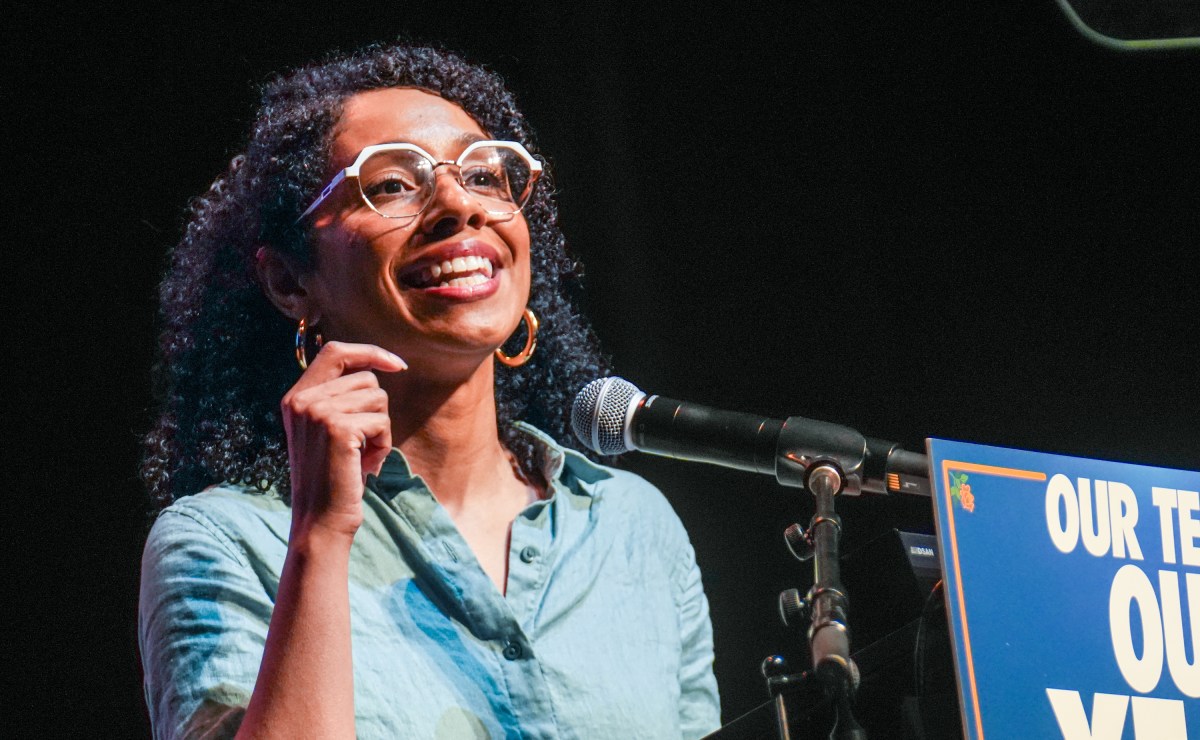
“It’s about making sure our children can afford to have good childhoods, dignified childhoods with good education,” she explains. “To say that you love your community, that is something that you have to show and prove every single time you make a policy choice.”
Because she shares these lived experiences, Chevalier maintains a deep understanding of the apathy and political disengagement that voters in her community have felt for years. The disconnect between establishment politics and the daily struggles of working people has left many feeling abandoned by the very systems meant to protect them.
“I get it. I understand why so many of us have felt so disillusioned by a politics that has told us that the only thing we can do is vote against something even scarier and not present to us a vision for something that we actually want to vote for,” she says. “And I think we have an opportunity here to build the government that we deserve, and we need to really grab onto that.”
She adds further perspective on the urgency of the current political moment: “We are in a moment where we can either succumb to the fascism that we’re facing, or we can fight back and build something much better, something that will actually lead towards having dignified lives for every single person in the city and across the country.”
Chevalier, who previously served as an organizing lead for Mamdani’s mayoral campaign within her district and has made New York City her home for the past 14 years, has frequently grappled with the alienation fostered by establishment politics. Adopting an approach akin to Mamdani’s, she avoids abstract ideological jargon, choosing instead to focus laser-sharp attention on the tangible issues shaping daily life in her district—ranging from soaring rents and exorbitant childcare costs to reliable access to affordable healthcare and groceries.
For millions of Americans across the country, life has grown steadily more expensive, a reality felt most acutely by younger generations. This economic pressure explains why young voters’ widespread disillusionment with politics is not directed solely at the Republican Party. A significant portion of this frustration is aimed squarely at the Democratic Party, with critics arguing that mainstream Democrats have consistently failed to deliver sufficiently on the foundational issues that directly dictate the quality of everyday life.
Mamdani’s political rise reflects a burgeoning appetite among younger demographics for candidates who speak directly to these kitchen-table concerns. Instead of relying on traditional, focus-grouped political messaging, campaigns centered on economic justice are finding success by addressing the concrete needs of voters who are searching for tangible solutions rather than empty, broad promises.
Within many Latine communities, the political baggage attached to the word “socialism” has historically been met with apprehension, fueled by longstanding misconceptions regarding what the ideology means and how it might manifest in the United States. However, young voters are increasingly recognizing that democratic socialism is not an effort to dismantle capitalism, but rather a framework for ensuring that basic human needs are met. It is rooted in the fundamental understanding that healthcare should be universally accessible, that housing must be treated as an affordable human right, that childcare ought to be free and available to all working parents, and that the government must maintain a robust role in actively reducing economic inequality.
“For far too long, we’ve had a Democratic party that claimed to be fighting for working people and yet our lives got more and more unaffordable, and yet they could not present a vision for how to make our lives better,” Chevalier notes. “I think the most common misconceptions I hear are the idea that socialists just don’t want to work. It’s completely counter to the notion.”
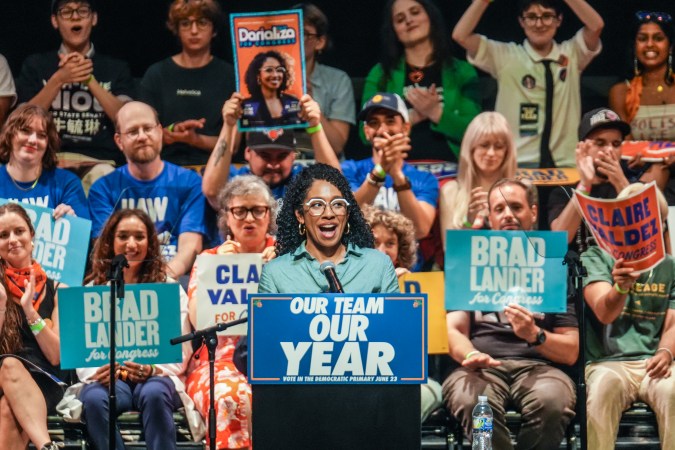
Rather than discouraging labor, Chevalier maintains that socialism is fundamentally built on the premise that there is profound purpose and dignity in work, and that labor should provide genuine meaning to human lives.
“It’s not that folks want to stop working. It’s that folks want to be able to work in a way that gives their lives dignity and purpose, and what we’re seeing right now is a system that is deeply exploitative, where people who own make more money than the people who work,” she explains. “We shouldn’t have a world where, when working people are struggling, they are left without the resources they need to survive.”
Reflecting on the historical roots of the political polarization and the deep-seated fear of socialism that has characterized American politics for decades, Chevalier points to the rise of the neoliberal movement during the 1970s. Neoliberal economic theory argues that private markets are inherently more efficient than government administration and should therefore manage many of the essential services previously provided by the public sector.
“The reason that started to happen is because we have a society, a system, an economic system, that prioritizes profit over human lives—over people,” she says. “And so there was an inundation of rhetoric that sought to tell everybody in our society that public goods are bad and the private industry is what’s going to help us have a more fruitful economy and a more robust economy. And that’s what we’ve seen because of this neoliberal politics of divestments from public goods, those schools, public infrastructure, public housing, roads—all those things that are getting defunded.”
With New York’s primary elections scheduled for Tuesday, June 23, determining the candidates ahead of the upcoming midterm elections in November, Chevalier remains focused on leading with core values rather than partisan labels.
“I think we get lost in these labels, these terms, but if you tell anybody in our community, ‘Hey, I think healthcare is a human right, I think everyone should be able to afford a dignified place to live, I think anybody who works should be able to also enjoy the product of that work that they’ve done, they’d agree,’” she emphasizes. “Pero we have had this inundation of purposeful misrepresentation as to what these terms actually mean that I think it’s just time we start talking about the values and then saying, ‘And that is why I’m a Democratic socialist.’”
Ultimately, Chevalier’s insurgent campaign speaks directly to a broader, ongoing reckoning within American politics. As intense affordability pressures continue to transform urban centers like New York City, younger voters are increasingly gravitating toward political figures who approach governance as a practical tool for systemic change rather than a vehicle for symbolic representation. This shifting tide suggests that her candidacy may not be an isolated exception, but rather a clear signal of the direction in which the next generation of American politics is heading.