






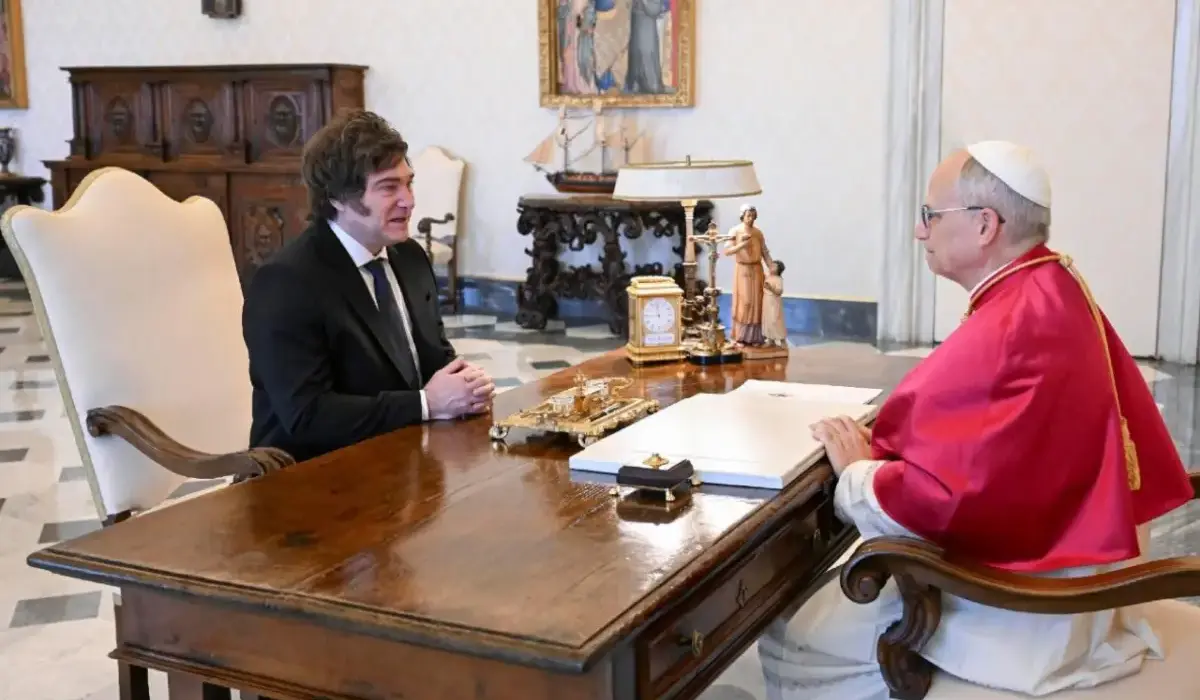
President Javier Milei is scheduled to be the first Argentine political leader to meet Pope Leo XIV shortly after the pontiff’s arrival on the afternoon of Sunday, November 8. However, the libertarian leader will certainly not be the only prominent figure attempting to capture the Holy Father’s attention and secure his ear during a densely packed, four-day pastoral and diplomatic visit to the South American nation.
The private audience at the Casa Rosada, which is being coordinated as a standard part of the diplomatic protocol governing papal visits, will provide President Milei with an essential opportunity to present his administration, philosophy, and overarching economic program directly to the head of the Catholic Church.
This high-stakes encounter takes place against a turbulent backdrop. Milei’s aggressive fiscal austerity drive—characterized by dramatic spending cuts that successfully drove down headline inflation—has increasingly faced fierce resistance from broad segments of society, particularly those who have been hit hardest by his sweeping, metaphorical "chainsaw" measures.
As a result, numerous critics and opponents of the current government are actively seeking to share their own perspectives and grievances with the pope. This visit marks a historic milestone for Argentina, as it represents the first time a leader of the Vatican has traveled to the country in nearly four decades.
Pope Leo XIV, who serves as the successor to the late Argentine pontiff Francis, shares many foundational views with his predecessor. He has consistently placed heavy emphasis on principles of social justice, the inherent dignity of labor, and the worsening plight of the poor and vulnerable. Consequently, throughout his tightly scheduled itinerary, which is set to conclude on Wednesday, the pontiff has purposefully planned a series of multifaceted meetings. These gatherings are specifically designed to allow him to listen directly to various civil and political sectors that remain deeply critical of the current libertarian economic model.
Political Opposition and Vice President Villarruel
Among the many individuals scheduled to interact with the pontiff are some of President Milei’s most formidable political rivals, including prominent figures who are already positioning themselves to challenge or replace him in next year’s general elections.
In what has been described by political observers as a rare gesture of institutional cordiality, the federal government formally extended invitations to opposition figures for the official reception. The welcome event is scheduled for Sunday at 6:30 p.m. at the Palacio Libertad, where authorities will officially welcome Pope Leo XIV to the nation.
The gathering is anticipated to draw a diverse array of political leaders spanning the entire ideological spectrum, alongside key government authorities, representatives of civil society, and members of the accredited diplomatic corps.
While former Argentine presidents have notably been omitted from the official guest list, the Mayor of Buenos Aires City and all 23 provincial governors have received invitations. A significant portion of these provincial leaders are left-wing Peronists affiliated with the nation’s primary opposition movement.
This large-scale gathering will afford opposition governors a valuable, albeit constrained, opportunity to bring their localized concerns directly to the attention of Leo XIV, even though strict diplomatic and logistical protocols do not guarantee one-on-one conversations during the reception.
The guest list also notably features Vice President Victoria Villarruel. Her increasingly bitter and highly publicized falling-out with President Milei has left her largely isolated and excluded from official government activities and inner-circle decision-making since late 2024.
Her presence at the Palacio Libertad will carry substantial political weight, given that she retains her constitutional role as president of the Senate and remains a senior institutional figure despite her deep political estrangement from the executive branch.
The inclusion of the vice president followed a unanimous formal declaration by the Senate urging the executive branch to guarantee proper institutional representation for the upper chamber at the official papal reception.

A spokesperson for Villarruel—widely recognized as the government’s most high-profile Catholic official—informed the press that the Senate resolution also sought to secure a private audience between parliamentary representatives and the pope. However, that specific request has yet to receive a formal response from Vatican or government organizers.
Governor Kicillof and Regional Itineraries
Although Buenos Aires Province Governor Axel Kicillof will similarly not secure a private audience with the pope during the official Sunday reception, the influential Peronist leader is widely viewed as a primary potential rival to Milei in the upcoming 2027 presidential race. Despite the lack of a private sit-down at the outset, Kicillof has secured at least two additional, high-profile opportunities to interact directly with the pontiff during the papal tour.
On Monday morning, Kicillof will personally welcome Pope Leo XIV as the pontiff arrives in Buenos Aires province—a region that accounts for nearly 40% of the nation’s total population. The pope’s journey into the province includes a deeply symbolic stop at the Pequeño Cottolengo Don Orione, a residential, educational, and healthcare institution located in Claypole that provides comprehensive, long-term care for individuals with severe disabilities.
This visit will place Leo XIV in direct contact with the institution’s vulnerable residents and dedicated staff. Their lived experiences are expected to offer an unvarnished, first-hand account of the daily operational challenges facing people with disabilities and their professional caregivers—groups that have been among the most vocal critics and those most directly impacted by the government’s sweeping federal spending cuts.
The visit carries distinct political resonance. Kicillof’s provincial administration has consistently sought to draw a sharp contrast between its own expansive social assistance policies and the stringent fiscal tightening pursued by Milei, utilizing the Cottolengo visit as a platform to underscore the vital importance of state-backed social protection.
The powerful provincial governor will secure a final, highly visible opportunity to meet with Leo XIV during the large-scale public Mass that the pontiff will celebrate on Wednesday morning—his final day in the country—at 10:00 a.m. The service will be held at the historic Luján Basilica in northeastern Buenos Aires province, a landmark that houses the Virgin of Luján, the revered patron saint of Argentina.
In a departure from the executive branch’s handling of the welcoming ceremony, Kicillof opted to extend invitations to former Buenos Aires governors to attend the closing Mass. Among those invited is his immediate predecessor and prominent political rival, María Eugenia Vidal, who represents the center-right PRO party.
Also slated to attend is Sergio Massa, the former federal economy minister who was defeated by Milei in the 2023 presidential runoff and is widely considered a leading contender for the Peronist presidential nomination in 2027.
Labor Unions, Industrialists, and Business Leaders
Beyond the traditional political establishment, Pope Leo XIV will dedicate substantial time to hearing firsthand assessments of Argentina’s complex economic reality from the social sectors most directly affected by ongoing structural shifts.
On Monday afternoon, the pontiff is scheduled to meet extensively with representatives of the domestic labor sector at the Catholic University of Argentina, known by its Spanish acronym UCA.
This collective gathering, formally slated for 4:10 p.m., is expected to draw approximately 1,000 attendees representing a cross-section of business organizations, organized labor unions, grassroots social movements, academic institutions, and other civil society groups.
Unlike the private, closed-door meeting scheduled with President Milei, this event will be structured as a broad collective assembly. During the session, the pope is expected to listen attentively to three distinct testimonies from organizational representatives before delivering a comprehensive address to the assembled crowd.
Ahead of the encounter, prominent union leaders and business representatives have been actively collaborating on a detailed joint document. This dossier explicitly outlines their mounting concerns regarding the country’s precarious economic and social situation, placing particular emphasis on the structural deterioration of formal employment and the severe operational difficulties currently facing workers, families, and small and medium-sized enterprises.

Key contributors to this collaborative report include the General Confederation of Labor—Argentina’s paramount labor federation, known as the CGT—and the Argentine Confederation of Medium-Sized Enterprises, or CAME.
The explicit intention of these diverse economic actors is to convey a stark, critical assessment of the prevailing economic trajectory and the acute social consequences triggered by the government’s rapid adjustment policies.
The nation’s powerful agricultural sector will also maintain a significant presence at the UCA gathering. The four primary organizations comprising the influential agricultural Liaison Committee—namely the Argentine Rural Society, Argentine Rural Confederations, the Argentine Agrarian Federation, and Coninagro—have all formally confirmed their participation.
Meanwhile, the broader industrial and commercial business community will be represented by the Group of Six, commonly referred to as the G6. This coalition brings together the country’s most prominent business associations, including the Argentine Industrial Union, the Argentine Chamber of Commerce and Services, and the Argentine Construction Chamber.
For these major corporate entities, the papal encounter represents an invaluable platform to discuss not merely the immediate domestic fallout of the government’s fiscal adjustments, but also the broader, systemic challenges associated with rebuilding national employment levels, boosting domestic production, and restoring long-term economic growth.
The Church’s Message and Pastoral Focus
Amid the flurry of high-profile political and economic engagements, Pope Leo XIV will also dedicate a significant portion of his schedule to meeting directly with Argentina’s ecclesiastical leadership and broader religious communities.
On Monday evening, immediately following the large-scale UCA event, the pontiff is scheduled to meet with prominent leaders of various Christian communities and other religious traditions at the Palacio San Martín. Following that engagement, he will participate in solemn evening prayers alongside the nation’s active bishops and synodal teams at the historic Metropolitan Cathedral.
On Tuesday, during a pastoral day trip to central Córdoba province, Leo XIV will hold dedicated meetings with regional bishops, parish priests, deacons, consecrated religious figures, seminary students, and pastoral workers at the city’s central cathedral.
These sustained ecclesiastical encounters will provide the local clergy—led by the President of the Argentine Episcopal Conference, Marcelo Colombo—with a direct opportunity to present their own comprehensive evaluation of the nation’s underlying social fabric and the specific pastoral challenges confronting the Catholic Church in Argentina.
The Argentine Episcopal Conference has played an instrumental role in coordinating the logistics and spiritual framework of the papal visit. Church leadership has repeatedly emphasized the strictly pastoral nature of the journey, working diligently to ensure that the pope’s physical presence in the country is not co-opted or converted into a partisan political platform.
Nevertheless, with Argentina’s profound political, economic, and social divisions almost certain to manifest in the diverse array of individuals and groups he encounters, Pope Leo XIV will have no shortage of competing perspectives, warnings, and appeals to weigh carefully before concluding his visit and departing the country on November 11.