








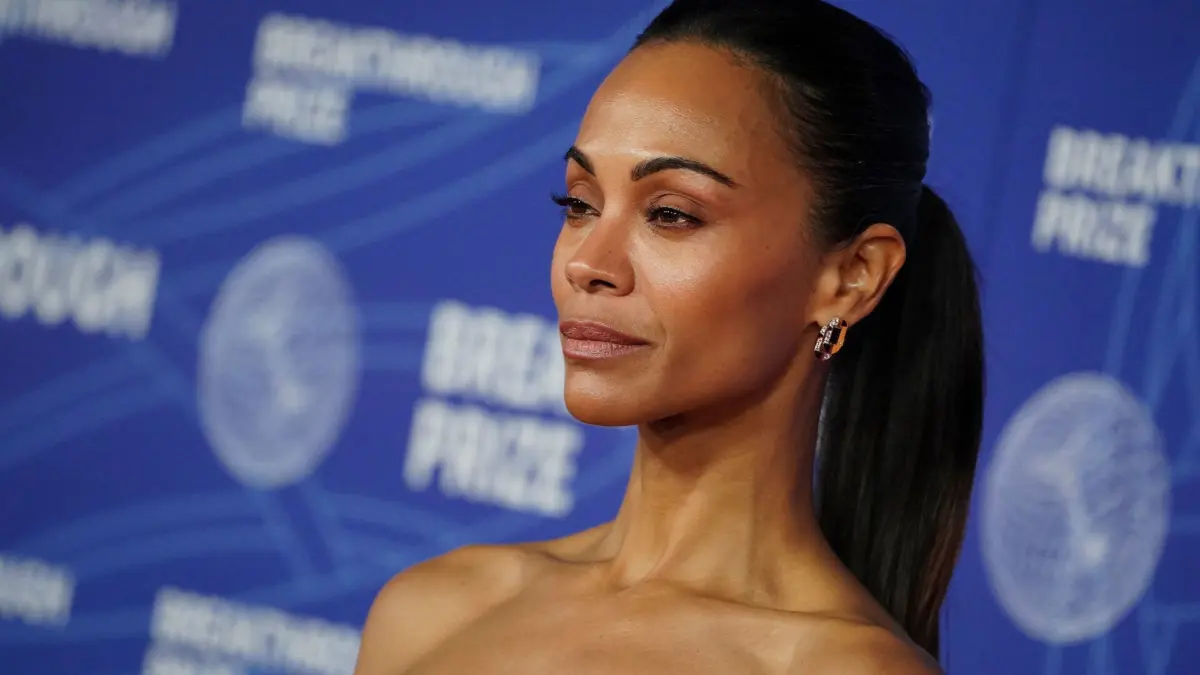
During a recent, candid conversation at the Locarno Film Festival, Oscar-winning actress Zoe Saldana addressed a frustration that is all too familiar to many professionals from underrepresented backgrounds: the exhausting experience of being the sole woman or person of color in the room, only to be peppered with political questions about Hollywood representation rather than being asked about her craft, her artistry, or her latest film.
Saldana pointed out that the relentless pressure to address systemic diversity and representation issues in film and television is far too often placed squarely on the shoulders of marginalized individuals, rather than on the industry’s actual gatekeepers. “I’m sorry, you don’t ask the only person that comes from the marginalized community. You ask the other 80 of them that are part of the gatekeepers, and you ask them if they know the answer because I think we’re making people of color work double to be in the room,” she told Variety.
If you happen to be a Black or brown woman, you probably know exactly what Saldana is referring to, because that insidious double work rarely stops once you finally manage to get through the door. In fact, it tends to follow professionals everywhere they go. Many marginalized individuals do not simply show up to do the technical, creative, or administrative jobs they were hired to perform; they also feel an implicit, pervasive pressure to explain their culture, represent their entire communities, translate their personal experiences, and educate others about complex systemic issues affecting their lives—issues that they were never responsible for creating in the first place.
As a Latina journalist who has dedicated her career to telling authentic stories for her community, I have found myself in this exact situation far too many times to count. I have even had to sit down with leadership and explicitly explain that I do not believe every single interview I conduct with a Latine celebrity needs to revolve around representation. Sometimes, an artist simply wants to talk about their craft, their latest character, or the technical challenges of a demanding production, without being forced to act as a sociological spokesperson for an entire demographic.
There is, in fact, a widely recognized name for this phenomenon: cultural taxation. Sociologists and workplace experts define cultural taxation as the extra, and frequently unpaid, labor expected from employees and professionals with marginalized or underrepresented identities, tasking them with handling diversity initiatives and cultural education entirely outside of their normal job descriptions and everyday responsibilities.
I experienced a stark version of this early in my career during a brief stint in a public relations job shortly after graduating college, at a time when I was still struggling to secure stable work outside of unpaid magazine internships. I ultimately left that position within a matter of weeks after realizing I had essentially been hired to serve as the company’s designated Latina representative. The agency—consisting entirely of white women, with me as their sole non-white hire—made it abundantly clear during my very first week that I was brought on largely because certain corporate brands they represented were desperate to reach Latina editors and targeted publications.
I will never forget the surreal day when my direct report walked over to my desk and asked, “How do you think Latina skin reacts to a brown sugar scrub?” I honestly could not believe the words I was hearing. I remember pausing and responding, “You know that Latinas consist of individuals who vary widely across racial backgrounds and have completely different skin tones, skin types, and skin textures, just like any other group of people, right?” She looked at me with open annoyance, as though she wanted to dismiss my very existence, immediately brushed off my thoughtful response, handed me a product sample, and said, “Try this over the next couple of days and let me know what you think.” I don’t think I have ever quit a job quite so quickly in my professional life.
The core of the issue is that identity does not grant any single individual the authority to speak for an entire population of people who happen to share it. Even as a Latina who has overseen prominent Latina media sites and digital verticals, I have had to repeatedly explain this fundamental truth to editors and supervisors. As a Dominican American raised in Queens—considering all the intricate nuances, personal history, and unique experiences that have shaped who I am today—I certainly cannot represent the entirety of Latinidad. Nor can I reasonably act as a blanket spokesperson for all Dominicans, because our individual experiences, backgrounds, and viewpoints vary wildly.
When institutions and colleagues expect this kind of monolithic representation from people, that is precisely where the dehumanization begins. You suddenly stop being perceived as a multi-dimensional person with your own distinct thoughts, flaws, and talents, and instead transform into a living, breathing symbol for your culture.
In my own experiences with this phenomenon, it suddenly felt as though I was no longer Johanna—the individual professional who happens to be Latina—but rather “the Latina in the room who is expected to have an answer” for every cultural nuance, news cycle, or workplace diversity hiccup.
Zoe Saldana made a vital and incisive point when she argued that this heavy intellectual and emotional labor should fall squarely on the shoulders of institutional gatekeepers rather than on marginalized communities. When the burden is routinely placed on a person from a marginalized group to represent their community and single-handedly solve or address the structural issues it faces, those in positions of actual power are let entirely off the hook. They are stripped of their institutional responsibility, even though they are almost always the only ones with the systemic leverage and capital required to create genuine change. Why is the person with the least amount of corporate or institutional power suddenly made responsible for fixing an industry’s deeply entrenched problems?
Saldana was speaking her fundamental truth: do not ask me to solve Hollywood’s pervasive representation problem—ask the executives, studio heads, and power brokers who actually possess the authority to change Hollywood. To be entirely clear, it is evident she was not saying, “Don’t talk to me about my identity or my cultural heritage.” Saldana has consistently and proudly expressed her deep love for her culture and her identity as a Latina throughout her celebrated career. What she was conveying is that the real trouble begins when our identities become the exclusive lens through which we are permitted to be seen by the public and our peers.
Saldana is an Oscar-winning actress with decades of box-office success and critical acclaim; she is profoundly more than her demographic identity. When she is out promoting a major film, there is an enormous array of creative, technical, and storytelling topics she is qualified to discuss beyond the systemic diversity shortcomings that happen to exist within the broader entertainment industry. Her Latinidad is an integral, beautiful part of who she is as a person, but it does not encompass everything that she is.
We talk incessantly in modern professional spaces about wanting more people from marginalized communities in the room. In my own professional circles, I am constantly advocating for how urgently we need more Latinas in the big, influential rooms where major decisions are made. Yet, we rarely have honest conversations about what actually happens to those individuals once they finally get through the door, a reality that Saldana has bravely brought to light.
If professionals are immediately expected to carry the weight of representing everyone who looks like them, we have to ask a hard question: Are we being invited into those high-level rooms for our professional skills, our talents, and our expertise? Or are we merely being asked to occupy a seat as token representatives of our broader communities? As history and personal experience show, those two things are categorically not the same.
Over the years, I have learned that there is a profound, non-negotiable difference between true professional representation and basic human personhood. I have been in far too many rooms where being the only Latina meant that everyone around me viewed me strictly as a walking symbol of diversity, while entirely forgetting that I am a living, breathing human being who happens to be Latina.
I am deeply glad that Zoe Saldana used her prominent platform to call out this exhausting dynamic, because it is long past time for industries to stop demanding this invisible tax from marginalized workers. We deserve to take up space in professional rooms—regardless of our specific profession, industry, or level of expertise—without being burdened by the unspoken requirement to represent an entire demographic. As Latinas, and as working professionals everywhere, I would love to see a world where we are invited into rooms as whole, complex people rather than expected to drag an entire community in with us on our backs. I would love that for all of us.