









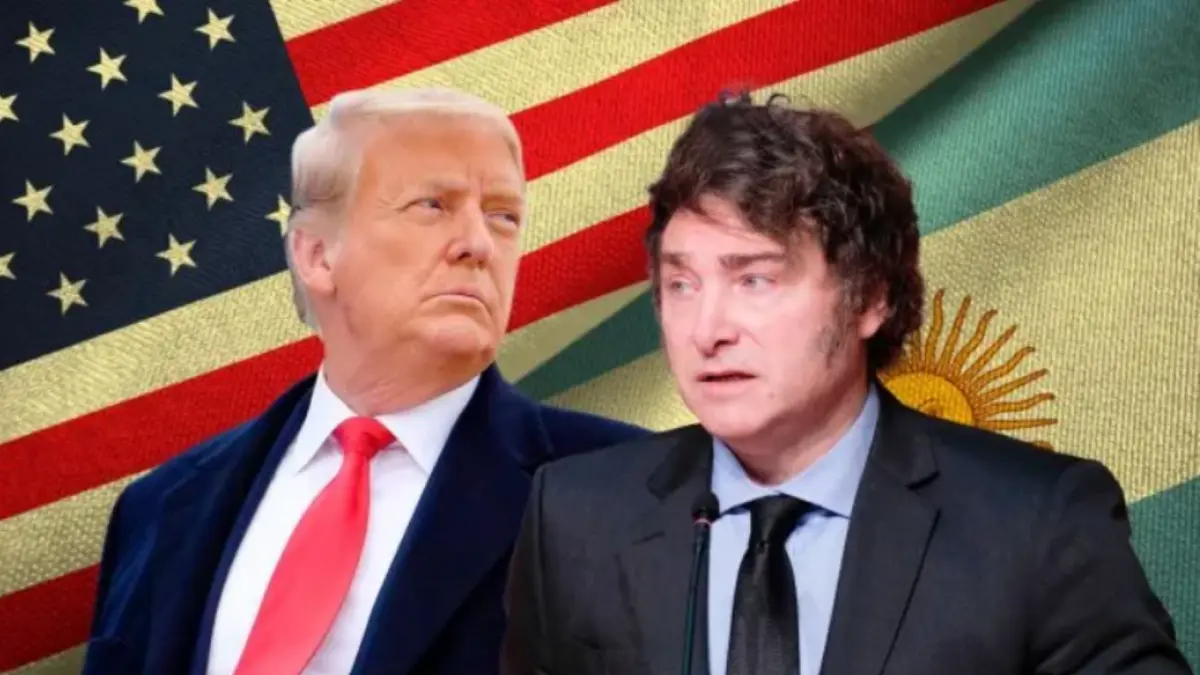
The political landscape in Washington is already casting long shadows over the southern hemisphere, forcing financial markets and economic analysts in Buenos Aires to confront a pressing and uncomfortable question. Following U.S. President Donald Trump’s decisive defeat in the 2026 midterm elections, economists and investors are urgently looking ahead to Argentina’s crucial 2027 presidential contest. The central dilemma occupying financial minds is whether the U.S. Treasury would step in to rescue President Javier Milei—one of Trump’s closest ideological and political allies in the region—should his administration encounter severe economic turbulence, much like it did in October 2025.
This rising uncertainty arrives at an exceptionally delicate moment for Argentina’s fragile stabilization program. The country risk index has recently surged past the 850-point threshold, touching its highest level since the legislative elections held late last year. This troubling peak represents more than double the low of 402 points that the index had successfully achieved on July 10. Within this challenging economic climate, issuing new sovereign debt on the international capital markets at a reasonable interest rate appears entirely out of the question, according to prominent economists and banking sources consulted by this publication. Consequently, intense analytical scrutiny is now directed at why the government chose not to issue debt much earlier when market conditions were considerably more favorable. Furthermore, professional projections regarding the broader global outlook for emerging markets heading into 2027 remain deeply divided.
Market is still closed for Argentina
The ongoing debate regarding Washington’s potential intervention is gaining critical traction largely because the alternative route—returning independently to international credit markets—is presently closed.
"I think there was a misreading of the situation at the beginning of the year, when it was decided to wait for conditions to improve," observed market analyst Cristian Buteler, pointing to the early miscalculations of the economic team.
According to Buteler’s assessment, the decision to delay borrowing stemmed from an economy that had noticeably stopped growing, compounded by an international context where Trump’s aggressive tariff policies were widely expected to exert upward pressure on consumer prices and compel the U.S. Federal Reserve to maintain elevated interest rates. For Buteler, the probability of successfully issuing debt at a reasonable rate is now rapidly dwindling, unless the Argentine government proves willing to pay a much higher financial penalty than it would have faced back in January of this year.
Gustavo Neffa, head of Research for Traders, offers a slightly different perspective on the trajectory of the crisis. While Argentina’s country risk index briefly dipped below 450 points, Neffa characterizes that favorable figure as a short-lived anomaly. That brief window was swiftly followed by an international interest rate storm, a series of unforced policy errors by the domestic administration, and an undeniably recessionary third quarter.
For Neffa, issuing a single bond in absolute isolation does little to alter the broader macroeconomic picture, particularly because the nation faces the structural necessity of rolling over its heavy January and July debt maturities every six months. "Argentina needs a sustained rollover, just as all other countries in the region do," he stated plainly.
Back in mid-October, when the country risk hovered around 700 basis points, several voices inside Washington argued that the government should have forced a bond issuance regardless of the elevated cost. Opening up every possible market channel amid an increasingly volatile global context seemed like an unlikely option, but it was not entirely ruled out by pragmatic observers at the time. That argument was grounded in the stark reality that the United States—burdened by a national debt exceeding 128 percent of its Gross Domestic Product and a fiscal deficit surpassing six points—will continue to absorb the lion’s share of global financing. Conversely, Argentina, currently lacking sustainable access to credit and nursing low international reserves, remains in no position to dictate its own borrowing costs.
Barely two weeks later, with the country risk index climbing further to 852 points, that borrowing window appears even more remote. Nonetheless, the Argentine government insists it remains deeply confident in its overarching financial blueprint for 2027, which relies heavily on anticipated inflows of foreign capital. Because of this strategic optimism, the administration strongly prefers to avoid endorsing excessively high interest rates, particularly since it retains a $6 billion repo facility and the theoretical backing of the U.S. Treasury—even though that vital backstop is now clouded by political doubt.
The Exchange Stabilization Fund (ESF), which serves as the specific financial instrument utilized by the U.S. Treasury during the 2025 rescue operation, possesses one crucial structural advantage: it does not require formal legislative approval from the U.S. Congress. Based on this mechanism, the consulting firm 1816 argued in a recent note that "Trump retains his ability to help Argentina" unless the U.S. Congress successfully amends the complex regulations governing that specific fund and the president finds himself unable to veto the legislative change.
The fundamental complication, however, is the immense political cost attached to such a maneuver. Congressional Democrats had already introduced companion bills in both chambers aimed at suspending the currency swap arrangement with Argentina. Armed with their newly acquired majority following the midterms, opposition lawmakers could easily push for aggressive congressional investigations into the 2025 Treasury operation through the specific oversight committees that monitor the federal purse.
This swirling political uncertainty is further compounded by mounting doubts concerning the professional future of Scott Bessent, the influential U.S. Treasury Secretary who served as the principal architect of the 2025 bailout. Scarcely a month ago, Bessent responded with an unequivocal "of course" when asked by reporters if he would assist Argentina a second time if needed. Yet, in the wake of the administration’s bruising electoral defeat, several political analysts do not rule out the strong possibility that President Trump will undertake a sweeping reshuffle of his cabinet.
Prominent economist Alberto Ades recently brought this exact vulnerability to the forefront via a two-pronged inquiry. The primary questions focus on whether Bessent will retain his cabinet post and, should he remain, how much political leeway he would realistically possess to repeat measures as extraordinarily risky as those deployed last year.
The financial requirements facing Buenos Aires throughout 2027 are exceptionally demanding. A comprehensive report published by the Center for Argentine Political Economy (CEPA) estimates that if the government ultimately fails to place fresh debt on international markets, the Treasury could be forced to purchase approximately $12.5 billion directly from the Central Bank next year. This heavy domestic burden comes on top of scheduled net payments to international financial institutions totaling another $4 billion, a figure that includes $2.7 billion owed specifically to the International Monetary Fund.
Caution or missed opportunity?
Domestic financial entities inside Argentina are adopting a noticeably more cautious outlook regarding the missed financing opportunities of the past year.
"It would certainly have been preferable for them to issue debt on global markets at 400, 500, or at most 600 basis points. Anything over 600 seems too expensive to me," a senior bank analyst told the Herald’s sister publication, Ámbito.
The same banking source categorically dismissed the viability of issuing debt under current panic conditions merely because market fundamentals could deteriorate further tomorrow. Looking forward, the source established a firm threshold, indicating they would only advise taking advantage of a market window if dollar-denominated borrowing rates settled in the neighborhood of nine-and-a-half percent—an outcome they view as highly unlikely to materialize before the upcoming elections.
Other market observers are even more definitive in their pessimism. "The government has no chance of issuing bonds with this level of country risk," remarked another banking insider. In their estimation, the government’s economic team will likely be forced to seek sporadic, one-off financial transactions akin to those arranged in recent years, while steadfastly avoiding the issuance of any standard sovereign bond carrying punishing double-digit interest rates.
On the external front, macroeconomic projections remain deeply divided among international financial institutions. One major multinational bank estimates that the U.S. Federal Reserve will implement at least two additional interest rate hikes—one occurring before the close of the current year and another materializing during the first quarter of 2027. This institution cautioned that the Fed maintains very limited room to maneuver given the overwhelming weight of overall U.S. national debt.
Conversely, analyst Cristian Buteler maintains a more optimistic view regarding global monetary policy, suggesting that a potential de-escalation or formal end to the conflict in the Gulf region could drive down international oil prices and effectively ease global interest rates. Although a Republican legislative defeat could theoretically foster a more hospitable global environment for emerging markets overall—characterized by stricter caps on the U.S. fiscal deficit, a weaker dollar, lower long-term borrowing rates, and a swift resolution to Middle Eastern hostilities—such external tailwinds would not necessarily translate into an immediate direct benefit for Argentina, given its unique and troubled domestic context.
"As the country’s elections draw nearer, uncertainty will continue to grow," Buteler warned, noting that this domestic political anxiety could easily translate into sliding bond prices and an even higher country risk rating.
Neffa similarly concurs that the current elevated risk premium is primarily driven by shifting political circumstances rather than pure economic insolvency. "If you present me with a scenario where there’s a high probability that these economic policies will continue, you won’t have a country risk of around 700 points—you’ll have a country risk of 500," he stated.
Meanwhile, Ignacio Abuchdid, president of the IEB financial group, took to social media to voice his strong disbelief, writing on X that a country risk rating exceeding 800 points "is utter nonsense."
"It’s completely completely disconnected from Argentina’s macroeconomic fundamentals […] In my view, the explanation is fundamentally political. The market is extraordinarily overestimating the electoral risk. Argentine assets seem to be trading as if a victory from [Buenos Aires Province Governor Axel] Kicillof were already a foregone conclusion—a scenario I consider completely unjustified," Abuchdid argued.
With traditional debt markets effectively closed and Washington’s financial backing subjected to intense scrutiny by a newly empowered opposition Congress, strategic focus has inevitably returned to the domestic accumulation of foreign reserves. "The best thing the government can do is accelerate reserve purchasing," advised one of the prominent banking sources.
Echoing this sentiment, another economist consulted anonymously questioned the administration’s recent inability to maintain a steady, disciplined pace of dollar purchases, warning pointedly that a sudden currency devaluation "won’t save you" if necessary structural reforms, such as aggressive tax cuts, sweeping deregulation, and critical infrastructure investments, continue to be delayed.
In the days immediately preceding the U.S. midterm elections, Alejandro Díaz, CEO of the American Chamber of Commerce in Argentina (AmCham), expressed steady confidence that Washington would maintain its supportive posture toward Buenos Aires regardless of domestic political shifts.
"The U.S. government will do what is necessary. It already did so in 2025," Díaz told a gathering of journalists. In his estimation, the foundational relationship between the two nations is unlikely to experience significant disruption, provided there is political continuity in Argentina following the 2027 elections, whether led directly "by Milei or with an Argentine president of a similar profile."
Díaz also highlighted a notable diversification in Washington’s foreign financing toolkit. As he detailed, the U.S. International Development Finance Corporation (DFC) is currently evaluating the allocation of up to $20 billion toward strategic projects in Argentina, with roughly 25 such initiatives actively under review.
He clarified that this substantial sum remains entirely separate from the $7 billion previously committed by the Export-Import Bank of the United States (Eximbank), which earmarks $6 billion for a major liquefied natural gas (LNG) project and $1 billion for infrastructure development along the designated transport corridor connecting western mineral deposits to the Atlantic coast.
Although these commitments do not represent direct cash disbursements to the Argentine national government—functioning instead as financial guarantees, commercial insurance, structured loans, and targeted capital contributions that cover only a portion of total project costs—Díaz viewed this engagement as a dramatic shift from previous years when Eximbank’s official lending capacity for Argentina stood squarely at zero.
Nevertheless, the primary vulnerability for these ambitious projects lies within the chambers of the U.S. Congress. Eximbank’s current legislative authorization is scheduled to expire on December 31, and its critical ten-year statutory renewal has not yet been formally approved.
The AmCham CEO estimated that the recent midterm election results should not necessarily serve as a decisive roadblock, pointing out that the agency has historically operated effectively under administrations from both major political parties. However, he cautioned that contemporary congressional Democrats are "not the same as those of the Clinton and Obama eras" and warned that a White House forced to navigate a hostile legislative branch will inevitably juggle multiple competing policy fronts simultaneously.
Business is business
Within official circles in Washington, policymakers quietly hope that congressional Democrats will ultimately adopt a pragmatic stance that safeguards the deepening diplomatic and commercial ties with Argentina. Proponents point to several foundational agreements forged during the Trump administration, including the Reciprocal Trade and Investment Agreement (ARTI), cooperative initiatives designed to secure and process critical minerals, the development of the Andes-Atlantic Corridor, expanded Eximbank financing, an increased quota for Argentine beef imports, and prospective inclusion in the U.S. Visa Waiver Program.
U.S. political leadership has consistently maintained that Argentina currently operates under a revived free-market system, thereby establishing a uniquely favorable economic ecosystem for long-term foreign investment that the newly arrived "blue wave" in Congress should ideally allow to endure.
"Business is business" was the pragmatic refrain heard in U.S. policy circles just weeks ago, even as prominent Democratic leaders such as Representative Gregory Meeks and Senator Elizabeth Warren—alongside progressive figures like Abdul El-Sayed—publicly questioned the propriety of direct financial assistance directed toward Argentina. These criticisms were further inflamed by President Milei’s vocal public expressions of political support for Republican Congresswoman María Elvira Salazar during her tightly contested Florida reelection campaign.
At the same time, foreign policy analysts note that a significant portion of the newly elected U.S. lawmakers remain entirely unfamiliar with Argentina’s complex economic trajectory or its geopolitical positioning.
The legislative and administrative steps taken by the incoming U.S. Congress in the coming months will ultimately determine whether the bilateral partnership deepens into an enduring strategic alliance, or whether its recent momentum was merely a temporary byproduct of personal political affinity between two populist leaders.