










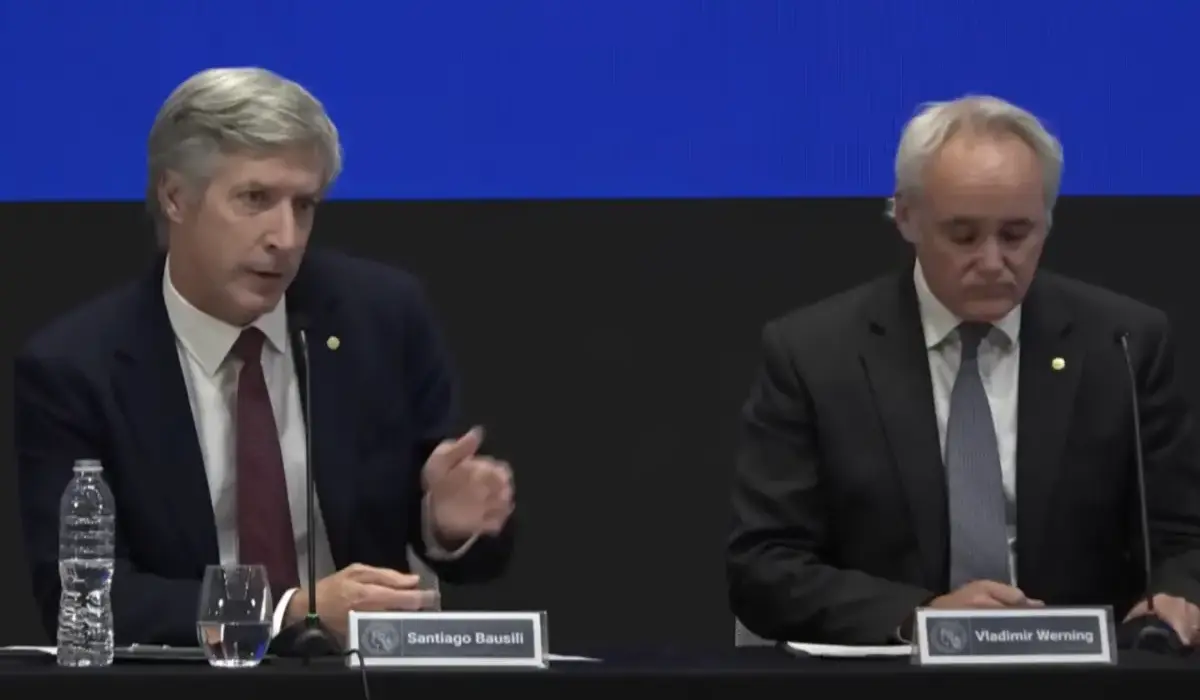
Top officials at the Central Bank of the Argentine Republic (BCRA) delivered a comprehensive defense of the nation’s monetary policy trajectory, addressing critical questions regarding foreign exchange stability, economic activity, inflation pressures, and the ongoing controversy surrounding the country’s overseas gold reserves.
The remarks were delivered during an unannounced press conference called to coincide with the presentation of the Monetary Policy Report (IPOM) for the third quarter. The surprise briefing caught both financial insiders and outside observers off guard, particularly given that the quarterly publication typically follows a more predictable schedule, with the previous edition having been released on August 6.
Presiding over the conference were BCRA President Santiago Bausili and Vice President Vladimir Werning. The two financial chiefs used the platform to outline the central bank’s macroeconomic outlook as Argentina navigates the closing months of the year and prepares for the economic and political landscape of the upcoming year, which will feature high-stakes presidential elections as President Javier Milei seeks a second term in office.
No Currency Run Expected, but Policy Arsenal Remains Flexible
Among the most pressing inquiries fielded by journalists during the briefing was the potential for renewed foreign exchange volatility. Specifically, reporters questioned whether the country might face a repeat of the portfolio dollarization episodes seen during previous electoral cycles, a phenomenon that drove intense demand for foreign currency and placed heavy pressure on domestic reserves. According to internal BCRA data, past election-related volatility triggered unprecedented demand reaching up to $35 billion.
Addressing the prospect of similar market turbulence as the nation approaches the 2027 presidential elections, Bausili offered a measured response while emphasizing institutional preparedness.
"We have no projections of a currency run. We don’t make those kinds of projections," Bausili replied when pressed on the likelihood of future foreign exchange instability.
When questioned about which specific policy instruments the Central Bank would deploy first should unexpected market shocks materialize, Bausili declined to identify a single mechanism or predict the exact scale of potential turmoil. Instead, he stressed that monetary authorities would rely on tactical flexibility depending on the circumstances.
"It depends on the nature of the shock," he explained, adding that the central bank’s primary objective is to "maximize the number of available tools" so that monetary authorities can tailor their policy response to each distinct market event.
To reinforce confidence in the nation’s external liquidity buffers, officials confirmed that several international financial backstops remain active. The $5 billion portion of the bilateral currency swap agreement with China remains fully in effect. Additionally, a $20 billion financial arrangement with the United States is officially in force, though officials clarified that it operates under a separate structural arrangement and has not been activated.
Economic Activity Expected to Improve in the Final Quarter After Technical Recession
Turning to the state of the domestic economy, Central Bank officials addressed the recent contraction in economic activity during the third quarter, which briefly pushed Argentina into a technical recession. However, leadership downplayed the long-term implications of the downturn, attributing the negative gross domestic product (GDP) figures primarily to external headwinds that temporarily disrupted growth trajectories.
Despite the third-quarter slowdown, the newly released IPOM projects a marked economic rebound during the final quarter of the year.
"Once agricultural activity returns to normal and the temporary factors that affected the economy in July dissipate, GDP is expected to post a significant increase in the fourth quarter," the official report stated.
The central bank’s optimistic outlook for year-end growth is tempered by potential calendar disruptions in November. Officials warned that economic expansion could face minor constraints due to a reduced number of working days resulting from public holidays surrounding the historic visit of Pope Leo XIV.
Nevertheless, the report maintained an overarching positive trajectory for the broader macroeconomic framework.
"Despite short-term volatility in monthly economic activity indicators, which could be affected by the exceptional reduction in the number of working days expected in November, GDP would grow for the second consecutive year in 2026," the document noted.
Controversy Continues Over Argentina’s Overseas Gold Reserves and Transparency
The press conference also revisited one of the most politically sensitive topics surrounding the current administration’s financial management: the handling and location of Argentina’s international gold reserves.
Bausili used the briefing to formally confirm that, under his administration, a portion of the nation’s sovereign gold reserves was physically transferred to London, recognized globally as the world’s most active trading hub for the precious metal. However, he moved to clarify misconceptions regarding where the assets are currently stored, explicitly denying that the physical bullion had been deposited with the Bank of England.
"The Central Bank has nothing in England, and there is no account at the Bank of England," Bausili confirmed to reporters.
Instead, he explained that the gold was routed through the British capital so that the Bank for International Settlements (BIS), headquartered in Basel, Switzerland, could formally receive and manage the assets as part of a strategy to optimize reserve management.
"What we have is an electronic certificate issued by the BIS confirming that holding," he stated.
When pressed for specific figures regarding the volume of gold transferred abroad, Bausili declined to disclose exact amounts, citing prudential considerations and security protocols. He further noted that he did not track the precise physical location of the gold on a day-to-day basis, emphasizing that the primary purpose of the transfer was to "monetize it" and generate a higher financial return on assets that otherwise remained idle in domestic vaults.
The transparency of the gold transfer has been a persistent point of contention between the government and political opposition since the transaction was first brought to light. Earlier this year, Economy Minister Luis Caputo confirmed that Argentina had dispatched a portion of its gold reserves overseas. However, the initial lack of detailed documentation or clear explanations regarding the destination and legal framework of the assets drew sharp criticism from opposition lawmakers, who raised concerns over accountability and institutional oversight.
The debate intensified last month when Bausili testified before the Argentine Senate. During that legislative presentation, the BCRA chief similarly affirmed that "part of the international gold reserves is deposited at the BIS in Switzerland," a statement that has done little to quell ongoing parliamentary scrutiny and public debate over the management of the nation’s sovereign wealth.