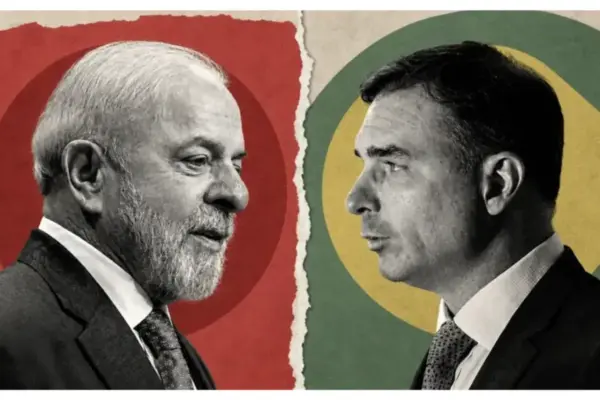






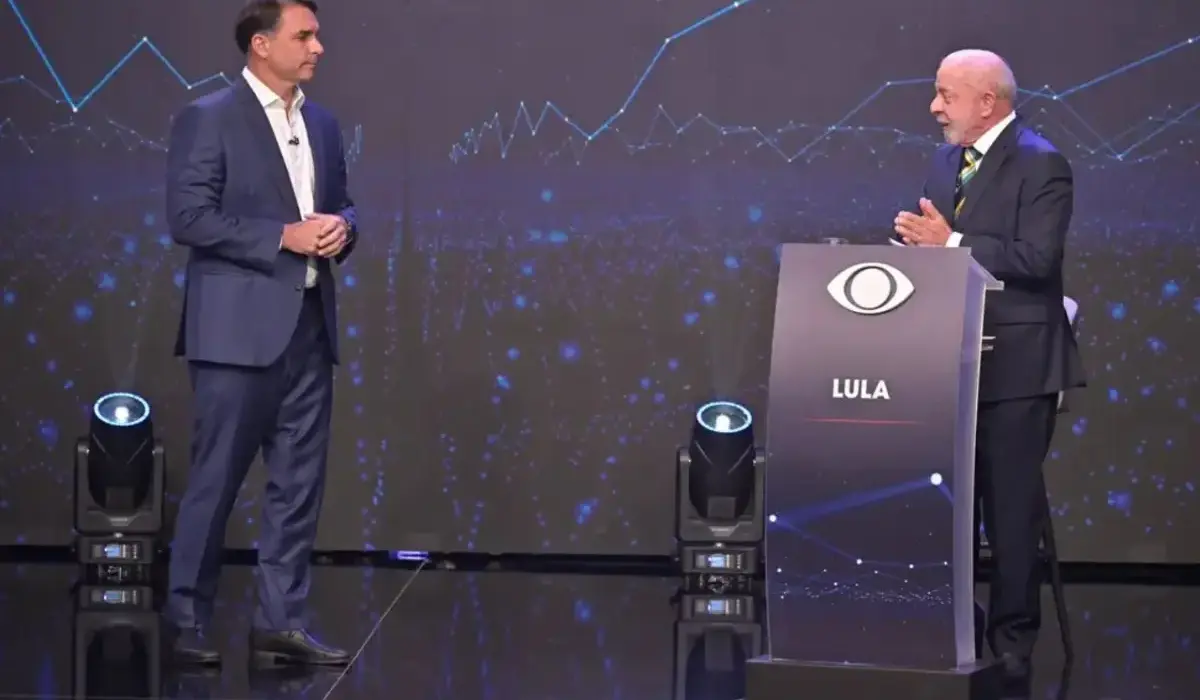
Brazilian President Luiz Inácio “Lula” da Silva and Senator Flávio Bolsonaro, the son of former President Jair Bolsonaro, faced off on Sunday night in their first-ever presidential debate, setting the stage for an increasingly fierce and deeply polarized runoff campaign.
The high-stakes encounter took place in São Paulo, organized by the prominent news channel TV Band, and immediately set a combative tone for the final week of campaigning. The two candidates are locked in a tight race to secure the presidency in the upcoming runoff scheduled for Sunday, October 25. The winner of the vote will officially take office in early 2027 to lead Latin America’s largest economy. Sunday’s televised event marked the first of two scheduled debates, with the final showdown slated for Friday.
The debate was defined by sharp exchanges, mutual accusations of corruption, intense disagreements over public safety and labor rights, and several notable references to neighboring Argentina under President Javier Milei. Both candidates used the platform to present competing visions for the country while attempting to court the critical bloc of voters who sat out the initial round or supported eliminated candidates.
The Road to the Runoff
The runoff was triggered after the closely contested first round of voting on October 4. In that initial ballot, far-right candidate Flávio Bolsonaro, representing the Liberal Party (PL), secured a leading 47% of the vote. Center-left incumbent Luiz Inácio da Silva, running for reelection under the banner of the Workers’ Party (PT), finished closely behind in second place with 45% of the total vote.
Ten other candidates also participated in the first round but collectively garnered a very small share of ballots in what proved to be a deeply polarized electoral landscape. Under Brazilian law, a presidential candidate must capture an absolute majority of at least 50% of the vote to secure an outright victory in the first round, necessitating the upcoming runoff.
In the days leading up to Sunday’s debate, political tensions spilled onto the streets as enthusiastic supporters of both camps gathered in large numbers across major urban centers, including São Paulo and Rio de Janeiro, waving flags and displaying campaign banners. With the race hanging in the balance, both campaigns recognized the urgency of appealing directly to moderate voters and addressing the core concerns traditionally championed by their political rivals.
Competing Policy Proposals on Labor and Debt
During the debate, policy discussions quickly turned to economic relief and labor reforms, areas deeply felt by everyday Brazilian families. Flávio Bolsonaro sought to appeal directly to the working-class electorate by explaining a notable shift in his political stance. The senator discussed a recently approved congressional labor law, strongly backed by Lula and the PT administration, which successfully reduced the standard workweek and guaranteed employees two consecutive days off instead of the traditional single day.
Although Bolsonaro had initially opposed the sweeping labor reform, he ultimately reversed course and voted in favor of the legislation the previous week. Defending his change of heart during the debate, the senator explained that his perspective evolved after listening closely to the grievances and demands of workers during his campaign travels across various regions of Brazil.
“I’m someone who knows how to listen; I’m someone who, if convinced, can change my mind if it’s also better for Brazilian citizens,” Bolsonaro stated on stage.
Expanding on his economic platform, the far-right candidate also introduced a proposal aimed at addressing household debt, which has reached historically unprecedented levels across Brazil, currently impacting approximately 81.7% of families. Bolsonaro proposed launching a targeted government program to facilitate the renegotiation of consumer debts with dramatic discounts of up to 90%. He outlined plans to establish what he termed a “Ministry of Prosperity” and suggested that the government could purchase individual and corporate debt from commercial banks at reduced rates to help bring down burdensome interest rates.
The issue of household debt has been a central theme in the national economic conversation. President Lula recently rolled out his own administration’s debt-relief initiative, known as Desenrola (“Unroll”), which is designed to offer substantial discounts and assist citizens in climbing out of financial distress.
For his part, Lula concentrated a significant portion of his policy presentations on public safety—traditionally a cornerstone of the Bolsonaro family’s political platform and a frequent point of criticism directed against the current administration. Lula announced plans to establish a dedicated Ministry of Public Safety if reelected. He argued that the new cabinet-level department would significantly improve operational coordination between the federal government, state authorities, and municipal forces in the ongoing battle against organized crime and powerful criminal militias.
Furthermore, Lula defended existing penal policies that permit well-behaving inmates to take temporary leave from prison facilities to visit their families during specific holidays. The defense served as a direct counter to harsh criticisms previously leveled by his opponent regarding the country’s prison system.
Heated Personal Attacks and Corruption Accusations
While policy proposals formed a baseline for the debate, the encounter frequently boiled over into intense personal attacks and fiery rhetoric between the veteran leftist leader and the conservative senator.
At one point during the security debate, Bolsonaro challenged Lula to explain a statistic indicating that 73% of incarcerated individuals had reportedly voted for him in the first round. The question prompted a swift and sharp retort from the president.
“I want it to be 100%, even your dad!” Lula fired back, making a direct reference to former President Jair Bolsonaro. The elder Bolsonaro is currently serving a 27-year prison sentence under house arrest following his conviction for plotting a coup d’état and conspiring to assassinate Lula after losing the 2002 presidential election.
The sparring continued as Bolsonaro raised the specter of past corruption scandals, bringing up Lula’s high-profile 2019 arrest stemming from the sweeping Lava Jato (“Car Wash”) corruption investigation. The senator remarked that Lula was “the only one” on the debate stage to have been criminally convicted of corruption. Lula spent nine months behind bars before his conviction was ultimately annulled by Brazil’s Federal Supreme Court in 2021, which ruled that the original trial court lacked proper jurisdiction.
Stung by the accusation, Lula turned the tables by challenging his opponent to make their respective personal and family bank account records entirely public. “Let’s see whose family steals,” the president retorted.
Lula also pressed Bolsonaro on his stated economic ambitions, specifically the senator’s expressed intention to emulate the radical economic austerity model implemented by Argentine President Javier Milei. In a pointed critique, Lula questioned the viability of such an approach for Brazil.
“Have you already asked Milei for his chainsaw?” Lula asked, alluding to the symbolic prop used by the Argentine leader during his campaign to signify deep cuts to public spending, while also drawing attention to Argentina’s ongoing struggles with high poverty and unemployment rates.