








The Argentine men’s national football team secured a commanding 4-0 victory over Bolivia on Wednesday night, marking a significant milestone as the first competitive outing since former captain Lionel Messi announced his retirement from international football.
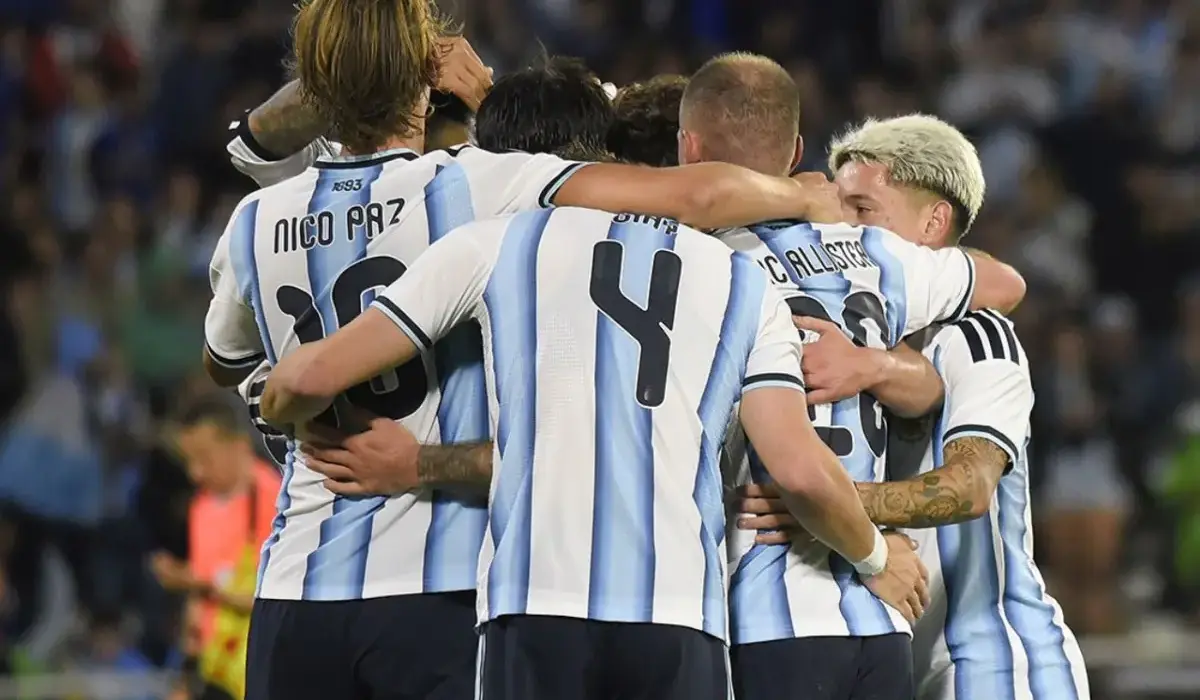
Goals from Lautaro Martínez, Nicolás Paz, Cristian “Cuti” Romero—who proudly wore the captain’s armband for the night—and José López sealed a comprehensive win. The fixture served as the opening road test of what the future holds for the Albiceleste as they navigate the daunting task of establishing a new identity in the post-Messi era.
Head coach Lionel Scaloni hosted the Bolivian national team at the Mario Alberto Kempes Stadium in Córdoba province. However, the venue cut a ghostly and surreal profile, operating at only 50% capacity. The restriction was enforced as Argentina served a disciplinary sanction imposed by world football governing body FIFA, a penalty stemming from discriminatory chants and insults directed by Argentine spectators during recent 2026 World Cup qualification fixtures.
Despite the subdued atmosphere inside the partially filled stadium, Argentina took absolute control of the match from the opening whistle, going up against a Bolivian side that looked to defend deep, absorb pressure, and deliberately waste time to disrupt the rhythm of the game.
The Albiceleste’s play flowed with the fluid passing and tactical cohesion that characterized the absolute height of Scaloni’s tenure. Just 19 minutes into the contest, the deadlock was broken. Lautaro Martínez latched onto a defense-splitting pass into space delivered by midfielder Alexis Mac Allister, calmly finishing past the goalkeeper to put the hosts ahead.
Ten minutes later, the lead was doubled through a moment of brilliance that immediately evoked memories of the departed legendary number ten. A gorgeous, weighted pass from Exequiel Palacios set up Nicolás Paz in a one-on-one situation. Showing remarkable composure, the young midfielder cheekily chipped the ball over the onrushing goalkeeper, sending the limited crowd into raptures and signaling that the creative pipeline of Argentine football remains fully operational.
Bolivia attempted to alter their tactical approach in the second half, seeking to press higher up the pitch and gain some measure of agency and possession. Yet, their efforts proved entirely to no avail against a well-drilled Argentine defense. In the 53rd minute, central defender Cristian “Cuti” Romero rose highest to head home from a brilliantly executed set-piece delivered by Paz. The goal marked Romero’s very first strike while wearing the captain’s armband for Argentina, extending the lead to 3-0 and effectively extinguishing any hopes of a Bolivian comeback.
As the match entered its final third, the tempo dipped slightly and the game temporarily lost some of its attacking luster as a deluge of substitutes entered the pitch, with players looking to find their footing and tactical instructions. Nevertheless, Argentina maintained control. In the dying moments of the game, substitute José López capitalized on a loose ball inside the penalty box, sharply poking it home to round out the scoring and seal a resounding 4-0 victory.
Evolution, not revolution
Scaloni appeared to begin the meticulous construction of the post-Messi era by building firmly upon the solid foundations laid by the Qatar 2022 World Cup champions. Several key members of that historic squad formed the undisputed spine of the team on Wednesday night. Lisandro Martínez and Romero marshaled the backline with authority, Mac Allister dictated the tempo in the middle of the pitch, and the familiar attacking duo of Lautaro Martínez and Julián Álvarez provided constant danger up front.
However, the looming prospect of the first major international tournament without Messi among the ranks has visibly set in motion the squad renovation that many pundits and supporters had been calling for in the wake of the 2024 Copa América.
The historic right-back duo of Gonzalo Montiel and Nahuel Molina, who shared the starting spot for the vast majority of Scaloni’s tenure, notably lost out to an ever-impressive Agustín Giay. Meanwhile, 22-year-old Román Vega made his senior international debut at left-back, securing the starting role ahead of seasoned options like Nicolás Tagliafico and Facundo Medina.
In midfield, the absence of Rodrigo De Paul was brilliantly covered by the industrious Exequiel Palacios. At the same time, Mac Allister and, to an even greater extent, Nicolás Paz stepped directly into the creative void left by Messi’s retirement. Having previously missed out on a World Cup squad spot, former River Plate wonderkid Franco Mastantuono also returned to the fold and delivered an impressive performance.
Aside from Vega, four other players made their official senior national team debuts during the fixture: midfielders Santiago Simón and Ezequiel “Equi” Fernández, defender Valentín Gómez, and 18-year-old Boca Juniors forward Leonel Flores. The integration of such young talent underscores Scaloni’s proactive vision for the future of the national program.
“We’ll keep playing the same way”
Head coach Lionel Scaloni expressed deep satisfaction with the collective work his players put in on the pitch, acknowledging that Wednesday night marked a definitively successful first step into a brave new world without their talismanic captain.
“The boys took on this match like you have to when wearing this shirt,” Scaloni stated in his post-match remarks. “Everyone wants to contribute their part.”
During the pre-match press conference, the Argentina manager steadfastly refused to comment on who the leading candidates might be to eventually inherit Messi’s iconic No. 10 shirt. He insisted firmly that no player will be assigned the number until after the star’s official farewell events.
The comprehensive win will undoubtedly help ease Scaloni’s underlying anxieties concerning the long-term future of the squad. Following the dramatic World Cup final victory over France and subsequent challenges, the coach had previously admitted that it would be remarkably “hard to build a team like that one again.”
While he hinted during pre-match media availability at a potential contract renewal beyond his current expiration date in December 2026, recording a dominant first victory in the post-Messi era will assuredly go a long way toward cementing his continued commitment to the project.
“You could see the team’s identity, and that’s something we’ll respect regardless of who’s playing,” Scaloni emphasized.
Reflecting further on the transition, Scaloni readily conceded that “Messi is irreplaceable,” but quickly pivoted to underline the core challenge facing the reigning world champions. The ultimate objective, he insisted, is for Argentina to “keep playing the same way.”