








BOGOTÁ — Less than two months after taking office, Colombian President Abelardo de la Espriella has confirmed that national authorities are officially negotiating a financial assistance package with the International Monetary Fund (IMF) aimed at stabilizing the country’s mounting fiscal deficit.
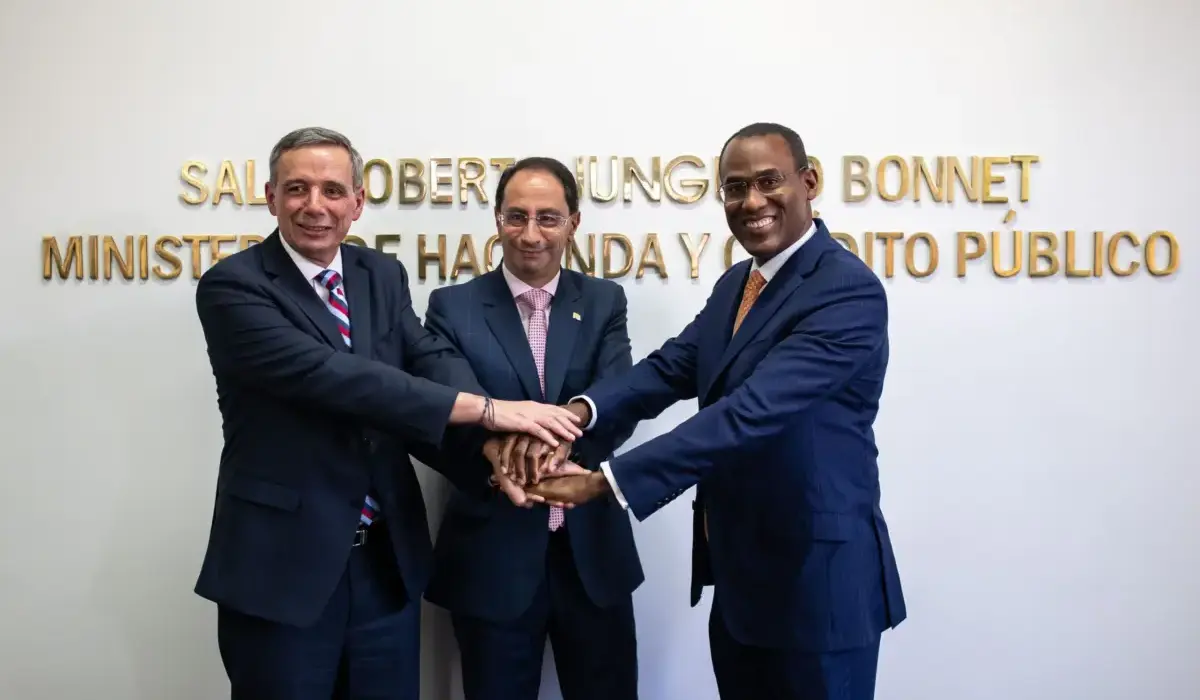
The high-stakes financial talks were officially set in motion last weekend when IMF Deputy Managing Director Nigel Clarke arrived in Bogotá for a high-level, four-day official visit. During his packed itinerary in the Colombian capital, Clarke held intensive closed-door meetings with key members of the new economic leadership team, including Vice President José Manuel Restrepo, Finance Minister Miguel Gómez, and Leonardo Villar, the head of Colombia’s central bank.
The engagement marks a significant pivot for the South American nation, which has not turned to the IMF for financial support packages since 2020, during the height of the global coronavirus pandemic. The decision to open negotiations with the Washington-based lender underscores the immediate economic hurdles facing the administration of the far-right outsider, who assumed the presidency promising sweeping reforms to right the nation’s economic ship.
Following the conclusion of his visit, Clarke issued a formal statement outlining the parameters of the discussions and the multilateral lender’s perspective on Colombia’s economic trajectory. He emphasized that “timely and credible action to reduce fiscal imbalances” in Colombia “can help strengthen confidence, lower borrowing costs, and create more favorable conditions for private investment and job creation.”
At the same time, the IMF official acknowledged several foundational strengths within the Colombian economy, pointing to what he described as the nation’s proven “economic resilience,” a solid political framework, an independent central bank, and a resilient financial system that has weathered multiple regional and global shocks over recent years.
However, the international financial backing under discussion will not come without conditions. Clarke outlined the major structural reforms and policy adjustments that the IMF is expected to formally request from Colombia in exchange for its financial support and ongoing partnership. Among the primary conditions highlighted by the IMF are reducing persistent barriers to domestic and foreign investment, improving national security, addressing critical infrastructure gaps, curbing economic informality, and strengthening the rule of law alongside regulatory predictability.
The dialogue between Colombian economic authorities and the international lender is slated to continue next week, when a delegation of Colombian officials travels to Washington, D.C., to meet directly with IMF technical staff to hash out the finer details of a potential arrangement.
A Delicate Financial Situation
The necessity for external financial assistance stems from a pronounced deterioration in Colombia’s public finances during the final years of the administration of former President Gustavo Petro. Over that period, the country’s fiscal metrics slipped significantly, leaving the incoming administration with a narrow margin for error and a heavy debt servicing burden.
According to official economic data, the primary fiscal deficit—which explicitly accounts for debt payments—stood at 4.3 percent of Gross Domestic Product (GDP) in 2023. That figure widened dramatically to 6.7 percent in 2024, before hovering around 6.4 percent the following year. Economic historians and analysts note that, excluding the acute fiscal fallout experienced during the first two years of the pandemic, this consecutive two-year span represents the highest fiscal deficit recorded in Colombia so far in the 21st century.
Independent projections suggest that the fiscal strain is far from over. Estimates published by the prominent financial firm Corficolombia indicate that the deficit for the current year and the next could surpass previous peaks, potentially climbing above 7 percent of GDP in both years if proactive containment measures are not swiftly implemented.
The announcement of the IMF negotiations has triggered a lively debate among local economists, political analysts, and think tanks regarding the best path forward for Colombia’s economic recovery.
Oscar Torrealba, director of research at the Colombian Institute of Political Science (ICP), offered a cautious assessment of the administration’s strategy. Speaking to the press, Torrealba noted that while securing additional financing “may prove necessary” under the current macroeconomic circumstances, it does not mean that turning to the IMF is inherently “desirable or that it constitutes a solution to the fiscal problem.”
Torrealba argued that any credit obtained from international lenders does not “replace the correction of the structural problems” plaguing the nation’s budget. Instead, he stressed that national efforts must remain squarely focused on “reducing the deficit and not on replacing [fiscal tightening] with greater debt.”
“A state whose spending is sustained by debt and grows inertially is not sustainable,” Torrealba added, highlighting the long-term dangers of relying on external borrowing to fund ongoing government operations without enacting fundamental spending reforms.
Conversely, other prominent economic voices have welcomed the government’s move as a crucial stabilizing signal to nervous financial markets. Marcela Meléndez, director of the influential Colombian think tank Fedesarrollo, described the administration’s decision to seek an agreement with the IMF as unequivocally “good news.”
“It represents the possibility of having an independent expert entity accompanying the government in charting a credible path of fiscal sustainability,” Meléndez said. She emphasized that bringing in the IMF serves as a definitive “sign of fiscal discipline that markets need” to regain confidence in the country’s macroeconomic management.
Meléndez further pointed out that securing an IMF agreement typically serves as a powerful catalyst, easing the government’s access to additional credit lines from other major multilateral institutions, such as the World Bank, the Inter-American Development Bank (IDB), or the Development Bank of Latin America and the Caribbean (CAF).
“The main benefit is that we will have the IMF as an ally in the constant review of the plan that is agreed upon, and that will allow for lowering the cost of financing and being able to make sound decisions,” Meléndez concluded, highlighting the stabilizing influence that external monitoring can provide as the government works to reassure both domestic and international investors.