









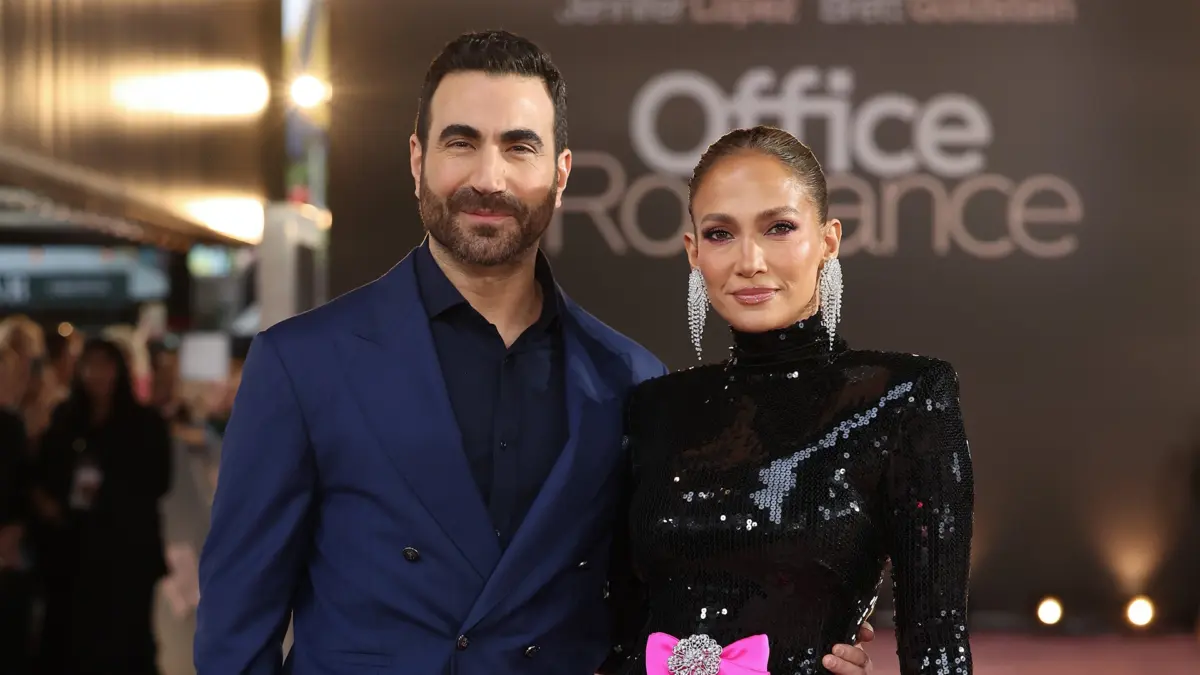
What began as undeniable on-screen chemistry during the promotional tour for a Netflix romantic comedy has now spilled over into real life, or at least into the relentless rumor mill of celebrity culture. Jennifer Lopez and her Office Romance co-star Brett Goldstein, who spent months dodging speculation that their palpable connection extended far beyond the script, are reportedly casually dating.
The whispers first reached a fever pitch earlier this year during the press tour for the film. Goldstein admitted in June during an appearance on NBC’s Today that he had written the film specifically with Lopez in mind. During the promotional rounds, host Savannah Guthrie highlighted the romantic undertones of their working relationship, referencing an appearance Lopez made on Andy Cohen’s Watch What Happens Live, where she playfully named Goldstein her “best kisser” among her co-stars.
While both actors exchanged smirks and nervous giggles to deflect the inevitable questions about whether they were romantically involved, audiences largely remained skeptical. The situation drew immediate comparisons to the intense, highly publicized speculation that followed Bradley Cooper and Lady Gaga after the release of A Star Is Born. Many observers wondered whether the undeniable sparks were simply a carefully orchestrated promotional tactic designed to drive viewership for the streaming release.
Now, months after the film’s premiere and the whirlwind press tour, the narrative has shifted. According to recent reports from Page Six, Lopez and Goldstein were spotted leaving a Los Angeles party together in the same vehicle, immediately reigniting speculation that a real-life romance has blossomed behind the scenes. As of now, neither Lopez, Goldstein, nor their respective representatives have confirmed or denied the rumors, leaving the internet to piece together the clues and construct a full-blown love story.
If the reports are true, the pairing has drawn plenty of enthusiastic support from fans who recognize their chemistry and believe Lopez deserves to enjoy her life. However, the recurring cycle of public commentary surrounding Lopez’s love life highlights a persistent double standard in how society views the romantic pursuits of women compared to men.
The intense scrutiny raises broader questions about why cultural expectations still demand that women treat every single relationship with a man as though he is “the one.” It places an unfair burden on women—particularly Latinas, regardless of age—to continuously prove that every romance will inevitably lead down the aisle toward marriage, an expectation that is rarely, if ever, imposed on men.
At 57 years old, Lopez has lived a public, highly scrutinized life. Having been married and divorced four times and raising two children, she brings a wealth of life experience and self-awareness to any new chapter. While it remains entirely possible that Goldstein is a great match for her, the rush to assume that a casual sighting signals a serious, long-term commitment overlooks the simplicity of dating. For all the public knows, the two may simply be enjoying each other’s company and exploring a connection at their own pace. The heartbreak of her recent high-profile divorce from Ben Affleck does not mean that every subsequent man she is seen with must automatically be cast in the role of her next husband.
Our culture frequently treats a woman’s romantic relationships as a direct reflection of her personal judgment, self-worth, and capacity for growth in a way that rarely applies to men. Lopez’s extensive romantic history has unfortunately become a central pillar of her public persona, often weaponized by commentators who use every new connection to suggest she has failed to learn from her past, makes poor choices, or must continually prove her intrinsic value by ensuring her next relationship lasts forever.
This societal pressure is further amplified for Latinas, who navigate unique cultural expectations regarding love, marriage, and respectability politics. While younger generations, particularly Gen Z, have begun to experience more cultural leniency, many Latinas across older generations were raised under the traditional "señorita" mentality. Originally used simply to designate an unmarried woman, the term became heavily intertwined with notions of virginity and female purity.
In many traditional Latin American families and communities, the archetype of a "good woman" was explicitly tied to modesty, behavioral restraint, and preserving sexual experience exclusively for marriage. Women were taught that their societal value and personal reputation depended heavily on appearing sexually inexperienced and well-behaved for a future husband. These deeply entrenched expectations are rooted in machismo and patriarchal structures. Although these pressures may manifest differently today than in the past, women are still frequently nudged to protect their reputations, avoid being misconstrued as promiscuous, and select partners strictly with an eye toward matrimony.
A woman who accumulates multiple romantic partners—even within the context of serious, committed relationships—is often subtly or overtly expected to express regret for her choices. The public subjects Lopez to this exact standard on a near-constant basis.
Conversely, a man with a comparable romantic history is routinely granted grace, viewed as experienced, or simply characterized as taking his time before deciding to settle down. Men who date casually are frequently praised as independent, confident, and proactive individuals with a healthy array of options. The more successful a man is professionally, the more excuses society tends to make for his prolonged bachelorhood.
Yet a woman as successful, attractive, wealthy, famous, and desirable as Lopez is frequently framed through a cynical lens that suggests she simply cannot keep a man. Observers remain endlessly fascinated by the idea that despite having achieved immense professional and financial success, she has not yet secured a permanent romantic destination.
The underlying assumption that the end of a marriage constitutes a personal failure at love ignores the reality that relationships can be meaningful without lasting forever. Lopez’s past divorces do not mean she owes the public proof of her worth by finding a permanent match in Goldstein. If their relationship is casual, it is an entirely valid choice. She retains the right to explore an exciting connection without the pressure of a lifelong guarantee.
Men are routinely permitted to treat dating as an ordinary phase of life, while women are expected to treat it strictly as a pathway toward a permanent destination. A man can spend years vocalizing his disinterest in commitment, his desire to focus on his career, or his preference for keeping his options open. Even when such behavior is viewed critically, society readily accepts that he is simply dating.
Women, by contrast, face extensive interrogation for making similar choices. Society asks whether a woman is afraid of commitment, overly selective, making poor decisions, or carrying unresolved trauma. As women age into their forties, fifties, and beyond, these invasive questions only intensify. Observers demand to know why she has not settled down, why her previous relationships failed, and whether she harbors regret for how she has lived her life.
It is worth noting that women can also internalize and enforce these very same restrictive rules. Society has conditioned many women to view their romantic and sexual choices as fundamental indicators of their character. At the same time, legitimate reasons exist for women to approach dating with heightened caution. Women carry a disproportionate share of the risks involved in romantic and sexual encounters, including the threat of sexual violence, the primary physical consequences of reproduction, unequal emotional labor, and severe double standards that can damage a woman’s personal and professional reputation.
Discussions surrounding a person’s romantic history often reveal deeply ingrained social conditioning. While personal preferences regarding celibacy, intimacy, and exclusivity are entirely valid choices for individuals who prefer to reserve sex for committed relationships, they should not be used as benchmarks to measure a woman’s worth or self-respect. Solidarity among women does not require uniform personal choices or the universal application of individual experiences.
Ultimately, Jennifer Lopez does not owe the public a successful, permanent marriage to prove that she has "figured out love." She is entirely permitted to seek companionship, chemistry, and pleasure on her own terms. Whether a connection lasts for a single season or a lifetime, she retains the freedom to enjoy relationships without knowing where they will ultimately lead, proving that living well remains the best response to lingering cultural double standards.