




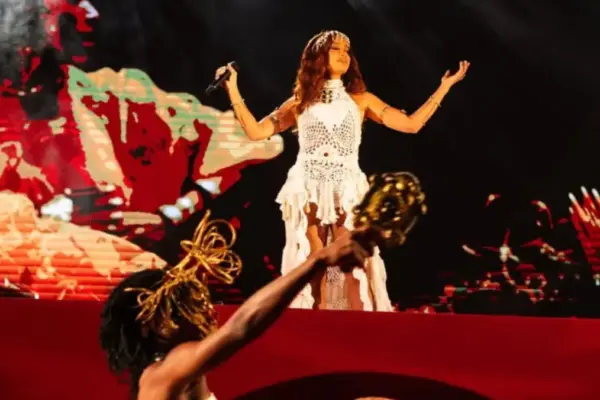




Daniela Avanzini has found herself at the center of an intense online debate, becoming the latest public figure of Latin American descent to be asked to prove whether she is “Latina enough.”
The member of the global pop-adjacent girl group KATSEYE has recently been scrutinized by critics across social media platforms like TikTok, with users questioning whether she is only now leaning into her Venezuelan and Cuban roots as a strategic branding move. This skepticism has felt particularly acute to critics at a time when Latinidad is experiencing unprecedented mainstream visibility, commercial success, and global cultural embrace.
The discourse surrounding the young singer intensified further following unrelated controversies involving her family. Specifically, public backlash grew after her father, Rafael Avanzini, made contentious remarks suggesting the group should continue with scheduled performances despite bandmate Manon Bannerman taking a health-related hiatus. However, beneath the surface of these specific controversies, the core of the criticism directed at Daniela appears to be rooted in the timing and visibility of her heritage. Detractors argue that she did not publicly embrace her Latina identity early on, suggesting she benefited from her privilege as a white-presenting Latina to blend in, and is only now highlighting her background to appeal to a broader, more international audience.
Conversely, Daniela’s supporters offer a starkly different perspective. They argue that she has consistently identified as an American-born Latina, pointing to past interviews, live streams, and vocal performances where she demonstrated that she is bilingual and proud of her heritage. For many fans, the heavy criticism and ongoing scrutiny feel less like genuine community accountability and more like a form of digital policing.
This debate touches upon a much broader and deeply sensitive cultural conversation. Over the past decade, as identity politics has become more prominent in mainstream media and public figures face heightened scrutiny for their words and actions, communities of color have increasingly grappled with internal accountability. Yet, within many communities of color, and particularly within the diverse Latine diaspora, this has often manifested as the strict policing of identity.
Many individuals born or raised in the United States have been told at some point that they are not “Latina or Latino enough.” This exclusion often stems from a lack of fluency in Spanish, specific differences in upbringing, or how an individual is racially perceived. While this behavior is frequently framed as a method of holding people accountable, it can often create rigid boundaries that do more harm than good.

As a member of KATSEYE—a diverse girl group formed through global pop pathways featuring members from various cultural and ethnic backgrounds—Daniela operates in a sphere where fans are exceptionally quick to investigate and police authenticity. This dynamic inevitably raises complex questions about identity: Who ultimately gets to define who belongs, and by whose standards are those definitions measured?
Reviewing the historical record, Daniela has previously spoken about her background as a Latina from Atlanta with Venezuelan and Cuban parents. Critics and supporters alike now debate the fairness of assuming she concealed her identity in the past, while also questioning whether individuals should be allowed to reconnect with and embrace their heritage later in life.
This tension between diaspora identity and performance highlights a deeper layer of complexity. Daniela is part of a global pop group designed for cross-cultural appeal, and she possesses the privilege of presenting as white within a society historically rooted in white supremacy. While it is unfortunate that she must navigate the complex weight of a diaspora’s collective pain, cultural observers note that this debate is not solely about her as an individual. Rather, it speaks to a systemic struggle over who is permitted to claim Latinidad. People of color living in the United States are frequently required to prove their loyalty to their communities and demonstrate their connection to their culture in ways that white Americans are rarely, if ever, asked to do.
This cultural dynamic reveals deeper truths about history, power, and the racial hierarchy embedded in the United States. In American society, whiteness is rarely treated as a distinct ethnicity; instead, it functions as the default baseline. White Americans are not routinely asked whether they are "Irish enough" or "Italian enough," because their Americanness is assumed and left unquestioned.
Because whiteness has historically been positioned as the societal norm, everyone else is categorized as "something else" requiring explanation or validation. Conversely, communities of color have historically faced systemic denial of belonging. From slavery and segregation to immigration restrictions, cultural erasure, and forced assimilation, Black, Latine, Asian, and Indigenous communities have had their legitimacy repeatedly questioned.
Consequently, identity for people of color has often become something that must be actively defended, proven, and preserved. Because opportunities for representation in media, music, film, television, and politics remain limited, high stakes are attached to public figures who represent these communities. There is a valid underlying concern regarding whether a public figure accurately reflects the community or represents it favorably. However, this creates an unfair pressure for individuals to serve as flawless embodiments of an entire culture, a burden that white Americans, who enjoy abundant and normalized representation, do not experience.
Within the Latine community specifically, race plays a critical role. Colorism and proximity to whiteness heavily influence how individuals are perceived and treated globally. There is a common misconception that Black and brown Latines who react with suspicion when white or white-presenting individuals suddenly claim their heritage are acting out of jealousy or arbitrary gatekeeping.

Instead, these reactions are typically rooted in lived experiences shaped by race and power. Latinidad features its own internal racial hierarchy that mirrors broader societal whiteness. Lighter skin, straighter hair, and Eurocentric features have historically been rewarded within Latine communities, while darker skin, Afro-textured hair, and Indigenous or African features have faced marginalization and erasure.
This legacy of colonialism and colorism means that proximity to whiteness frequently equates to greater social access. When a white or light-skinned Latine person publicly emphasizes their identity, it does not happen in a vacuum. It interacts with a system where they have likely benefited from not being visibly othered, whereas many darker-skinned individuals lack the privilege to opt out of their racial visibility.
For brown and Black Latines, identity is often visible regardless of whether it is actively claimed. They experience racism externally and colorism internally, meaning they cannot move through the world as "just white" or selectively reveal their heritage when convenient. This reality prompts difficult questions about where light-skinned individuals were during moments of systemic marginalization, leading to perceptions of cultural opportunism when pride is suddenly expressed during periods when Latinidad is trending or profitable.
At the core of this criticism is a fundamental question of equity: Are individuals benefiting from cultural elements that others are still penalized for? For darker-skinned Latines, a sudden public embrace of heritage can feel less like personal growth and more like a familiar pattern where Latinidad is celebrated primarily when it holds commercial value in mainstream pop culture.
At the same time, cultural commentators note that a more public embrace of heritage does not automatically equate to inauthenticity. It does not mean an individual is not Latina enough, nor does it invalidate the idea that people are allowed to grow into their identity, particularly if they were not raised immersed in it.
The core challenge lies in holding these truths simultaneously: recognizing the systemic history and power dynamics that advantage white-presenting individuals, while still making space for personal connection and cultural discovery. As conversations around representation continue to evolve, the underlying question for communities remains how to protect cultural integrity without fostering rigid exclusion, ensuring that heritage remains welcoming to all who seek to connect with it.