







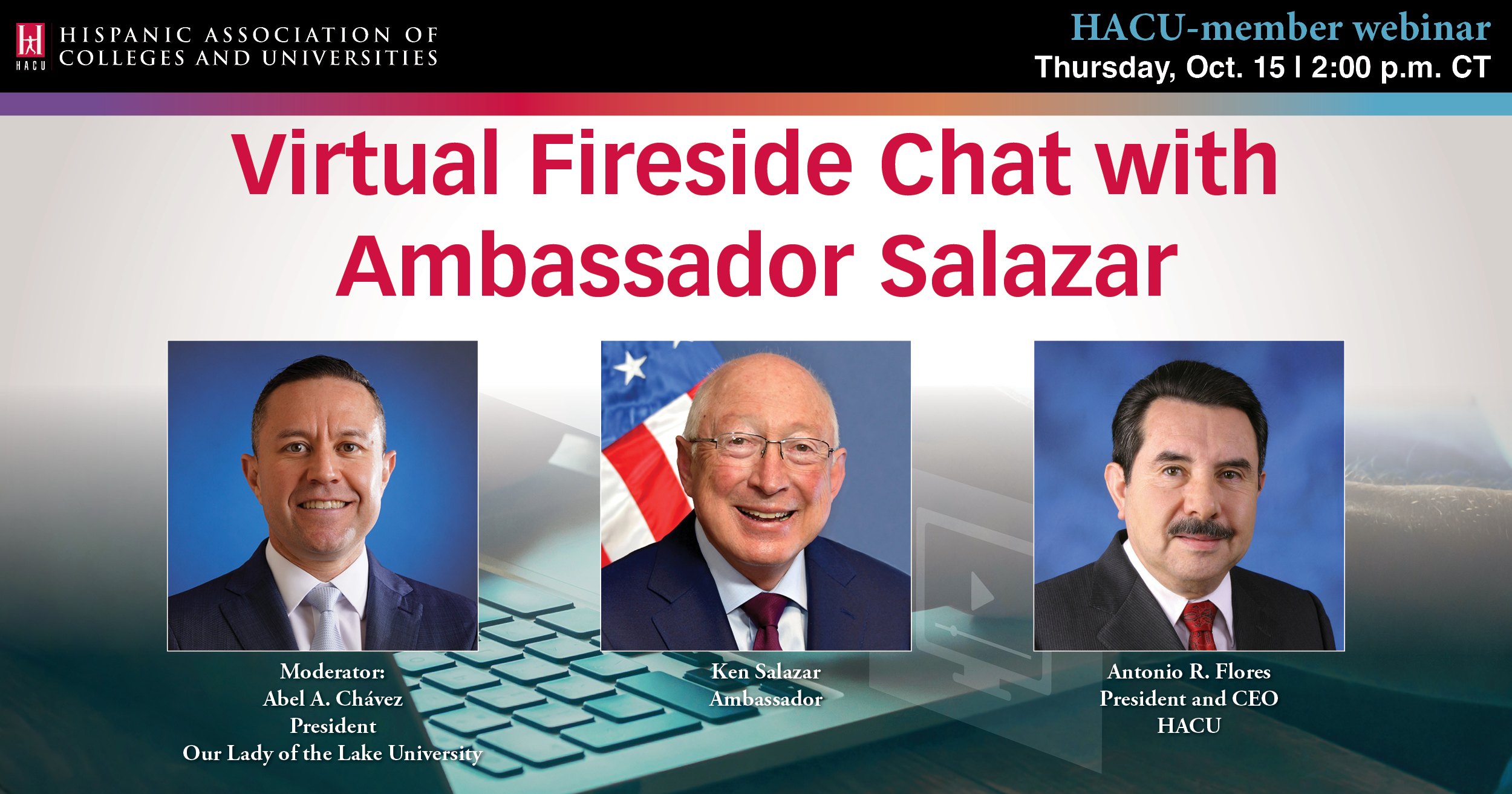
The Hispanic Association of Colleges and Universities (HACU) recently convened educators, students, and public service advocates from across the nation for an engaging virtual fireside chat with Ambassador Ken Salazar. Held on October 15, 2026, the special online event centered on Salazar’s newly published memoir and manifesto, Borderlands: My Fight for an Inclusive America, offering participants a profound look into the intersections of heritage, higher education, leadership, and public service.
HACU President and CEO Antonio R. Flores joined Ambassador Salazar for the interactive dialogue, which drew a wide audience of academic leaders and campus communities. The conversation was expertly moderated by Our Lady of the Lake University President Abel A. Chávez, who guided the discussion through complex themes of identity, cross-border diplomacy, and the indispensable role that educational institutions play in shaping the future of the United States.
The virtual gathering served as both a celebration of Salazar’s remarkable personal trajectory and a forward-looking examination of the responsibilities held by Hispanic-Serving Institutions (HSIs) in cultivating the next generation of diverse leadership. Through thoughtful dialogue and personal anecdotes, the speakers unpacked what it means to build an inclusive nation in an increasingly interconnected global landscape.
A Life Rooted in the American West and Public Service
Ambassador Salazar’s journey to the highest echelons of American government and diplomacy is a quintessential American story rooted in perseverance, community, and education. Growing up on his family’s traditional ranch in the rugged terrain of Colorado’s San Luis Valley, Salazar was immersed in a rich cultural heritage that deeply influenced his worldview. As the very first member of his family to attend college, he broke through generational barriers, charting a path that would eventually lead him through some of the most influential halls of power in state and federal government.
Throughout his distinguished career, Salazar has shattered glass ceilings and served in monumental leadership capacities. His public service record includes serving as the attorney general of Colorado, representing his home state as a United States Senator, and guiding national environmental and public lands policy as the U.S. Secretary of the Interior under the Obama administration. Most recently, he extended his legacy of public duty onto the international stage by serving as the United States Ambassador to Mexico, where he worked on complex diplomatic, economic, and security issues affecting both neighboring nations.
In his book Borderlands, Salazar reflects deeply upon these decades of public service, drawing from his unique vantage point as a Hispanic leader navigating the highest levels of American governance. The memoir is more than a retrospective account of a life in politics; it is a passionate and reasoned case for building a stronger, more inclusive America that harnesses the talents and cultural richness of all its people, particularly as the nation experiences profound demographic shifts.
Higher Education, Leadership, and Hispanic-Serving Institutions
A central pillar of the conversation between Flores, Salazar, and Chávez was the transformative power of higher education and its capacity to bridge divides. The panelists explored how family values and educational opportunities serve as the twin engines of social mobility and civic engagement. In a nation where higher education acts as the primary gateway to leadership roles in the public and private sectors, academic institutions carry a profound responsibility to foster environments where students from all backgrounds can thrive.
The discussion placed a particular emphasis on Hispanic-Serving Institutions and their critical mission. As enrollment at HSIs continues to grow across the country, these colleges and universities find themselves uniquely positioned to prepare students for leadership in an increasingly diverse society. Salazar and the university presidents discussed how HSIs can intentionally cultivate leadership qualities among their student bodies, ensuring that young scholars are equipped not only with technical knowledge and professional skills, but also with the civic consciousness required to address the most pressing challenges facing local communities and the nation at large.
By intentional mentorship, institutional support, and culturally responsive programming, higher education institutions can dismantle the barriers that have historically kept underrepresented communities from entering fields like law, public policy, diplomacy, and higher education administration. The virtual chat underscored that empowering Hispanic and minority students is not merely a matter of institutional equity, but an absolute necessity for the continued economic vitality and democratic health of the United States.
Bridging Divides and Strengthening U.S.-Mexico Relations
Moving beyond the domestic sphere, the fireside chat broadened its lens to examine the geopolitical and cultural relationships that define the North American continent. Drawing on his extensive experience as U.S. Ambassador to Mexico, Salazar offered valuable perspectives on the importance of strengthening bilateral ties between the United States and Mexico. The dialogue addressed the realities of bridging political and cultural divides, emphasizing that cooperation and mutual respect are essential for addressing shared regional concerns.
Furthermore, the conversation explored tangible ways to expand opportunities for cross-border collaboration in areas such as education, academic research, and workforce development. In an interconnected global economy, the prosperity of the United States is inextricably linked to the strength of its partnerships with international allies, particularly immediate neighbors. Academic institutions, including Hispanic-Serving Institutions, were highlighted as vital agents in this collaborative framework, capable of fostering binational research initiatives, student exchange programs, and joint workforce training initiatives that benefit communities on both sides of the border.
Expanding Reach Through the "One Book, More Voices" Initiative
Toward the conclusion of the event, Ambassador Salazar introduced an exciting opportunity for colleges, universities, and student organizations seeking to integrate the themes of Borderlands into their campus communities. Through the newly launched One Book, More Voices effort—a program of the Borderlands New North American Alliance Fund—educational institutions have access to matching copies of the book.
This initiative is designed to make the memoir accessible for integration into classrooms, campus libraries, and student leadership programs. By participating in the effort, academic institutions can encourage campus-wide reads, panel discussions, and student forums centered on the book’s core themes of inclusivity, civic duty, and cross-cultural understanding. HACU’s hosting of the virtual fireside chat served as a natural catalyst for this nationwide educational effort, inspiring academic leaders to bring these vital conversations directly to their students.