










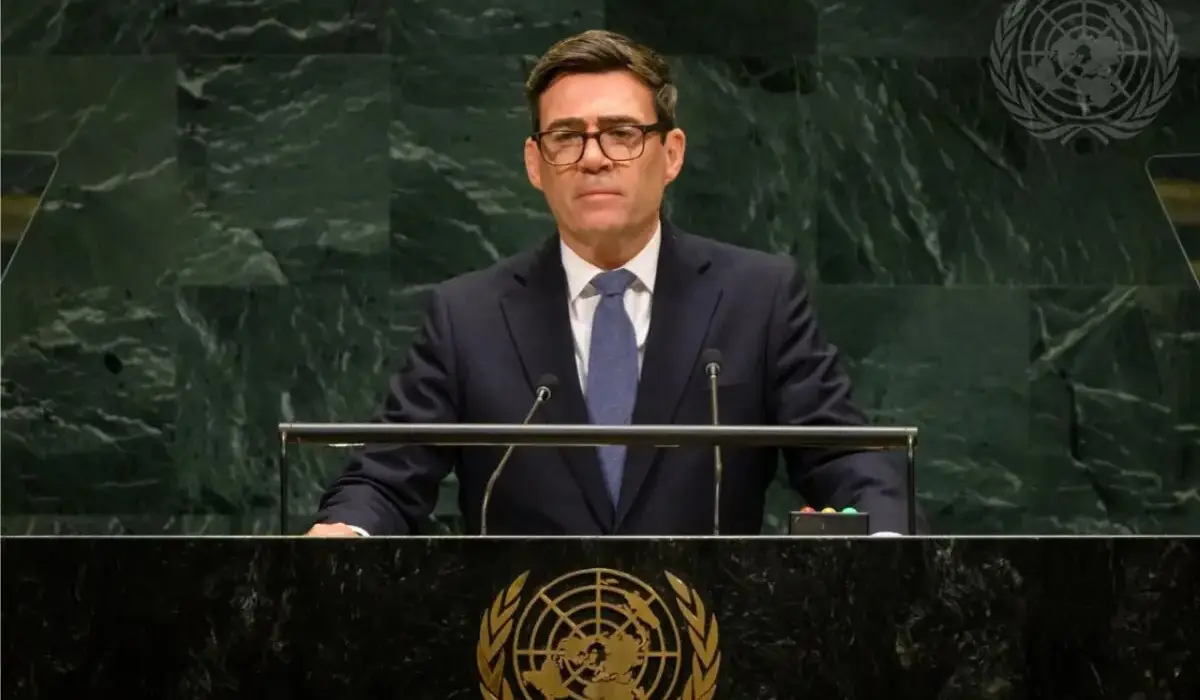
UNITED NATIONS — British Prime Minister Andy Burnham used his address before the United Nations General Assembly on Tuesday to deliver a resolute message on the international stage, declaring that the United Kingdom would "stand firm in the face of any threats." Framing his broader policy objectives as a steadfast defense of the UN charter and the international rule of law, Burnham explicitly linked global security challenges with the defense of British overseas territories, specifically pointing to the right of the Falkland Islands to remain British in the face of external claims.
The inclusion of the South Atlantic archipelago in a speech primarily dedicated to modern global governance highlights London’s ongoing sensitivity regarding the long-standing sovereignty dispute. While the core of Burnham’s address tackled pressing contemporary issues—such as the global proliferation of state-backed disinformation, the urgent need to establish international artificial intelligence safety standards, and the revitalization of multilateral diplomacy—he made it clear that traditional territorial integrity remains a cornerstone of British foreign policy. Furthermore, the Prime Minister used the global platform to urge world governments to take a more active regulatory role in governing emerging technologies rather than leaving the responsibility entirely in the hands of private tech corporations.
Beyond his remarks on territorial sovereignty and technological governance, Burnham used his UN General Assembly debut to reiterate the United Kingdom’s traditional alliances and policy positions. He reaffirmed the nation’s unwavering commitment to the North Atlantic Treaty Organization (NATO), emphasizing collective security in Europe. He also signaled the continuation of robust military, financial, and infrastructure support for Ukraine as it continues to defend itself against Russian aggression. In the Middle East, Burnham voiced his support for a viable two-state solution, firmly condemning ongoing Israeli settlement expansions while simultaneously maintaining the U.K.’s strict opposition to Hamas and broader Iranian regional aggression.
The address came on the heels of a busy diplomatic schedule in New York, which included high-level bilateral meetings with key international counterparts to discuss defense, trade, and geopolitical stability.
High-Stakes Bilateral Talks with President Trump
Prior to stepping up to the podium at the General Assembly, British Prime Minister Andy Burnham held a crucial closed-door bilateral meeting with United States President Donald Trump earlier in the day. The primary focus of their private discussions centered on the issue of sovereignty surrounding the Falkland Islands, an issue that has recently returned to the forefront of transatlantic diplomatic chatter following shifting rhetoric from Washington.
Speaking to reporters outside the meeting room shortly after the conclusion of their talks, Burnham revealed that he had used the face-to-face encounter to brief the U.S. leader directly on Britain’s unyielding position. "We will defend the right of the Falkland Islanders to self-determination and to remain British," Burnham told the gathered press corps. "I just wanted the president to know directly from me. That’s the clear British position, and he very much understood what I was saying."
The bilateral meeting takes on added significance in light of recent diplomatic developments involving the United States administration. In late August, President Trump publicly remarked that Washington may "review" its official diplomatic position regarding the sovereignty dispute over the Malvinas Islands, sparking a wave of speculation across both South America and Europe regarding a potential shift in U.S. policy.
Historically, the United States has maintained a carefully balanced diplomatic neutrality on the ultimate question of sovereignty over the archipelago, declining to formally endorse either Argentine or British claims to the territory. However, Washington has long formally acknowledged the practical reality that the United Kingdom administers the islands on a day-to-day basis. Burnham’s preemptive push to clarify London’s stance directly with the U.S. president appears designed to forestall any unexpected diplomatic shifts and underscore the democratic mandate of the islanders themselves.
Argentina Responds from the UN Podium
The diplomatic friction between London and Buenos Aires was brought into sharp relief later in the day when Argentine Foreign Minister Pablo Quirno took to the United Nations floor to deliver a swift and pointed response to Prime Minister Burnham’s earlier remarks regarding the disputed territory. Quirno used his time at the podium to formally reiterate Argentina’s historic and ongoing claim to the islands, challenging the legitimacy of British administration.
"I wish to remind this assembly that the Malvinas, South Georgia, and South Sandwich Islands and the surrounding maritime areas are an integral part of Argentine national territory," Quirno declared to the delegates assembled in New York.
The Argentine Foreign Minister categorically rejected the assertion that the United Kingdom holds any legitimate sovereign rights over the archipelagos or the vast surrounding maritime zones. To support his argument, Quirno pointed to the historical timeline of the dispute, emphasizing that "the British occupation of the territory dates back to 1833, when United Kingdom forces occupied the Malvinas Islands, violating the country’s territorial integrity and expelling legitimately established Argentine authorities and residents."
Furthermore, Quirno insisted that the international community, through the institutional framework of the United Nations, officially recognizes the existence of a bilateral sovereignty dispute that requires active resolution. He highlighted previous UN resolutions and mandates that have formally called upon the governments of both Argentina and the United Kingdom to set aside their differences and resume direct bilateral negotiations. According to Buenos Aires, returning to the negotiating table remains the only viable pathway to finding a peaceful and lasting solution to the dispute and ultimately completing the decolonization of the territory.