








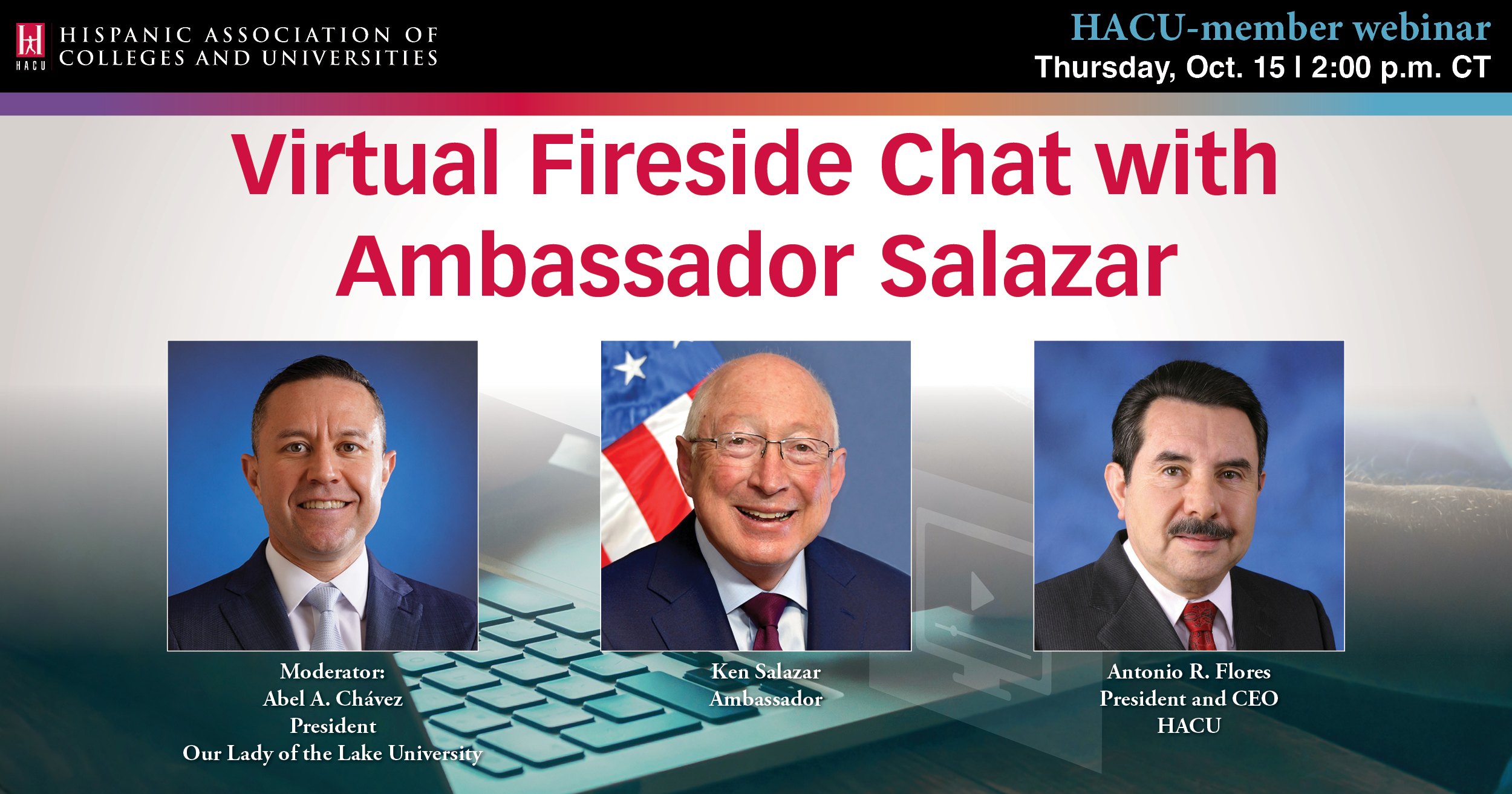
The Hispanic Association of Colleges and Universities (HACU) recently convened an engaging and deeply reflective virtual fireside chat featuring Ambassador Ken Salazar, focusing on his acclaimed book, Borderlands: My Fight for an Inclusive America. Held on October 15, 2026, the online event brought together educators, students, and leaders from across the nation to discuss the intersection of personal heritage, educational access, and public service. HACU President and CEO Antonio R. Flores joined the conversation alongside Ambassador Salazar, offering institutional perspectives on how higher education can continue to shape the next generation of American leaders. The discussion was expertly moderated by Abel A. Chávez, President of Our Lady of the Lake University, who guided the dialogue through themes of leadership, cross-border diplomacy, and the evolving role of Hispanic-Serving Institutions (HSIs) in the modern educational landscape.
Ambassador Salazar’s life story forms the bedrock of the themes explored during the virtual gathering. Growing up on his family’s traditional ranch nestled in Colorado’s picturesque San Luis Valley, Salazar was grounded from an early age in the values of hard work, community resilience, and stewardship of the land. As the first member of his family to pursue higher education, his journey represents a powerful testament to the transformative potential of colleges and universities for first-generation students from rural and historically underrepresented backgrounds. From those formative roots in the American West, Salazar embarked on a distinguished career in public service that eventually took him to the highest corridors of governance and diplomacy. He has served as the Attorney General of Colorado, a United States Senator representing the state, the Secretary of the Interior under the federal government, and, most recently, as the United States Ambassador to Mexico. In Borderlands, Salazar reflects extensively upon these decades of public leadership, drawing from his unique vantage point to make a compelling and impassioned case for a stronger, more inclusive, and unified America.
Throughout the virtual fireside chat, the conversation naturally expanded to encompass a wide array of pressing topics relevant to contemporary society, higher education, and international relations. President Antonio R. Flores and President Abel A. Chávez engaged Ambassador Salazar in a dialogue that explored how early family influences and educational milestones serve as the primary catalysts for a life dedicated to public service. The participants examined the vital responsibility that institutions of higher learning—particularly Hispanic-Serving Institutions—hold in identifying, nurturing, and developing future leaders who can navigate complex cultural and political environments. By reflecting on his own career trajectory, Salazar emphasized that educational institutions must actively foster environments where diverse backgrounds are viewed as distinct assets in problem-solving and governance.
Furthermore, the discussion addressed the critical need to bridge widening political and cultural divides within the United States. Ambassador Salazar drew upon his extensive background in domestic policy and international diplomacy to articulate how mutual understanding and civic engagement can heal fractured communities. The dialogue also placed a significant emphasis on strengthening the vital partnership between the United States and Mexico. As neighbors with shared economic, cultural, and environmental interests, the two nations rely heavily on robust diplomatic and educational channels. The conversation highlighted the vast opportunities for expanding cross-border collaboration in areas such as higher education, academic research, and comprehensive workforce development, ensuring that communities on both sides of the border can thrive in an interconnected global economy.
In addition to exploring the thematic depths of his book, Ambassador Salazar introduced a practical initiative designed to bring the lessons of Borderlands directly to college campuses and classrooms. He shared details regarding "One Book, More Voices," a newly established effort spearheaded by the Borderlands New North American Alliance Fund. This initiative aims to provide matching copies of the book for academic classrooms, campus libraries, and student-focused engagement programs, making the text widely accessible to learners eager to engage with its core messages of inclusion and civic duty. Through this program, participating academic institutions have a unique opportunity to integrate the book’s themes into their curricula and campus programming, encouraging students to critically examine their own roles in shaping a more inclusive society.