






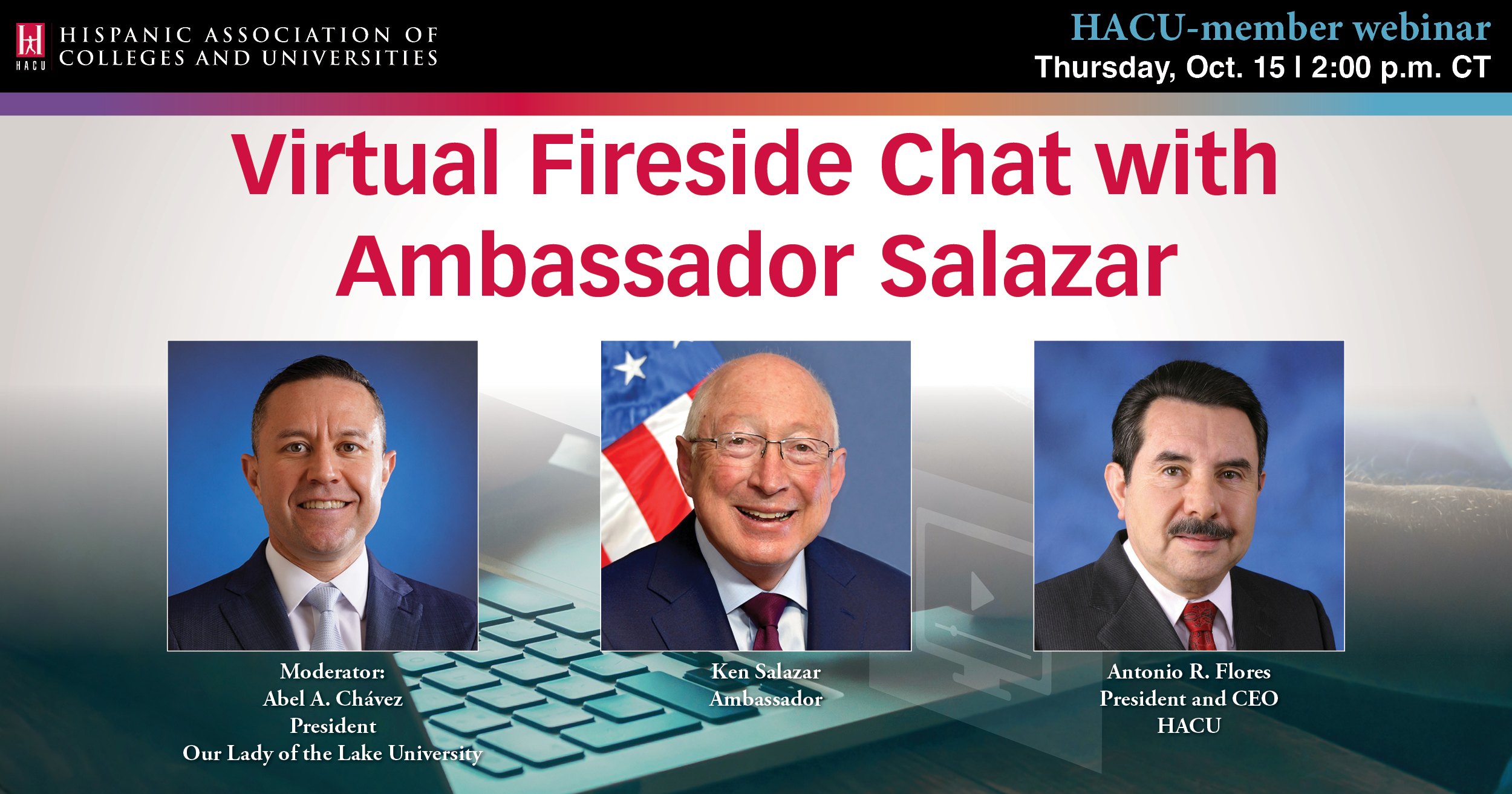
The Hispanic Association of Colleges and Universities (HACU) recently convened an engaging and deeply reflective virtual fireside chat featuring Ambassador Ken Salazar, the esteemed author of the acclaimed book Borderlands: My Fight for an Inclusive America. Held on October 15, 2026, the online event drew educators, students, administrators, and public service professionals from across the country to discuss leadership, educational opportunity, and the ongoing pursuit of a more equitable and inclusive society.
The special event was spearheaded by HACU President and CEO Antonio R. Flores, who joined Ambassador Salazar in the high-profile conversation. To guide the dialogue, the organizations tapped Our Lady of the Lake University President Abel A. Chávez to serve as the moderator. Together, the leaders steered a comprehensive discussion examining the intersections of personal background, higher education, civic duty, and international diplomacy, capturing the attention of a wide-ranging audience invested in the future of Hispanic-Serving Institutions (HSIs) and the students they serve.
A Life Rooted in Public Service and Higher Education
Ambassador Salazar’s remarkable personal and professional journey served as a foundational theme throughout the virtual session. Growing up on his family’s ranch nestled in the picturesque and culturally rich San Luis Valley of Colorado, Salazar experienced firsthand the challenges and values of rural working-class life. Significantly, he was the first member of his immediate family to attend college, a milestone that fundamentally altered the trajectory of his life and opened doors to extraordinary levels of public leadership.
From those humble beginnings on the family ranch, Salazar built a distinguished career in public service that spans multiple decades and high-level offices. He went on to serve the people of Colorado as their state attorney general before transitioning to national politics as a United States senator. His executive experience expanded further when he was appointed as the U.S. secretary of the interior, managing vast public lands and natural resources for the federal administration. Most recently, Salazar represented the United States abroad as the U.S. ambassador to Mexico, playing a critical diplomatic role in managing bilateral relations between neighboring nations.
In his book, Borderlands: My Fight for an Inclusive America, Salazar reflects extensively on these rich experiences, utilizing his personal narrative to make a compelling and timely case for a stronger, more inclusive United States. During the fireside chat, he unpacked some of these core themes, emphasizing how his upbringing, cultural heritage, and educational opportunities shaped his worldview and prepared him to navigate complex political and diplomatic landscapes.
The Vital Role of Higher Education and Hispanic-Serving Institutions
A major focus of the conversation centered on the transformative power of higher education and its indispensable role in cultivating the next generation of leaders. President Flores and Ambassador Salazar explored at length how universities and colleges—particularly Hispanic-Serving Institutions—serve as vital engines of upward mobility for students from diverse and underrepresented backgrounds.
The dialogue underscored how institutions of higher learning do more than simply impart academic knowledge; they act as incubators for civic engagement, critical thinking, and leadership development. For HSIs specifically, the mission extends to intentionally creating pathways for Hispanic and first-generation college students, ensuring they possess the tools, mentorship, and confidence required to step into leadership roles across the public and private sectors.
Salazar emphasized that educational institutions must actively work to bridge political and cultural divides in contemporary society. By fostering environments of open dialogue, mutual respect, and rigorous intellectual inquiry, colleges and universities can help students navigate an increasingly polarized world. The conversation highlighted that the unique cultural assets and bilingual strengths often found within HSI student populations are not merely advantages for the individual learners, but strategic national assets for the United States as a whole.
Strengthening U.S.-Mexico Relations and Cross-Border Collaboration
Given Ambassador Salazar’s extensive tenure as the U.S. ambassador to Mexico, the virtual fireside chat naturally expanded into discussions regarding international diplomacy and cross-border cooperation. The panelists addressed the deep historical, economic, and cultural ties binding the United States and Mexico, framing strong bilateral relations as an absolute necessity for mutual prosperity, security, and cultural enrichment.
The discussion moved beyond traditional diplomatic and governmental channels to examine how academic institutions can foster grassroots international collaboration. Higher education institutions, research centers, and workforce development agencies were identified as critical partners in building lasting bridges across the border. By expanding opportunities for collaborative academic research, student exchanges, and joint workforce training programs, universities can help prepare graduates to thrive in an interconnected global economy.
Ambassador Salazar noted that the challenges and opportunities present along the U.S.-Mexico border region are emblematic of a broader, interconnected North American future. Strengthening educational and economic ties across these communities fosters stability, innovation, and a shared sense of purpose that benefits citizens on both sides of the international boundary.
Bringing Borderlands to Campuses Through "One Book, More Voices"
Toward the conclusion of the event, Ambassador Salazar introduced an exciting opportunity for educational institutions wishing to integrate the themes of his book into their academic programs. He shared details regarding One Book, More Voices, a brand-new initiative launched through the Borderlands New North American Alliance Fund.
This innovative effort is designed to make Borderlands widely accessible to students by providing matching copies of the book for classroom instruction, campus libraries, and specialized student programs. Through this initiative, colleges and universities can more easily adopt the text into their curricula, sparking campus-wide conversations about identity, civic responsibility, and the ongoing American experiment.
By connecting students directly with the narrative and ideas found in Borderlands, institutions can inspire learners to reflect on their own potential as civic leaders and changemakers. The program serves as a practical extension of the themes discussed during the fireside chat, providing concrete resources for academic leaders committed to fostering inclusive excellence on their campuses.
The virtual event concluded with expressions of gratitude from HACU leadership to Ambassador Salazar and President Chávez for their thoughtful contributions to the ongoing dialogue surrounding education, leadership, and national unity.