






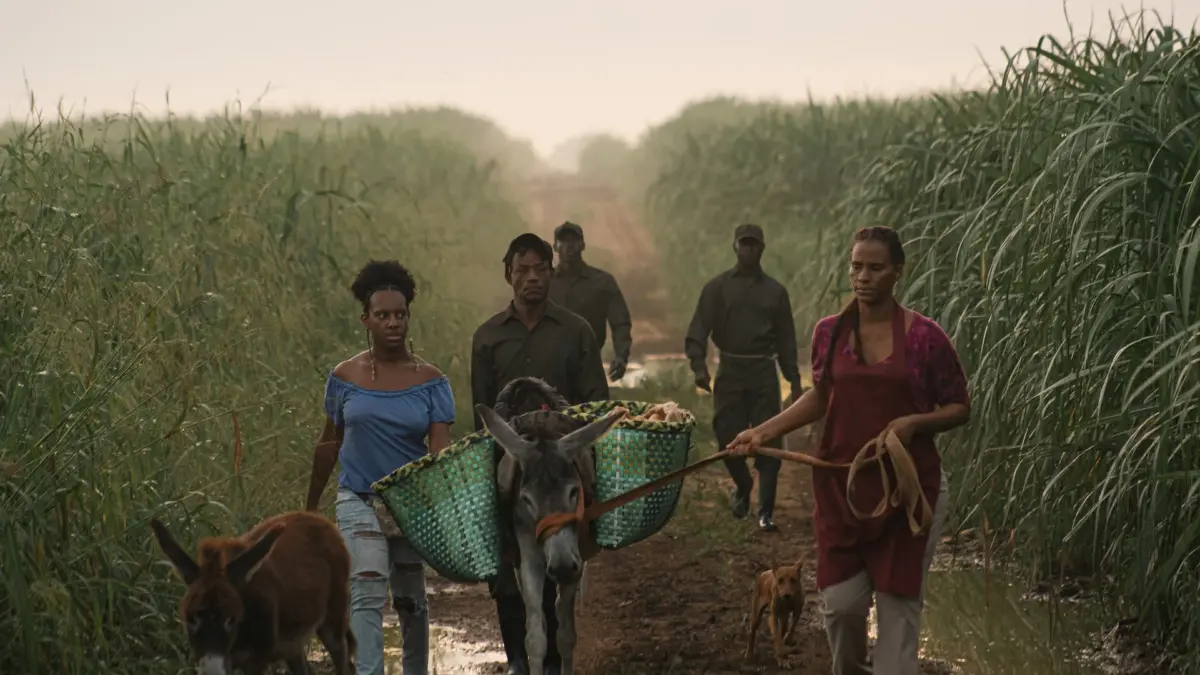
In the quiet, sun-baked expanses of the Dominican Republic’s sugarcane communities, the ordinary rhythms of adolescence can be abruptly upended by systemic realities that few outside these regions witness. This raw, political, and deeply spiritual landscape forms the core of Sugar Island, a powerful coming-of-age film directed by Afro-diasporic artist and filmmaker Johanné Gómez Terrero. The movie follows 14-year-old Makenya as she navigates a sudden and life-altering teenage pregnancy against a backdrop of deep-seated structural inequalities.
In a recent interview with HipLatina, Terrero discussed the making of Sugar Island and the intricate, dynamic ways that bodily autonomy, bureaucratic documentation, labor rights, and ancestral spirituality function as foundational pillars throughout the film. Rather than merely coexisting, these themes reinforce one another, effectively revealing how one young girl’s unexpected pregnancy serves as a window into the broader sociopolitical forces shaping life on the island of Hispaniola.
Operating from a Caribbean and decolonial framework, Terrero consciously roots her cinematic work in personal lineage. She notes that the initial spark for the narrative came from the realization that teen pregnancy was not an isolated incident within her own family. When her niece became pregnant at just 13 years old, it mirrored the experiences of Terrero’s mother and grandmother, both of whom had also given birth at a young age. This recurring generational thread compelled the director to rigorously interrogate how girlhood, personal agency, and cultural expectations of womanhood violently collide in the region.
Observing the women in her family circle, Terrero recognized that their lives changed radically the moment they became mothers, noting that personal desires frequently moved to the background or disappeared entirely. This observation mirrors the daily reality for countless young girls across the Dominican Republic and the broader Latin American region. While recent demographic data indicates a significant 65% decline in Hispanic teen pregnancies within the United States between 2008 and 2018, the socio-legal landscape across Latin America remains starkly different. The Dominican Republic stands as one of only 24 countries worldwide—and one of only six in Latin America—that maintains a total ban on abortion without a single exception, not even for cases of rape, incest, or when the life of the mother is in jeopardy. Consequently, for young women like Makenya, unexpected parenthood is rarely a matter of personal choice; rather, it functions as an inevitability dictated by rigid laws, systemic poverty, and deeply entrenched cultural norms.
Terrero weaves this stark contradiction into the fabric of the film. In one fleeting, vibrant scene, Makenya is seen dyeing her eyebrows blond, blasting dembow music, and savoring the carefree playfulness that adolescence ought to guarantee. In the very next moment, a missed menstrual period arrives to rewrite the trajectory of her existence. Elaborating on this dynamic, Terrero points out that teenage motherhood has grown increasingly complex in the modern era, largely because traditional systems of communal mothering have eroded, leaving the entire physical and emotional weight of child-rearing to fall squarely upon a body that has not yet reached adulthood.
This heavy burden is further compounded in the film by Makenya’s fractured domestic life. She lives in a modest household shared only with her mother and her grandfather, an environment shaped by past losses and the persistent racialized borders that define contemporary Dominican society. Makenya’s grandfather is of Haitian descent, while her late grandmother was Dominican. This blending of cultural identities, once a common characteristic of the nation’s historic sugarcane communities, now sits directly at the center of the Dominican Republic’s fraught and tense relationship with national citizenship and belonging. The modern wealth of the Dominican Republic was largely built upon the sugarcane industry, a system sustained by the exploitation of impoverished Haitian laborers who were recruited decades ago to work in rural settlements known as bateyes, frequently stripped of official paperwork, basic rights, and state protections.
Makenya’s grandfather serves as a living embodiment of this complex history. After dedicating decades of his life to cutting cane, he finds himself transformed into a pension activist, fighting desperately for financial compensation that the mechanization of the agricultural industry has rendered precarious. As heavy machinery rapidly replaces human labor, aging workers are routinely discarded, threatened with deportation, denied proper paperwork, or left entirely without accumulated wages. Highlighting this injustice, Terrero explains that Makenya explicitly articulates this reality in the film, noting that her grandfather was only viewed as useful for as long as his hands could perform manual labor. Human bodies that can no longer be ruthlessly exploited are cast aside and deported without any guarantees of fundamental human rights. For the grandfather, this ongoing fight is not merely economic; it is fundamentally existential. Without proper documentation, he—like countless other individuals of Haitian descent living in the Dominican Republic—remains legally invisible to the state.
This systemic invisibility is ultimately passed down to Makenya as a bitter generational inheritance. Throughout the course of the film, audiences are confronted with brief yet potent moments where the young protagonist realizes her unborn child will likely inherit her grandfather’s undocumented status—a precarious life defined by restricted physical mobility, constant state surveillance, and a profound lack of official recognition. Terrero maintains a clear-eyed view of how this erosion of human dignity is intentionally perpetuated. She observes that poverty is inherited just as great fortunes are handed down through generations, serving as the primary mechanism by which the existing social status quo is maintained. By denying official documents and perpetuating statelessness, the system effectively prevents marginalized populations from climbing the social pyramid, reinforcing the reality that without an officially recognized identity or documentation, human dignity is routinely denied.
This persistent question of what is passed down through generations naturally leads the film into its rich spiritual dimensions. In socio-political spaces where state power systematically strips individuals of their fundamental rights, Afro-spirituality emerges as a vital site of resilience, communal connection, and self-definition. While Roman Catholicism maintains a dominant presence across the Dominican Republic, Makenya’s family practices las 21 divisiones, a vibrant syncretic spiritual tradition that seamlessly blends traditional African cosmologies, Catholic saint veneration, and indigenous Taíno influences. Within the narrative, these spiritual guides, known locally as "Misterios," function as protective figures and teachers, securely grounding the family in ancient rituals that actively defy the lingering colonial hierarchies embedded within broader Dominican society.
Elaborating on this worldview, Terrero explains that every spiritual system constitutes a unique "cosmosentir," or comprehensive worldview. Through her filmmaking, she seeks to dissolve the persistent veils of coloniality and illuminate the profound beauty inherent within ancestral traditions and alternative ways of imagining the world. Embracing Blackness, she emphasizes, is an act of cultural and personal expansion. Through this thoughtful lens, Sugar Island transcends a standard portrait of Dominican-Haitian girlhood, transforming into a vital restoration of Black Caribbean spiritual knowledge that has historically been dismissed or treated as taboo within mainstream Dominican cultural narratives.
Despite navigating the heavy thematic territory of teenage pregnancy, statelessness, and deep-seated colorism, Sugar Island remains a vital narrative that demands to be told, addressing experiences that are far too frequently overlooked in contemporary discussions surrounding Dominican-Haitian relations. Terrero deliberately chose to avoid a narrow, isolated perspective; instead, the parallel narratives of Makenya’s unexpected pregnancy and her grandfather’s tireless fight for labor rights powerfully underscore the complex geopolitical reality of existing as a darker-skinned Dominican or Haitian within the Dominican Republic. It is a lived reality marked by centuries of border violence and tension that persist in the present day. Acknowledging this ongoing friction, Terrero expresses a clear artistic and personal aspiration: she hopes to encourage healing conversations, revisit shared histories to foster collective recovery, and ultimately imagine what she describes as a "maroon future" rooted above all in radical tenderness.
While a surface-level glance at Makenya’s narrative might lead some to categorize it strictly as a tragedy, Sugar Island offers audiences a nuanced view that encompasses both the profound wounds and the enduring beauty of the island of Hispaniola, capturing the natural richness of the earth alongside the vibrant resilience of local traditions. Terrero successfully brings the fragile, fleeting nature of girlhood—a subject typically discussed only after it has already slipped away—directly to the forefront of contemporary cinema.
Sugar Island is currently scheduled to screen at the African Diaspora International Film Festival in New York City through December 14.