










Spanish music superstar David Bisbal is stepping into a deeply nostalgic space with his tenth studio album, Eternos, arriving on Thursday (Oct. 1). The project finds the acclaimed artist lending his voice to timeless romantic pop classics originally popularized by legendary performers of the 1960s, 1970s, and 1980s, including Nino Bravo, José José, Juan Gabriel, and Raphael.
While these are songs that Bisbal has known and lived with for virtually his entire life, the process of studying them with the sole intent of interpreting them himself offered an entirely transformative experience. Rather than viewing them merely as childhood memories, the detailed preparation allowed him to appreciate the sheer magnitude of the artists who first brought them to international acclaim.
Reflecting on the repertoire that defines the new record, Bisbal explains that the project serves as a heartfelt homage to what he considers the absolute peak of romantic pop music recorded in the Spanish language. When he first began analyzing the intricate vocal delivery and craftsmanship of those historic performers, he realized without a doubt that they represented the pinnacle of vocal artistry in the genre.
Finding a Personal Voice Within Familiar Melodies
To successfully tackle a tracklist so deeply embedded in the collective consciousness of Spanish-language music fans, Bisbal approached the material with a specific strategy. He began by imagining a scenario where the original songwriters had composed and handed these tracks directly to him as fresh, unreleased material.
From that foundational mindset, he sought out his own distinct way of delivering each lyric. He made a conscious effort to respect the foundational melodies and a vast majority of the original musical arrangements, intentionally steering clear of any attempt to simply mimic or copy the iconic interpretations that initially made the songs famous.
The 10-track collection features enduring staples such as "Te Quiero, Te Quiero," "Vivir Así es Morir de Amor," "El Amar y el Querer," and "Abrázame Muy Fuerte." For the majority of the album, Bisbal chose to remain remarkably close to the classic arrangements that fans remember. However, on select tracks, he permitted himself a greater degree of creative freedom—most notably on Raphael’s classic composition "¿Qué Sabe Nadie," which he successfully adapted to fit his own contemporary vocal styling.
Vocally, the album showcases a noticeably more restrained and measured approach from the pop star. Throughout much of Eternos, Bisbal dials back his delivery, allowing the classic melodies room to breathe naturally. He carefully reserves his signature powerful vocal prowess for strategic moments throughout the tracks when the emotional weight of the music truly demands it.
Capturing the Recording Magic of Decades Past
For the creation of Eternos, Bisbal reunited with Cheche Alara, the talented producer and arranger who previously worked alongside the singer on his 2024 Christmas album, Todo es Posible en Navidad. Together, they established a clear creative vision: to recapture the organic, immersive way music was recorded decades ago by bringing large ensembles of musicians together to play completely live in the studio. In certain tracks, this ambitious approach involved the participation of more than 90 musicians.
The core foundation of the album was recorded live at the renowned Henson Recording Studios in Los Angeles. During these foundational sessions, the core instrumentation—consisting of drums, bass, percussion, and Alara on the piano—was captured in real-time. Meanwhile, the rich string and brass sections were recorded later during dedicated sessions in Budapest, a process that Bisbal closely followed and guided remotely from his base in Madrid.

Bisbal notes that in the early days of the genre, achieving a grand, cinematic sound meant producers had no alternative other than utilizing a large physical gathering of musicians. While modern music production offers the capability to substitute live performers with digital programming, Bisbal emphasizes that replicating the authentic atmosphere of a record made 50 or 60 years ago required committing to those same rigorous live recording conditions.
A Profound Personal Connection to the Music
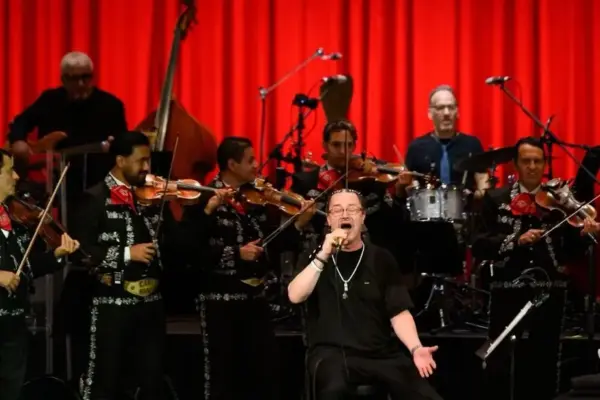
One of the standout moments on the album is "Amor Eterno," which features a grand symphonic mariachi arrangement complete with soaring strings, a traditional harp, brass instrumentation, and guitarróns. For Bisbal, however, the significance of this particular song ultimately transcended the purely musical realm.
At the time he went into the studio to record it, Bisbal’s father was experiencing a difficult health battle. As he worked on the track, the singer reflected deeply on Juan Gabriel and the profound grief that inspired the Mexican legend to write the song for his own mother. Following the passing of Bisbal’s father in February, the song took on a deeply personal and poignant meaning. Singing the lyrics shifted from an artistic exercise to an expression of his own personal loss, leaving him with the enduring feeling that his father remains close by his side.
A Masterclass in Songwriting and Master Arrangers
Among the legendary songwriters featured prominently across the tracklist, Manuel Alejandro stands out as the most represented creative force. His work anchors multiple highlights on the set, including "¿Qué Sabe Nadie," "Frente a Frente" (which he co-wrote with Ana Magdalena), and "El Amar y el Querer."
Bisbal notes that uncovering the lyrical depth of "El Amar y el Querer" proved to be a genuine revelation during his preparation for the album. Similarly, he found a unique artistic challenge in "Frente a Frente," a classic composition that has historically seen very few male cover versions, making it a particularly rewarding piece for him to perform. On the track "Quijote," the singer humorously observes that the lyric serves as a near-perfect narrative reflection of the extraordinary life led by Julio Iglesias.
After journeying through sweeping arrangements featuring rich strings, powerful brass sections, and symphonic mariachi instrumentation, Eternos concludes with the ultimate display of musical simplicity. The album closes with Bisbal’s voice delivering Joan Manuel Serrat’s beloved "Aquellas Pequeñas Cosas" entirely a cappella, providing a striking and minimalist conclusion to a project where elaborate arrangements otherwise play such a fundamental role.
Looking Ahead to the Stage
For Bisbal, this ambitious undertaking represents a natural continuation of a career spanning more than two decades, still fueled by an insatiable curiosity and a desire to continuously learn and evolve as an artist.
The immediate next challenge for the Spanish star will be translating these classic compositions to the live stage, a task he acknowledges will require a unique and dedicated interpretation every single night. To properly honor the sound of the record during upcoming live performances, he plans to expand his touring band by integrating a dedicated string section and a brass ensemble. As Bisbal puts it, while some performers rely on dancers or other stage elements, what he truly needs is his band.
The upcoming concert tour in support of the new album is scheduled to kick off on October 6 in Santiago, Chile. The itinerary will take the production through various countries across Latin America before continuing onward to Mexico and the United States, while fans in Spain will need to wait until the summer of 2027 to experience the tour live.