








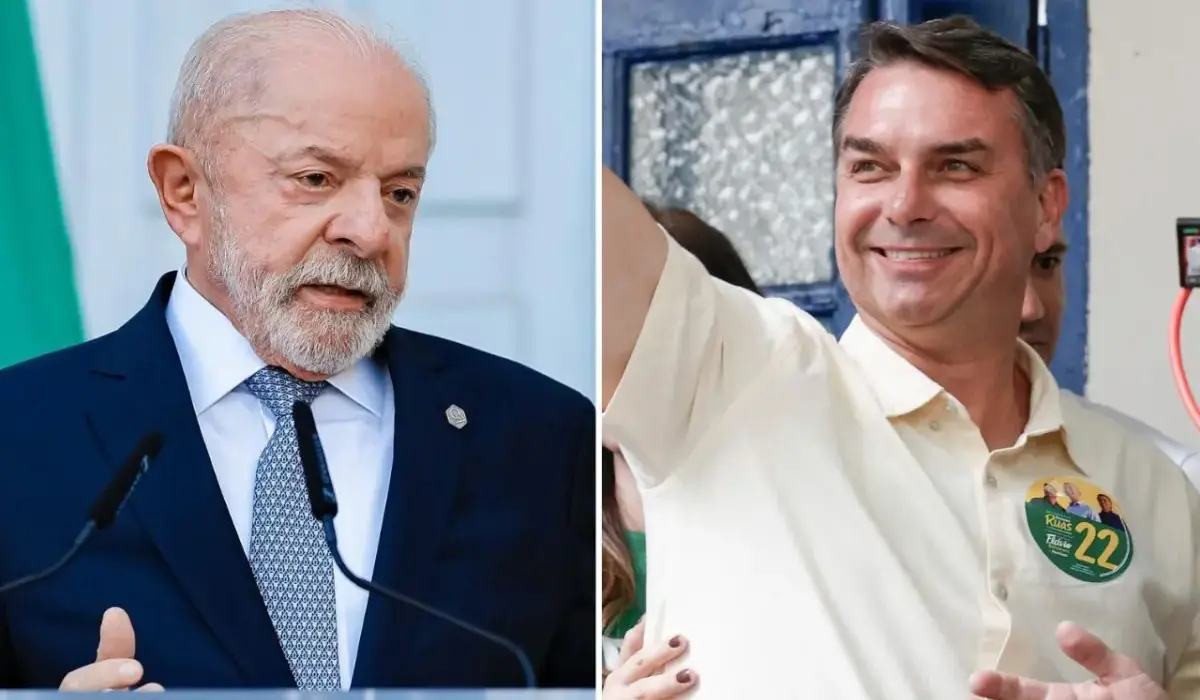
Brazil is officially headed for a high-stakes presidential runoff between center-left incumbent President Luiz Inácio “Lula” da Silva and far-right Senator Flávio Bolsonaro. The electoral landscape was dramatically reshaped last Sunday when the challenger took a surprise lead in the first round of voting, finishing nearly two percentage points ahead of the sitting president and stunning political observers across Latin America.
Ahead of the crucial vote, the overwhelming consensus among pre-election polling agencies pointed toward a solid advantage for Da Silva. However, when the ballots were finally tallied, the incumbent garnered 45.1% of the vote. Meanwhile, his primary rival—the eldest son of former right-wing President Jair Bolsonaro, who governed from 2018 to 2022—secured 47%. While it was a formidable performance for the challenger, it fell short of the absolute majority required to avoid a second round of voting.
The two political adversaries are now locked in an intense campaign trail ahead of the decisive runoff scheduled for October 25.
The immediate aftermath of the election has already brought shifting momentum. The first post-election survey released by the prominent polling agency Datafolha indicates that Bolsonaro has maintained his psychological advantage entering the final stretch, capturing 49% of voting intentions compared to 45% for Lula.
To break down the complex implications of these results for the candidates and the broader trajectory of the South American giant, the Herald spoke with three prominent Brazilian political analysts. Their insights paint a picture of a nation deeply polarized, politically fluid, and bracing for a historic parliamentary and executive realignment.
A Stunning Surprise at the Polls
“Flávio Bolsonaro’s victory in the first round was a huge surprise,” said political analyst Creomar De Souza, CEO and founder of Dharma Political Risk and Strategy, a prominent political consulting firm based in the country.
“The prevailing belief here was that Lula would be the winner,” De Souza noted, pointing directly to the numerous pre-election surveys that had consistently pointed to an entirely different outcome.
Yet, for other experts, the real shock extended far beyond the presidential tally itself. Cláudio Couto, a political scientist and professor at the Fundação Getulio Vargas Business School, told the Herald that what truly surprised him was not necessarily Bolsonaro’s first-place finish, but rather the unexpected, sweeping victory achieved by his political vehicle, the Liberal Party (PL, by its Portuguese initials), across concurrent congressional and gubernatorial elections.
The Liberal Party dominated regional executive races across the country, securing outright victories in five states during the first round. That number could climb as high as seven depending on the outcome of upcoming gubernatorial runoffs in the critical states of Amazonas and Rio de Janeiro.
According to Paulo Niccoli Ramirez, a political science professor at the Higher School of Advertising and Marketing (ESPM) and the São Paulo School of Sociology and Politics Foundation (FESPSP), Bolsonaro’s strong showing is emblematic of a broader modern political phenomenon. His success, Ramirez argued, “demonstrates the strength of the Bolsonarists, their use of social media, and their ability to sway voters’ thinking through Instagram, Twitter, or Facebook.”
Can Lula Turn the Election Around?
Even though the numerical gap between Da Silva and Bolsonaro in the first round sits at less than two percentage points, the interviewed analysts generally agree that it will be an uphill battle for the incumbent to reverse the trend and secure another term.
Historical precedent in modern Brazilian presidential elections weighs heavily against Da Silva. No candidate who has finished as the runner-up in the first round of a Brazilian presidential election has ever successfully gone on to win the subsequent runoff. Furthermore, political dynamics suggest that the vast majority of ballots cast for minor right-wing and conservative candidates in the initial round will naturally consolidate behind Bolsonaro on October 25.
“It is possible that Lula could make a comeback, but it’s very difficult,” Couto observed. “It’s not impossible, but it’s not the most likely outcome.”
Despite these formidable structural hurdles, the three analysts concurred that Lula still retains a narrow path to victory. His primary opportunity lies in mobilizing the substantial demographic of eligible citizens who chose not to cast a ballot during the first round of voting on October 4.
“There has never been such a narrow margin between the first and second place. And this gives Lula’s voters hope,” De Souza remarked.
Data shows that at least 21% of eligible voters abstained from participating in the first round. In response, Lula, his campaign team, and a broad coalition of supporters—including many who may not strictly belong to the political left but share a deep concern over the potential return of the far right to executive power—have launched an aggressive grassroots mobilization. Utilizing widespread social media campaigns and word-of-mouth networks, they are directly appealing to abstainers as well as those who cast blank or null ballots.
Ramirez highlighted the sheer volume of disengaged electorate, pointing out that nearly 37 million Brazilians sat out the first election. This figure dwarfs the modest 2.3 million-vote gap that currently separates the two leading candidates.
“I get the impression that many people may vote for Lula or choose not to vote for Bolsonaro out of fear of losing social and political rights, especially since Flávio Bolsonaro has threatened to change the constitution,” Ramirez explained. He added that while conservative votes from minor candidates will largely migrate to Bolsonaro, “they don’t even reach 4 million votes combined.”
The looming prospect of what critics describe as an “extremely dangerous” Bolsonaro administration could ultimately work to the incumbent’s advantage. De Souza suggested that this fear “might transform Lula into a kind of popular leader embodying democratic resistance, and this could be enough for a comeback.” Even so, he reiterated that Flávio Bolsonaro remains the clear frontrunner heading toward October 25.
Breaking Down Bolsonaro’s Win
To understand the current political earthquake, one must examine the background of the challenger. Flávio Bolsonaro is the eldest son of former right-wing President Jair Bolsonaro. The elder Bolsonaro is currently serving a lengthy 27-year prison sentence following convictions for plotting a coup d’état and orchestrating an assassination plot against Lula in the wake of Da Silva’s victory in the fiercely contested 2022 presidential election.
At that time, Jair Bolsonaro was the sitting president seeking reelection, only to be narrowly defeated by Lula. The uncovered coup plot was designed to block Da Silva from assuming office—an inauguration that ultimately took place in early 2023. Lula, who previously governed Brazil from 2003 to 2011 during the height of the country’s commodity boom, is now seeking a fourth presidential term. His remarkable political longevity follows a dark chapter in which he was barred from running in the 2018 election due to corruption convictions that were subsequently annulled by the judiciary.
While Flávio Bolsonaro possesses extensive legislative experience as a federal lawmaker, he had not historically been viewed as the primary gravitational center of national conservative politics until this election cycle. Analysts point to a combination of factors to explain his sudden surge.
For Couto, the result reflects profound public “dissatisfaction with the government.” Public opinion metrics show that roughly 40% of the electorate currently views Da Silva’s administration unfavorably, feeding into a broader “anti-establishment sentiment” that permeated the ballot boxes.
Bolsonarists, Couto noted, successfully positioned themselves as the true voice of the anti-establishment. In contrast, “Lula is a traditional left-wing politician, a social democrat,” and is consequently “closely identified with the political system,” including established state institutions and figures like Supreme Federal Court Justice Alexandre de Moraes, who has recently faced intense scrutiny amid political controversies.
De Souza added that beyond Lula’s plateauing popularity, Bolsonaro executed a highly disciplined campaign strategy. The challenger successfully persuaded right-leaning voters to consolidate behind his candidacy in the first round rather than splitting their ballots among competing conservative alternatives.
In typical Brazilian election cycles, voters frequently support a smaller, more ideologically aligned candidate in the initial round before coalescing around one of the two major finalists in the runoff. This time, however, conservative voters appear to have bypassed intermediate choices altogether.
“At the end of the day, Lula didn’t lose any votes. But Flávio has gained votes from people who didn’t reveal this preference in previous polls,” De Souza observed.
A Far-Right Congress Awaits
Regardless of which candidate ultimately prevails in the October runoff, the victor will face a dramatically altered legislative reality when the new congress is sworn in starting in February 2027.
The election results yielded a massive victory for Bolsonaro’s Liberal Party, which is projected to hold nearly a quarter of the seats in the Chamber of Deputies. More significantly, the PL will become the single largest bloc in the Federal Senate, securing a remarkable third of the upper house’s seats. When factoring in ideological allies and satellite conservative parties, the right-wing bloc moves tantalizingly close to holding an absolute majority in the Senate.
“This is far more than one might have imagined,” Couto stated.
Ramirez warned that such an assertive legislative majority would grant a hypothetical President Bolsonaro unprecedented leverage. “He will be able to push through constitutional changes based on his thoroughly conservative worldview marked by homophobia, racism, and the defense of evangelical values—which also puts other religions and their freedom of expression at risk,” Ramirez cautioned.
Indicating his legislative ambitions, Bolsonaro announced sweeping plans for constitutional reform. If elected, his administration intends to pursue lowering the age of criminal responsibility from 18 to 16 and abolishing the mechanism of presidential reelections.
Furthermore, Ramirez noted that this congressional backing would enable a Bolsonaro government to push for “the reduction or elimination of public funding for science, technology, the public health system, public universities, and social security, along with a greater trend toward the privatization of countless state-owned enterprises.”
Echoes of Argentina
The geopolitical parallels between Brazil’s current trajectory and regional neighbors have not gone unnoticed by the candidates or analysts.
“Flávio Bolsonaro’s victory would crown the triumph of the far right and pave the way for them to implement all the changes they desire, while the left will be in the minority in the next legislature,” Ramirez observed.
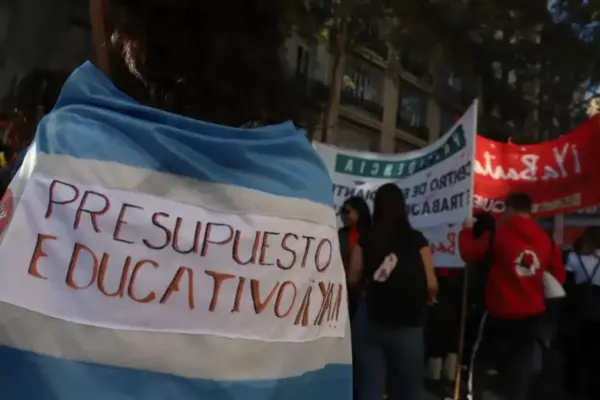
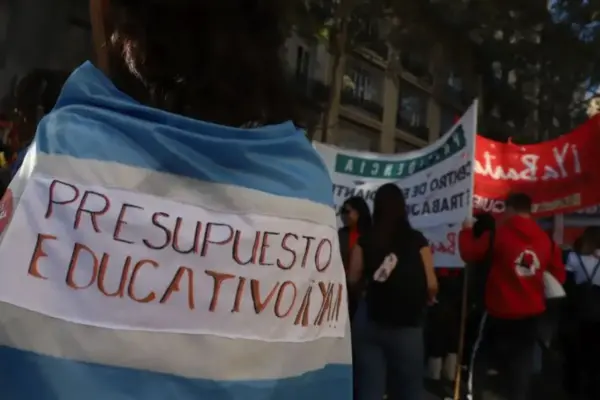
Throughout his campaign, Bolsonaro has openly embraced the political playbook of Argentine President Javier Milei, whose administration has implemented sweeping, aggressive austerity measures aimed at drastically cutting state expenditures and shrinking the public sector.
“If Argentina had a chainsaw, Brazil will have a massive cut in taxes, bureaucracy, and corruption!” Bolsonaro declared in June, publicly thanking Milei for his ideological alignment. To describe his domestic version of Milei’s policy, he utilized the Brazilian Portuguese expression tesolução, invoking the imagery of aggressively trimming down state apparatuses with oversized scissors.
The economic ideological clash has played out publicly between the two nations. In a recent social media post on X, Lula directly invoked the comparison, cautioning ordinary Brazilians against the painful economic consequences witnessed across the border in Argentina.
“There, they promised ‘chainsaw.’ Here, it’s tesolução. The result is always the same: against the people,” the Brazilian president wrote.
Conversely, analysts warn that even if Lula pulls off a historic comeback and wins the runoff on October 25, he will face an intensely hostile legislature. Such an outcome could plunge his administration into chronic legislative gridlock, threatening severe governability crises and raising the specter of potential impeachment proceedings against a Workers’ Party (PT) government operating from a permanent congressional minority.