









On October 19, addressing a roomful of oil and gas executives in the Patagonian province of Neuquén, Argentine President Javier Milei posed a rhetorical question that millions of everyday Argentines could have answered for him from their own kitchen tables.
“If they truly run out of money on the 20th,” Milei asked the gathered business leaders, “can you tell me how they live ten days without eating or drinking?”
The libertarian leader was mocking the widespread public complaint that household funds frequently run dry by the twentieth day of the month. He dismissed the notion outright as a political fabrication invented by the Kirchnerites, the political followers of former president Cristina Fernández de Kirchner. To underscore his skepticism, Milei used a colloquial Argentine insult, describing the claim as a "pelotudez del tamaño de una casa," which roughly translates to nonsense the size of a house.
Yet the actual answer to the president’s question is neither mysterious nor reassuring. People borrow. According to data from the Central Bank, household loans in arrears reached 12.81% in August, representing a delinquency rate nearly double what it was just a year earlier. In a survey conducted by the public opinion consultancy Equipo Mide, 53% of respondents reported taking on new debt within the previous three months, with 39% of those borrowers stating they needed the funds specifically to purchase food. Pablo Juliano, an opposition lawmaker from the Radical Civic Union, summed up the economic reality in a concise six-word response: "La respuesta es que se endeuda." They go into debt.
The more revealing element of the exchange, however, was the premise of Milei’s question itself. Under the president’s logic, if citizens are still physically consuming food on the 30th of the month, they cannot possibly have run out of money. Because severe macroeconomic hardship becomes nearly impossible to officially establish short of catastrophic starvation, he dismisses the broader socioeconomic strain as a partisan stunt orchestrated by his critics.
Global Discontent and Ideological Interpretations
While Milei fiercely rejected domestic grievances as political theater, he interpreted parallel waves of popular discontent abroad through an entirely different ideological lens.
Just days earlier, on October 17, more than half a million people flooded the streets across France, according to police estimates. What began as localized demonstrations by students and teachers protesting decaying public school infrastructure quickly snowballed into a broader national revolt over stagnant wages, pension reforms, soaring energy prices, and the punishing cost of living. While the vast majority of the French protests remained peaceful, some demonstrations turned volatile. Just a day prior, thousands of students had marched through major Italian cities to voice their opposition to Prime Minister Giorgia Meloni’s administration, pointing to run-down school buildings and chronically insufficient educational funding.
Simultaneously, in Albania, consecutive days of anti-government protests targeted Socialist Prime Minister Edi Rama. Demonstrators merged complaints regarding systemic corruption, high unemployment, and deteriorating education with fierce opposition to the sale of valuable coastal land to luxury foreign developers. Among the contentious projects was a real estate venture tied to a firm founded by Jared Kushner, the son-in-law of former United States President Donald Trump.
Seizing upon these international developments, Milei took to social media on October 18 to ask his followers whether his critics would finally admit he had been right all along about the inherent dangers of collectivism. He accompanied the post with a shared video clip of his widely discussed 2024 speech at the World Economic Forum in Davos, where he had warned global leaders that the Western world was under severe threat from collectivist policies.
For Milei, public anger over the cost of living abroad serves as an indictment of conventional governments that failed their citizens through bloated state intervention. Yet, when faced with virtually identical expressions of economic pain within his own borders, he treats the sentiment as a malicious fiction crafted by his political opponents.

Parallel Demands Across Borders
When placed side by side, the demands echoing through the streets of Buenos Aires, Paris, Rome, and Tirana reveal striking similarities. Across diverse political landscapes, citizens are demanding functional public schools, wages that comfortably cover basic household expenses, sustainable retirement pensions, and a tangible voice in managing the land and resources around them.
None of these grievances should sound foreign to the Argentine public, as they form the core of their daily survival struggles.
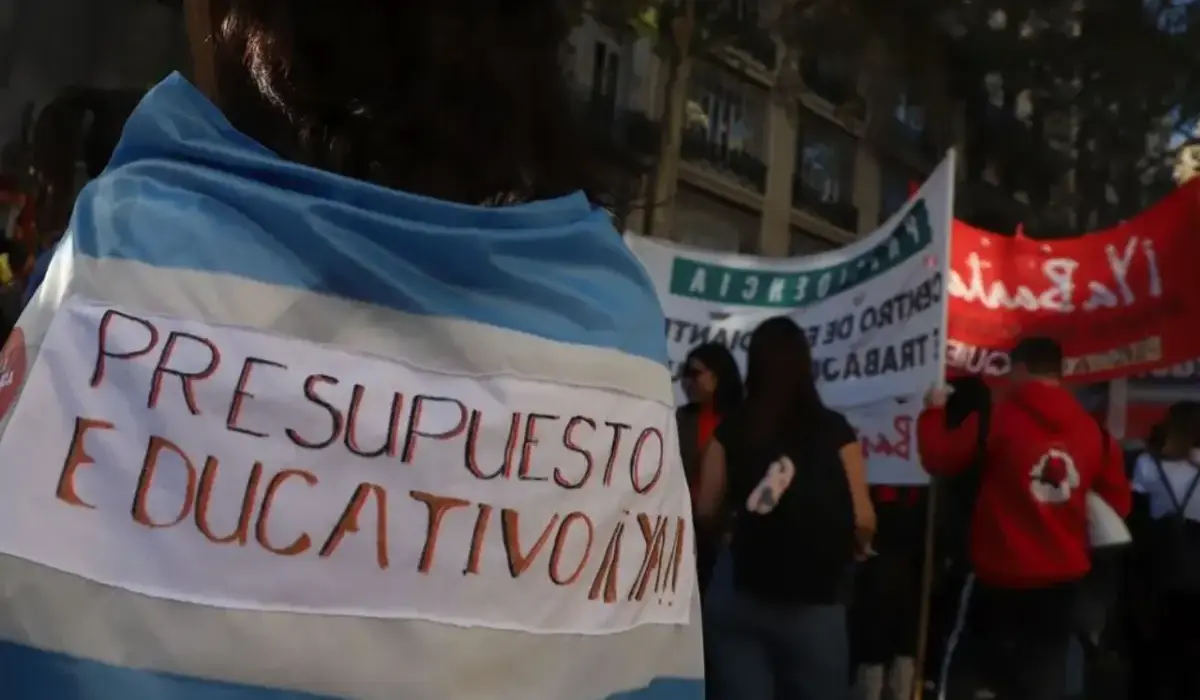
Consider the ongoing crisis in education. While French and Italian students took to the streets over deteriorating classrooms, Argentine students, professors, and university staff staged a massive mobilization on October 15 in Buenos Aires to protest sweeping budget cuts to national public universities. The demonstrations turned tense as security forces deployed tear gas and rubber bullets near the National Congress building, resulting in at least 25 arrests.
According to national budget data compiled by the prominent fact-checking organization Chequeado, the higher education budget for 2026 is slated to be 25.3% smaller in real terms than the allocation in 2023. Concurrently, data cited in the same analysis indicates that university professors’ salaries have plummeted to levels 24.2% below what they were in November 2023. A chemistry professor interviewed by international media outlets reported earning the equivalent of roughly US$700 per month—a stark illustration of the financial squeeze facing academics.
These profound losses in institutional funding and professional salaries have unfolded as part of Milei’s aggressive fiscal strategy to eliminate the federal deficit. The legislative branch pushed back in 2025 by overriding a presidential veto to pass a comprehensive university funding law, but the administration has largely declined to implement its key provisions. The legal standoff escalated when a federal judge imposed a daily fine of 100,000 pesos on the cabinet chief for non-compliance, though an appeals court subsequently suspended the financial penalty while the underlying legal obligation to comply remains under judicial review.
Parallels are similarly visible in disputes over land ownership. While Albanian protesters object to coastal territories being signed over to foreign capital, Argentina experienced its own fierce legal and legislative battles over property rights. Milei had previously repealed by executive decree a 2011 law that capped foreign ownership of rural land at 15%. Although a Supreme Court ruling on September 29 temporarily removed all legal limits, the high court suspended the repeal on October 9. The administration ultimately agreed to restore ownership restrictions within a broader private property bill approved by the Lower House, though the amended legislation still requires Senate approval. Even within the ruling coalition, lawmakers had strongly resisted the complete removal of these traditional protections.
Argentina’s broader cost-of-living indicators present a complex and mixed picture. Government data shows that the national poverty rate ticked upward from 28.2% in the second half of 2025 to 32.3% in the first half of this year, halting what had been five consecutive semesters of gradual decline. The cost of the basic food basket outpaced overall household income growth, rising 21.4% compared to an income increase of 11.5%. Meanwhile, the national unemployment rate stands at 7.9%, marking its highest level since 2021.
These figures require careful context. Poverty remains significantly below the 41.7% recorded when Milei first assumed office, and well beneath the devastating 52.9% peak reached in early 2024, which immediately followed a sharp currency devaluation executed by his own administration. Inflation has also fallen dramatically from its previous hyperinflationary trajectory. Macroeconomic stabilization is a genuine accomplishment, and the administration is fully justified in highlighting its fiscal achievements. What remains difficult to explain, however, is why a substantial portion of Argentine households continues to struggle to make their earnings last through the end of the month, or why the broader economic recovery appears to have stalled.
Blaming the Welfare State
Supporters of the libertarian government offer a straightforward and internally consistent defense. European welfare states have accumulated massive structural deficits over many years—France’s deficit reached 5.1% of GDP last year—and the painful public spending cuts sparking European protests are, from this perspective, the inevitable reckoning when public funds are entirely exhausted.
From this viewpoint, Argentina adjusted its economic course early to preemptively avoid a similar structural collapse. That argument warrants serious consideration. However, explaining why a government lacks the fiscal capacity to fund every public demand is fundamentally different from concluding that citizens voicing their grievances have no legitimate cause for complaint.

A public university can suffer from severe underfunding even while the national treasury maintains a primary fiscal surplus. A retired worker can struggle to pay for essential medications while official inflation rates decline. And a working family can completely run out of disposable cash by the 20th day of the month without literally starving for the remaining ten days.
The Limits of an Absolute Theory
President Milei appears far less interested in examining what these widespread protests reveal about economic anxiety than in finding where they fit neatly onto his pre-existing ideological map. The demonstrators in France are furious at a centrist executive; those in Albania are protesting a socialist government; those in Italy are marching against a right-wing prime minister who counts Milei as a political ally; and those in Argentina are confronting a self-proclaimed libertarian.
Although their specific demands and political contexts differ vastly, Milei looks at all four scenarios and draws the identical conclusion: collectivism has failed.
When every distinct political event is interpreted as absolute confirmation of a single overarching theory, that theory risks losing its ability to explain reality. By positioning his worldview so firmly at one ideological extreme, the frustrations of citizens living under governments of entirely opposing political stripes are seamlessly converted into evidence supporting his own administration’s path.
As the old observation suggests, from the North Pole, every single direction is south.
The massive European marches offered an opportunity to reflect on the mood of his own domestic electorate. Citizens are not necessarily rejecting the principles of fiscal discipline, nor are they demanding the return of unsustainable public subsidies. Many are simply asking a fundamental, human question: when do these immediate national sacrifices translate into tangible improvements in their daily lives?
Milei possesses a comprehensive, data-driven answer regarding national fiscal deficits, falling inflation rates, and the systemic economic disaster Argentina narrowly avoided—arguments grounded in real, verifiable achievements. Yet, that macroeconomic explanation does not quite answer the simpler question being asked by citizens trying to stretch their paychecks.
When Milei asked Argentines on October 19 to explain how they manage to survive the final stretch of the month, the public’s answer was written in credit card statements, personal loans from friends, deferred utility bills, and the careful calculation of which household expenses must be postponed. He might eventually discover that surviving until the 30th of the month and genuinely making ends meet are two very different realities.