








"Para bailar La Bamba se necesita una poca de gracia."
There is a strong chance you have heard those iconic opening lines, or the driving rhythm of the song "La Bamba," at least once in your life. Whether drifting from a car radio, playing over a television broadcast, or echoing through the aisles of a grocery store, the melody has become a permanent fixture of global popular culture.
While several artists have interpreted the tune over the decades, one of the most legendary and enduring versions was recorded by Ritchie Valens. Though his life and career were tragically cut short at the height of his youth, Valens left an indelible mark on American music. In recognition of Hispanic Heritage Month, Salud America! is celebrating Latino trailblazers, historical figures, and inspirational stories by highlighting the extraordinary life, career, and cultural contributions of a Mexican American singer and songwriter who blazed a trail for rock musicians for generations to come.
Ritchie Valens: Early Life Before Fame
Long before he was a household name, Richard Steven Valenzuela was born on May 13, 1941, in Pacoima, California. Growing up in the working-class expanse of the San Fernando Valley, a young Richard developed a deep, abiding interest in music. Encouraged by his family, he picked up the guitar and began teaching himself how to play, driven by an innate passion for sound and performance.
The path to musicianship was not without its hurdles. Although he was naturally left-handed, guitars configured for left-handed players were scarce and expensive for his family. Undeterred by the physical awkwardness, he was so eager to learn that he mastered the more readily available right-handed version of the instrument, adapting his technique to fit the standard configuration.
By the time he reached the age of 16, Valens’s talent had progressed to the point where he joined his first local band, the Silhouettes. The young performers played wherever they could find an audience, taking on local gigs, school dances, and community events. It was during these grassroots performances that he caught the eye of music publisher and producer Bob Keane. Impressed by the teenager’s raw talent and stage presence, Keane signed Valens to his independent Pacoima-based record label, Del-Fi Records, setting the wheels of a meteoric rise in motion.
Valens drew musical inspiration from a diverse array of sources. Growing up in a multicultural environment, his auditory landscape ranged from traditional Mexican folk music heard at home and in the community to popular rhythm and blues acts, as well as the innovative, high-energy rock and roll performers of the era, such as Little Richard, who heavily influenced his vocal delivery and energetic stage style.
Ritchie Valens: Finding Success in Music
As Valens prepared to enter the professional recording studio, Keane advised the young artist to shorten his surname from Valenzuela to Valens, believing that a shorter moniker would be more "radio-friendly" for mainstream American audiences.
The strategy proved effective almost immediately. Valens found commercial success with his very first single released under the Del-Fi label, an upbeat, driving rock track titled "Come On, Let’s Go." The track established him as a viable new voice in the burgeoning teenage-centric rock and roll market of the late 1950s.

However, the singer’s greatest triumphs were yet to come. In 1958, Valens released a pair of songs that would permanently cement his legacy in the annals of American music history. The first was "Donna," a tender, heartfelt ballad written about a real-life high school girlfriend. The track struck a massive chord with teenage listeners across the country, climbing all the way to number two on the national pop charts.
Its accompanying B-side was "La Bamba," a high-energy rock and roll adaptation of a traditional Veracruz folk song. The track was revolutionary for its time, seamlessly fusing elements of Mexican folk music with the driving backbeat and electric instrumentation of American rock and roll. According to Teach Rock, the song broke new ground by bridging two distinct cultural musical traditions into a single, cohesive mainstream hit.
As his records climbed the charts, Valens transitioned from a regional sensation to a national television and film personality. He made high-profile appearances on television staples such as American Bandstand and The Perry Como Show, and even secured a small acting role in the musical film Go, Johnny, Go!
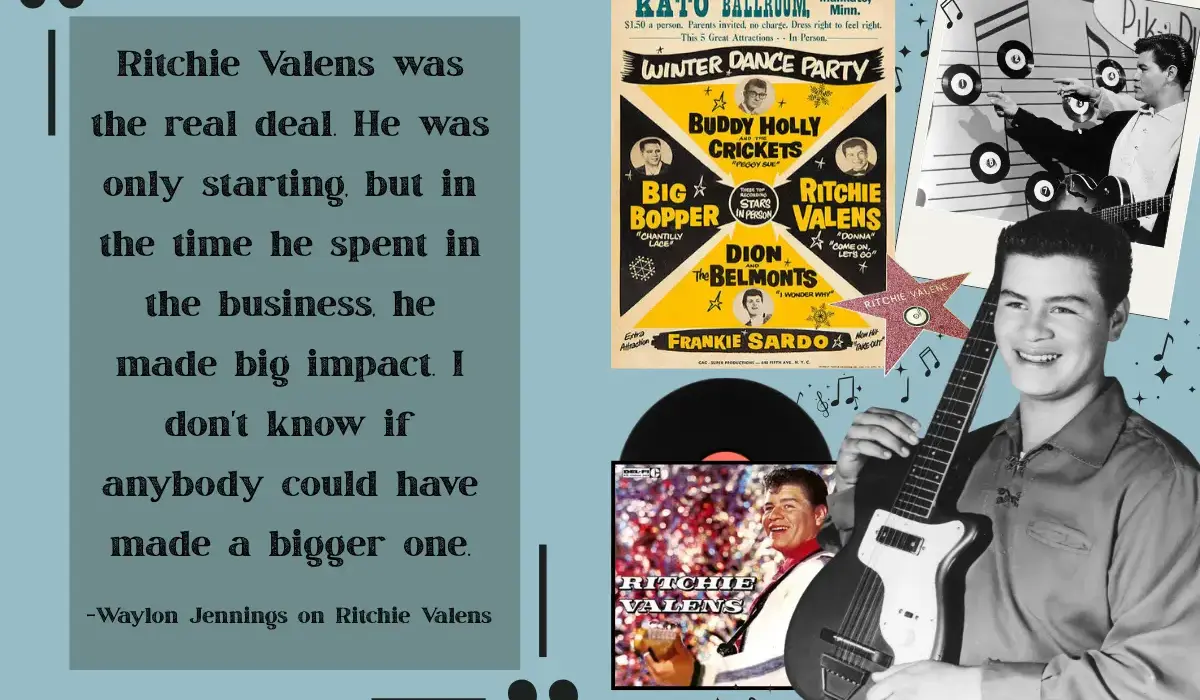
Eager to bring his music directly to fans across the country, Valens signed on to join the grueling Winter Dance Party tour in January 1959. The package tour featured a star-studded lineup of top-tier acts of the era, including Buddy Holly, Dion and the Belmonts, and J.P. "The Big Bopper" Richardson, traveling through the freezing Midwest during the dead of winter.
Ritchie Valens: The Day the Music Died
The grueling reality of the tour reached a tragic climax following a concert at the Surf Ballroom in Clear Lake, Iowa, on February 2, 1959. After the show, the exhausted performers packed their belongings to travel to their next scheduled stop in Minnesota.
Frustrated by the poor conditions of their tour buses—which lacked operational heaters and frequently broke down while navigating treacherous, snowy winter roads—Buddy Holly made the executive decision to charter a small four-seat airplane to take him and members of his backing band to Fargo, North Dakota. The alternative travel arrangement promised a chance to secure warm lodging and much-needed rest ahead of the next performance.
The aircraft had limited seating, accommodating only the pilot and three passengers. According to historical accounts and biographical records, a fateful series of events decided who boarded the flight. Ritchie Valens reportedly won a seat on the plane by flipping a coin against Buddy Holly’s guitarist, Tommy Allsup. Meanwhile, J.P. Richardson, who was suffering from a severe case of the flu, successfully asked to trade places with another original passenger, Waylon Jennings, to secure a more comfortable ride.
The small Beechcraft Bonanza airplane took off into the snowy, predawn darkness of February 3, 1959. It remained airborne for only a matter of minutes before crashing into a remote cornfield just a few miles outside of Clear Lake. The impact killed everyone on board instantly: Valens, Holly, Richardson, and the young pilot.
Later investigations revealed that the 21-year-old pilot, despite having four years of flying experience, was uncertified for instrument-only flying and tragically unaware of worsening weather advisories issued shortly before takeoff.

The news of the sudden and violent crash sent shockwaves of grief across the United States. The tragedy claimed the lives of several foundational architects of early rock and roll, none more so than Valens, who was only 17 years old at the time of his death.
In the wake of the disaster, Valens left behind a remarkably sparse physical archive of studio recordings, but his artistry endured. His self-titled debut album was rushed into production and released shortly after the accident, performing impressively well on the national charts. The historic tragedy would eventually be immortalized in American folklore and popular culture, most notably memorialized as "The Day the Music Died" in Don McLean’s iconic 1971 epic song, "American Pie."
Ritchie Valens: Lasting Impact
Though his career spanned only a matter of months rather than decades, Ritchie Valens’s name, image, and music have remained universally beloved and recognized for generations.
His inspiring, albeit heartbreaking, life story was brought to a massive global audience through the 1987 biographical film La Bamba, written and directed by Luis Valdez and starring Lou Diamond Phillips as Valens alongside Esai Morales as his troubled older brother, Bob Morales.
On the surface, La Bamba serves as a straightforward biographical narrative of Valens’s meteoric rise to stardom. However, the critically acclaimed film runs deeper, exploring complex themes of family bonds, the immigrant experience, and the systemic social barriers and discrimination that Latinos frequently faced in 1950s America.
The movie not only introduced Valens’s timeless music to younger generations of fans who were born long after his passing, but it also emerged as a powerful cultural touchstone for the Latino community. According to the Criterion Collection, by translating Valens’s story into a major mainstream motion picture, Valdez helped forge a pathway for Chicano life and narratives to be welcomed not merely as a niche subculture, but as an integral thread of the broader American fabric.
Today, music historians and cultural critics widely revere Valens as a true godfather of Chicano rock. His posthumous honors reflect his monumental impact on the industry. In 1990, Valens made history by becoming the first Latino rock artist to be honored with a star on the Hollywood Walk of Fame. A little over a decade later, in 2001, he was formally inducted into the Rock & Roll Hall of Fame.
By carving out a path to commercial success during an era when Latino voices were virtually nonexistent in mainstream American popular radio, Ritchie Valens established a foundational blueprint for the generations of musicians who followed him. His enduring legacy continues to resonate through the work of celebrated artists such as Los Lobos, Los Lonely Boys, and Carlos Santana, ensuring that his pioneering spirit lives on in every chord of Chicano rock played today.