









Over the past twenty years, the Institute for Health Promotion Research (IHPR) at UT Health San Antonio has stood at the forefront of a quiet yet powerful transformation in public health, dedicating its mission to improving health outcomes and achieving health equity in South Texas and across the United States. Under the visionary leadership of Dr. Amelie G. Ramirez, the institute has pioneered digital health communications tailored to Latino communities, developed culturally relevant patient navigation models that have saved lives, spearheaded effective smoking and vaping cessation campaigns, and established foundational research into cancer prevention and survivorship.
As the IHPR approaches its 20th anniversary on October 1, 2026, looking back at its journey reveals a legacy of groundbreaking milestones, rigorous scientific inquiry, and deep community partnerships. From publishing the first comprehensive regional health status review to launching national digital networks and multi-state clinical studies, the institute has consistently addressed the unique health disparities facing underserved populations.
IHPR Creates the Salud America! National Digital Communications Program
Just one year after its inception, the IHPR team established Salud America!, a pioneering initiative funded by an initial grant from the Robert Wood Johnson Foundation in 2007. Designed to tackle health disparities affecting Latino populations, it became the nation’s first digital health communication network of its kind. Over nearly two decades of continuous operation, Salud America! has cultivated a robust online network comprising more than 400,000 parents, school administrators, community leaders, and healthcare stakeholders spanning the United States.
The program operates by curating multimedia research, compelling personal stories, and practical tools designed to empower individuals and groups to advocate for systemic and environmental changes. These resources help build environments where Latino families—and all communities—can better live, learn, work, and play. Recent data underscores the tangible impact of these efforts. A recent survey of network members confirms that change-making actions taken within local communities are significantly associated with active engagement in the platform’s communications.

Furthermore, empirical studies published by the team have demonstrated that digital content curation functions as an effective and measurable public health promotion tool for raising awareness and catalyzing action. The program’s reach remains formidable. In 2025 alone, Salud America! curated 162 news stories and 15 role model hero narratives, generating over 2 million impressions across social media channels. During the same period, more than 17,000 advocates downloaded the Health Report Card, an innovative data visualization tool detailing non-medical drivers of health in local areas. Community leaders frequently utilize these report cards for local advocacy, sharing findings with decision-makers and integrating vital data into grant applications.
"Salud America! is truly helping community leaders drive community change for Latinos and all people in the US," Dr. Ramirez noted, reflecting on the program’s enduring legacy.
IHPR Launches First Report Highlighting Specific Disease Issues in South Texas
South Texas, a vibrant and culturally rich region home to approximately 5.2 million residents, has historically faced profound and complex health challenges. Recognizing the urgent need for baseline epidemiological data, the IHPR published its seminal report, the South Texas Health Status Review, in 2008, just two years after the institute’s establishment.
This comprehensive document served as the first thorough statistical illustration of the health burdens impacting residents across the 38-county South Texas region, ranging from chronic conditions like obesity to various forms of cancer. The findings revealed alarming disparities: South Texas Latinos faced a disproportionately greater risk of developing specific malignancies compared to their peers in the rest of Texas and the broader United States. Specifically, the review documented elevated risks for liver cancer by 64%, cervical cancer by 46%, gallbladder cancer by 8%, gastric cancer by 4%, and pediatric leukemia by 32%.

To maintain relevance and track epidemiological shifts, the IHPR updated the landmark review in subsequent years, releasing major updates in 2013 and 2018. According to Dr. Ramirez, this foundational research provided the essential groundwork necessary for the Mays Cancer Center to deliver highly responsive care and tailored scientific research specifically designed for the local population.
IHPR Finds Patient Navigation Speeds Confirmatory Breast Cancer Diagnosis and Treatment for Latinas
Breast cancer remains one of the leading causes of cancer-related mortality among Hispanic women, making timely diagnosis and intervention a critical public health priority. Addressing this urgent need, a series of studies led by the IHPR at UT Health San Antonio demonstrated that providing extra clinical and logistical support—known as "patient navigation"—dramatically improves healthcare trajectories for Latinas who receive an abnormal mammogram result.
In these studies, bilingual patient navigators worked closely with a cohort of 480 Latinas facing abnormal mammograms. Navigators provided comprehensive assistance by accompanying patients to medical appointments, offering vital phone support, arranging reliable transportation, bridging language barriers through translation services, and helping patients navigate complex insurance paperwork.
The clinical outcomes were profound. The intervention significantly shortened the timeline between an abnormal mammogram and the final confirmatory diagnosis, regardless of whether the result was benign or malignant. Moreover, navigated women exhibited markedly higher rates of initiating treatment within critical timeframes compared to control groups. Specifically, 69.0% of navigated women started treatment within 30 days of diagnosis, compared to just 46.3% of non-navigated patients. When extended to 60 days, 97.6% of navigated women had initiated treatment, versus 73.1% in the control group. On average, navigated patients began treatment in roughly 22 to 25 days, while non-navigated patients typically waited between 33 and 46 days.
"Our patient navigation likely saved the lives of many Latinas in the study by reducing the time to diagnosis and start of treatment," Dr. Ramirez emphasized.
IHPR’s Quitxt Program Helps South Texans Quit Smoking
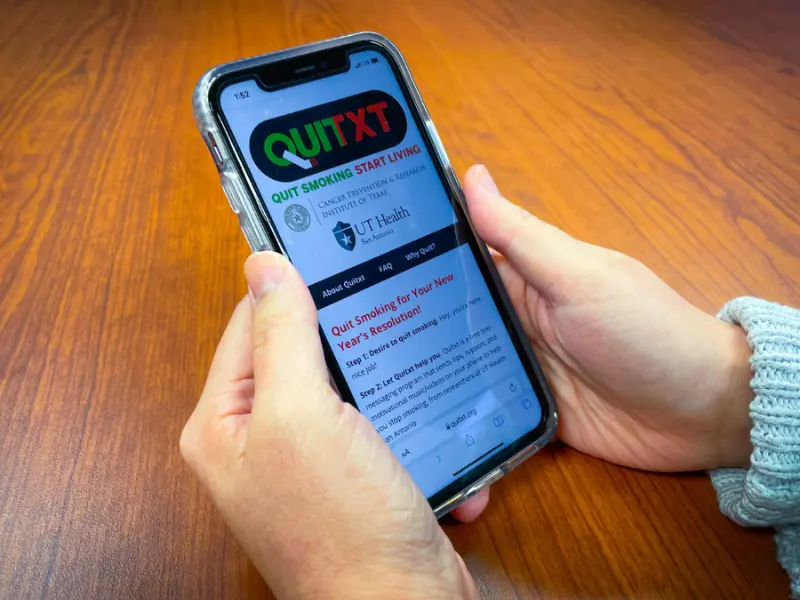
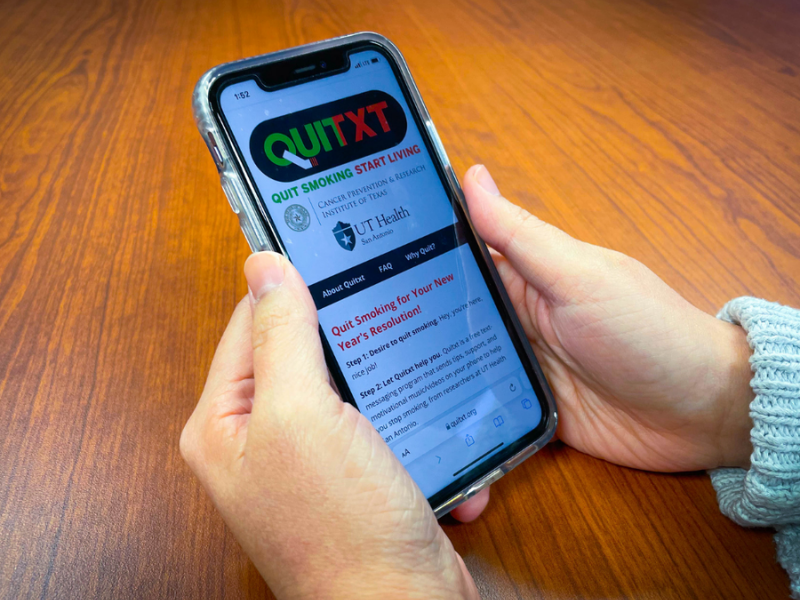
Tobacco use persists as the leading preventable cause of disease and premature death in the United States. To combat this public health crisis among tech-savvy younger populations, IHPR researchers Dr. Amelie Ramirez and Dr. Patricia Chalela designed and launched Quitxt in 2015. Funded initially by the Cancer Prevention and Research Institute of Texas (CPRIT), Quitxt was created as a free, bilingual, evidence-based smoking cessation service leveraging automated text messaging and mobile media platforms.
The initial rollout yielded promising results, achieving a verified 21.4% quit rate among enrollees at a seven-month follow-up assessment. Building upon this initial success, subsequent grant funding enabled the team to expand the program significantly. Quitxt added a specialized vaping cessation component, broadened its recruitment efforts to reach both rural and metropolitan areas across Texas, and integrated direct clinical referrals into tobacco-using patient workflows at the Mays Cancer Center and primary care clinics throughout UT Health San Antonio.
Today, Dr. Ramirez and Dr. Chalela are leading a major CPRIT-funded research grant designed to rigorously evaluate the effectiveness of Quitxt in helping 1,200 Latino smokers successfully quit tobacco use. "From starting up a culturally tailored quit-smoking service to expanding it to a large-scale research study, Quitxt reflects our long-term commitment to empowering young adults with accessible, culturally relevant tools to quit tobacco," Dr. Ramirez stated.
IHPR Establishes First-Ever Conference on Latino Cancer Continuum
Recognizing the vital need for multidisciplinary dialogue around cancer disparities, the IHPR partnered with the Mays Cancer Center at UT Health San Antonio in 2018 to host the inaugural Advancing Cancer Research for Latinos and All Populations (ACRLP) conference. This landmark gathering brought together a diverse group of researchers, clinicians, public health professionals, and community advocates to review the current state of science, identify emerging gaps in clinical care, and foster robust collaborations aimed at reducing the burden of cancer among Latinos and the broader population.
Since its inception, the biennial conference—with events held in 2018, 2020, 2022, 2024, and 2026—has united more than 200 distinguished guest speakers and 1,200 prominent attendees representing the United States, Puerto Rico, and Guatemala. These conferences have consistently generated innovative ideas for clinical research, public health practice, and effective health communication, while showcasing over 400 new scientific studies spanning the entire cancer continuum from primary prevention through long-term survivorship. Organizers have already announced dates for the next ACRLP conference, scheduled for February 23 through 25, 2028.
IHPR Institutionalizes Use of Promotoras de Salud
Throughout its two-decade history, the IHPR has consistently integrated community health workers (CHWs)—including patient navigators and promotoras de salud—into its public health initiatives across South Texas. Guided by Dr. Ramirez in collaboration with IHPR Assistant Director Rebecca Jones and Dr. Patricia Chalela, this community-engaged model has proven essential in bridging the gap between clinical institutions and historically underserved populations.
As trained bilingual and bicultural health professionals, CHWs possess a unique ability to identify barriers to care within local communities, assist individuals in overcoming logistical obstacles, and connect patients directly with essential health resources and social services. Their grassroots outreach has driven tangible results; between 2020 and 2025 alone, CHWs led more than 300 community events, directly educating over 9,347 individuals regarding cancer-related care, screening services, and prevention strategies.

"This initiative has strengthened our capacity to expand community access to relevant educational materials and foster greater participation in clinical research," Dr. Ramirez noted.
IHPR Establishes First Cohort Study on Latino Cancer Survivorship
While medical advancements have driven the number of Latino cancer survivors in the United States to an estimated four million, these individuals frequently encounter complex clinical challenges, including advanced disease stages, diminished quality of life, and stressful socioeconomic pressures. To address this critical knowledge gap, the IHPR co-leads the first national cohort study designed to examine the social, cultural, behavioral, psychosocial, biological, and medical factors influencing post-cancer life among Hispanic and Latino survivors.
Titled Avanzando Caminos (Leading Pathways): The Hispanic/Latino Cancer Survivorship Study, the initiative is supported by a six-year, $9.8 million grant from the National Cancer Institute (NCI). The project unites researchers from the IHPR and the Mays Cancer Center with their counterparts at the Sylvester Comprehensive Cancer Center at the University of Miami. The study aims to recruit and follow 3,000 Latino survivors of breast, colorectal, kidney, lung, prostate, stomach, or cervical cancers across study sites in Miami and San Antonio.
Many survivors have embraced the opportunity to share their personal stories to help future generations, including stomach cancer survivor Yolanda "Yoli" Barrera Day, breast cancer survivor Linda Mota, and prostate cancer survivor Rick Alvarado. "We are learning so much from our survivors that we hope will help future survivors heal, recover, and reduce the chances of cancer coming back," Dr. Ramirez observed.

IHPR Proves Yoga Can Help Cancer Survivors Stay Fit
Exploring accessible and holistic avenues for physical rehabilitation, IHPR researchers Dr. Amelie G. Ramirez and Dr. Daniel Carlos Hughes investigated whether yoga could serve as a viable fitness alternative for breast cancer survivors. Their comparative study divided participants into three distinct exercise groups: one engaging in therapeutic yoga, one participating in traditional gym-based workouts, and a control group maintaining their preferred physical activity levels, with all groups exercising for three hours per week.
The study found that all three exercise approaches yielded comparable outcomes regarding body fat reduction, overall fitness improvements, and restored physical function. These findings suggest that the active engagement in regular exercise behavior is substantially more important for recovery than the specific modality of physical activity chosen. Dr. Ramirez and Dr. Hughes collaborated with Nydia Darby, a San Antonio-based innovator in therapeutic yoga, to expand this work by integrating yoga instruction with comprehensive patient support programs.
Although Dr. Hughes has since retired from active research, the initiative continues to expand. In 2026, Dr. Ramirez and Darby secured a two-year, $400,000 leadership grant from Susan G. Komen to further enhance post-treatment recovery for cancer survivors through a combination of standard physical therapy and therapeutic yoga. "By focusing on the whole person and listening to survivor experiences, we hope to find more effective, culturally responsive ways to support recovery," Dr. Ramirez said.
IHPR Works with Survivors and Advocates to Create a Cancer Research Agenda
Given the elevated regional risks for liver cancer, cervical cancer, and pediatric leukemia in South Texas, establishing patient-centered research priorities remains essential for driving meaningful health improvements. To pave the way for highly responsive scientific inquiry, IHPR researcher Dr. Rebecca Jones spearheaded Creando Conexiones: Creating a Patient Centered Cancer Health Research Agenda in South Texas.
Dr. Jones’s project was designed to outline patient-centered comparative clinical effectiveness research priorities directly identified by South Texas cancer survivors, family caregivers, and local stakeholders affected by these specific malignancies. The culmination of this extensive community engagement effort was the release of the Creando Conexiones Cancer-Related Health Outcomes Research Agenda in 2026, which outlines several priority areas tailored to the distinct needs of cancer patients and survivors across the region.
"The agenda was shaped by survivors and caregivers who said the project played a role in their own healing process, and provided a way to share this experience to help other families navigate their own cancer journeys," Dr. Jones reflected.