










German corporate roots in Argentina run deep, tracing back to the mid-19th century when industrial giant Siemens installed a pioneering telegraph network alongside the country’s expanding railway infrastructure. Over the generations, that footprint has expanded profoundly, establishing a formidable presence across critical sectors of the South American economy. Today, household names in automotive manufacturing—including Volkswagen, BMW, and Audi—alongside heavyweights in chemicals and pharmaceuticals such as Bayer and BASF, anchor the German business community in the region.
Now, a confluence of profound global developments threatens to accelerate this economic integration even further. Recent geopolitical upheavals, most notably Russia’s invasion of Ukraine, the return of Donald Trump to the United States presidency, and persistent, widening conflicts in the Middle East, have forced Berlin and its industrial leaders to reassess their global supply chains and strategic partnerships. For German firms seeking stable democracies and resource-rich allies, Argentina has re-emerged as a compelling destination, with the long-awaited European Union-Mercosur trade deal acting as an additional catalyst for cross-continental collaboration.
The primary focus for these prospective investors lies within sectors deemed vital to the modern global economy: critical minerals, energy, and robust agribusiness. Yet, despite the soaring interest and the alignment of macroeconomic stars, tangible, large-scale investments continue to face persistent domestic headwinds. Chief among these obstacles are political uncertainty lingering on the horizon ahead of the 2027 presidential elections and the ongoing burden of Argentina’s elevated country risk index, which complicates long-term financial planning for foreign enterprises.
Strategic areas for cooperation
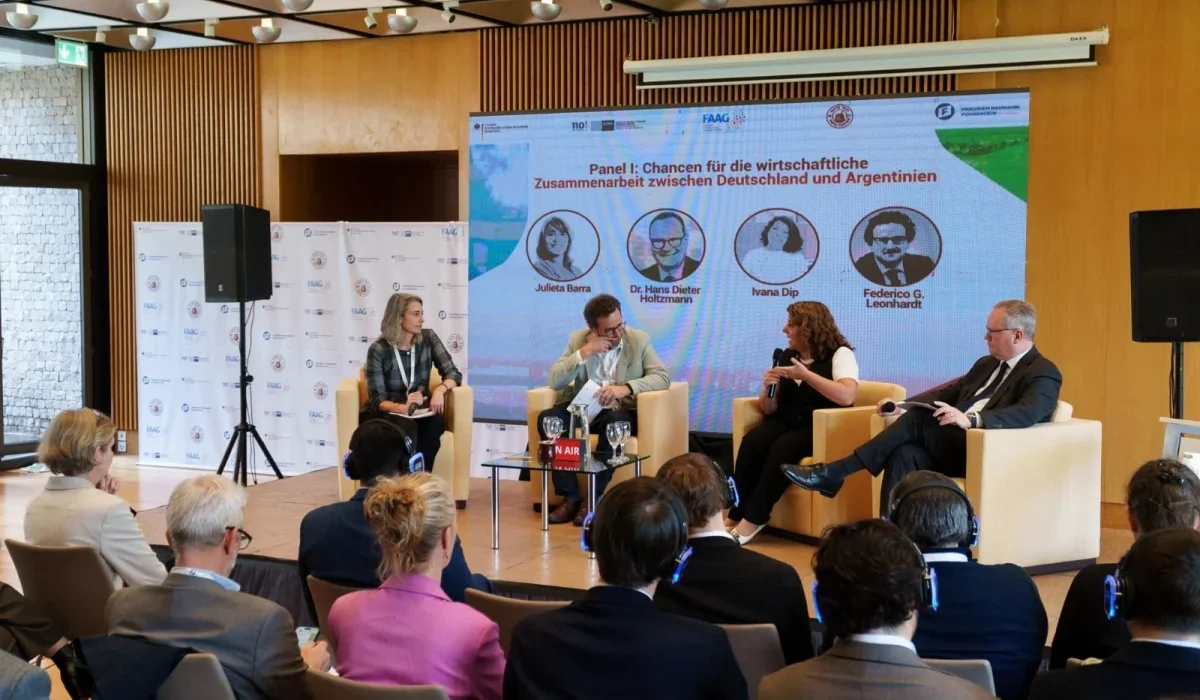
“Argentina has opened up to the world, and I believe good partnerships can emerge from that. It will be one of the central focuses of my work here,” German Ambassador Catalina Cullas remarked during a packed panel event hosted at the German embassy in Buenos Aires, which was attended by the Herald.
German companies, the ambassador noted, are displaying renewed and intense interest, particularly in industries tied directly to mining, energy, and agriculture. Cullas expressed cautious optimism that these vital economic engines could provide a much-needed macroeconomic boost to the broader Argentine economy, creating a ripple effect across domestic markets.
“There is a lot to be done in industrial production, which is where German companies have a lot to offer,” she said, pointing to three distinct macroeconomic and geopolitical factors currently working in favor of strengthening trade relations between Berlin and Buenos Aires.
The first decisive factor, according to Cullas, is the structural opening of the Argentine market and the tangible improvements in key macroeconomic indicators recorded since President Javier Milei assumed office. The second is the urgent strategic interest within Europe—and Germany specifically—to proactively diversify its international investments and supply lines in response to a volatile and unpredictable geopolitical landscape. The third and final factor is the long-stalled EU-Mercosur trade agreement, the trade-only segment of which was finally approved by both regional blocs earlier this year after more than two decades of grueling negotiations.
Despite this favorable backdrop, Ambassador Cullas was careful to acknowledge the significant hurdles that still lie ahead for foreign investors.
“Companies need, of course, predictability; they need to be able to plan. Country risk in Argentina remains high,” she cautioned.
Risks and opportunities
For Julieta Barra, foreign trade manager at the German-Argentine Chamber of Industry and Commerce (AHK Argentina) and a featured speaker at the embassy event, the universal corporate desire for economic stability is a constant thread among business communities, regardless of the host country. German companies operating within Argentina traditionally maintain a distinctly long-term strategic perspective, a mindset forged by the fact that many of these enterprises have maintained continuous operations in the country for more than a century.
“Those that have been here for many years have already experienced many of these ups and downs, and they have teams in the country that are accustomed to finding solutions to these challenges,” Barra told the Herald.
Nevertheless, Barra conceded that operating within a commercial market defined by clear regulatory frameworks and predictable long-term prospects remains an absolute priority for any German firm considering fresh capital deployment.
Asked whether German subsidiaries in Argentina view the influx of competitive Chinese imports as a threat, Barra downplayed the concern, framing it instead as a reflection of broader, irreversible international market trends. Regarding the freshly unblocked EU-Mercosur trade deal, she noted that it remains an open question whether the agreement will successfully unlock doors for product and service segments where the two nations have historically shared limited commercial interaction.
“Germany brings considerable expertise in environmentally important technologies, as well as in energy efficiency, innovation, automation, and digitalization,” Barra explained.
In her view, this deep technological reservoir could assist Argentine industry in making the critical productive leap it desperately requires following the recent opening of its domestic market to foreign competition.
In search of new partners
For Hans-Dieter Holtzmann, Southern Cone project director at the Friedrich Naumann Foundation, Germany’s pivot toward new international alliances is driven by an unavoidable reality: escalating geopolitical volatility and the severe economic challenges it generates for a manufacturing-reliant nation. He argued that the traditional post-Cold War economic model—in which the United States guaranteed Germany’s military security, China purchased its luxury and industrial vehicles, and Russia supplied cheap, abundant natural gas—has effectively collapsed.
“We have become too dependent on the unpredictable shifts in the United States,” Holtzmann asserted, adding that the German economy remains dangerously vulnerable to potential economic coercion by China, even as it continues to rely heavily on Chinese industrial inputs.
“This is especially true when it comes to the supply of raw materials and rare earths,” the economist explained.
This structural vulnerability intensifies the imperative for Germany to cultivate new international allies, a dynamic that goes a long way toward explaining Berlin’s growing diplomatic and commercial engagement with Argentina. Turning to the energy sector, Holtzmann pointed out that Germany had previously grown to depend far too heavily on Russian fossil fuels, leaving its domestic economy exposed.
“Companies and citizens are paying the price through extremely high energy costs, which affect Germany’s competitiveness and households,” he said.
The ongoing armed conflict in the Middle East, compounded by what he characterized as past misguided policy decisions in European energy planning, has only deepened Germany’s long-term energy-security vulnerabilities. Within this challenging context, Holtzmann highlighted a recent bilateral energy agreement signed between Germany and Argentina as a notably positive sign. The pact secures the supply of two million tons of liquefied natural gas (LNG) over an eight-year period, with the first commercial deliveries anticipated to commence by the end of 2027.
“It is good for Germany in terms of diversification, but it also gives Argentina the opportunity to become a kind of gateway and build trust, precisely when it comes to its ability to supply energy,” he observed.
Holtzmann concluded that Argentina’s vast reserves of raw materials, paired with Germany’s advanced industrial technology, represent a deeply complementary economic model capable of fostering mutually beneficial, long-term trade relations.
“It is not just about exporting raw materials, but also generating added value here and creating local jobs,” he emphasized.