









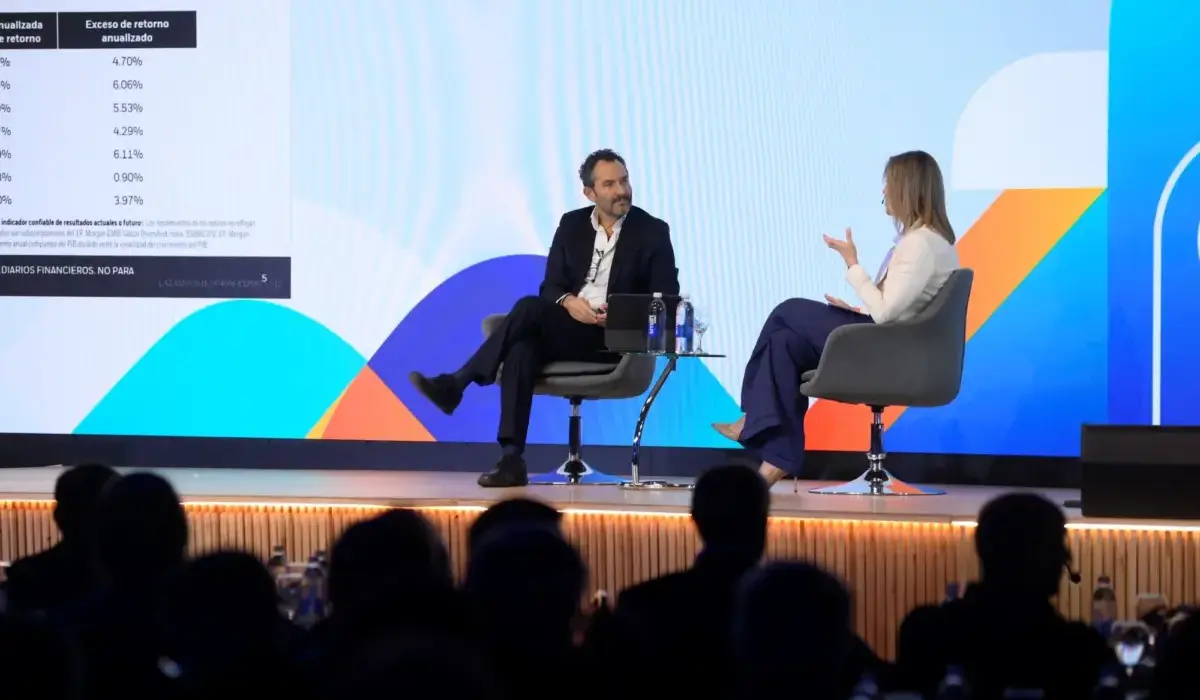
MAR DEL PLATA — Argentina’s primary economic hurdle is not a lack of underlying growth potential, but an enduring and paralyzing lack of stability. That was the central message delivered by Pablo Goldberg, a senior executive at BlackRock, during a high-profile address to business leaders at the IDEA Colloquium.
Speaking alongside Ana Cohen, IDEA treasurer and Grupo Cohen managing partner, Goldberg offered a blunt assessment of how international capital markets view South America’s second-largest economy. Until the nation can fundamentally rein in its chronic volatility, it will continue to be viewed through the lens of short-term speculation rather than enduring investment.
"Until Argentina manages to lower its volatility, it will remain a ‘trade,’" Goldberg said, employing the financial vernacular for high-risk, high-reward plays that invite rapid capital inflows followed by swift exits.
Goldberg, who currently serves as the head of Emerging Market Debt Research at BlackRock—the world’s largest asset manager—has monitored Argentina’s macroeconomic trajectory from abroad for a quarter of a century. When pressed during the panel discussion on whether the country represents a viable short-term bet or a permanent destination for institutional portfolios, he pointed squarely to its turbulent track record. Until that historical volatility changes, international capital will continue to treat the nation as an opportunistic swing trade rather than a place to settle long-term capital.
The Weight of the Past
To illustrate Argentina’s structural dilemma, Goldberg utilized the Sharpe ratio, a standard financial metric that measures return per unit of risk. When applied to sovereign economies, this analytical tool divides a nation’s growth rate by its macroeconomic volatility.
Goldberg originally presented this risk-return exercise back in 2011, with then-President Cristina Fernández de Kirchner seated in the front row. At that time, Argentina stood apart as an outlier, holding the worst risk-return ratio among a field of 60 evaluated countries. Revisiting the model, Goldberg noted that the nation’s relative standing has only deteriorated further. Following a succession of sovereign debt defaults over the intervening years, Argentina now ranks stubbornly among the worst long-term performers across emerging market bond indexes.
"That history stays in the memory," Goldberg observed, emphasizing that global investors do not easily forget repeated credit events.
To further contextualize the paradox, Goldberg examined Moody’s current breakdown of Argentina’s sovereign credit rating, comparing the country against peers sharing the exact same grade: Nigeria, El Salvador, and Ecuador. Looking purely at baseline economic, institutional, and structural fiscal strength, Argentina’s underlying metrics would comfortably qualify it for coveted investment-grade status. Yet, its turbulent historical track record acts as a persistent anchor.
"The past condemns you in some way," Goldberg remarked, pointing to how historical defaults continue to outweigh current metrics in the eyes of risk committees.
This structural impediment is further compounded by elevated domestic political risk and the chronic underdevelopment of a deep local capital market. Because domestic savings cannot reliably absorb sovereign debt issuance in local currency, the Argentine state is repeatedly forced to borrow abroad, assuming liabilities denominated in U.S. dollars while collecting its tax revenues in pesos—a currency mismatch that has historically triggered severe fiscal crises.
What Global Investors Look For
When asked by Cohen how many political cycles investors need to witness before placing genuine trust in Argentina’s economic project, Goldberg deflected the question of a specific timeline, offering instead a fundamental behavioral criterion.
"If locals don’t trust it, why should I?" he asked the audience of business leaders.
He explained that across successive political and economic cycles, ordinary Argentines routinely seek refuge in U.S. dollars well ahead of elections, converting their pesos to hedge against potential devaluation or policy shifts. If domestic actors systematically look for shelter from their own currency and policy framework, international investors will naturally follow the same defensive instinct.
True institutional credibility, in Goldberg’s view, cannot be manufactured through regulatory declarations alone; it requires a alignment between rules written on paper and consistent actions that prove those rules are respected over time. Crucially, this includes maintaining transparent, reliable official statistics. He pointed directly to past legal battles surrounding Argentina’s GDP-linked warrants, a high-stakes controversy tied explicitly to historical disputes over how national economic growth was measured.
Despite these deep-seated hurdles, Goldberg did acknowledge a notable cultural shift taking place within the country: a growing domestic consensus that large fiscal deficits can no longer be sustainably financed by simply printing money.
When international companies evaluate potential destinations for capital allocation, Goldberg explained, the evaluation process begins with geography. "The postal code" matters immensely, as sovereign country risk acts as an absolute ceiling on corporate creditworthiness and borrowing costs. Beyond the location, institutional investors search for predictable hard-currency revenues—or at least reliable, unencumbered access to foreign exchange markets to service debt coupons—backed by a stable legal framework.
"The best thing that can happen to us is to buy a bond and forget about it," he noted, summarizing the passive mindset of global fixed-income portfolio managers.
However, attracting that capital has become intensely competitive on a global scale. With global interest rates remaining elevated and massive technology conglomerates absorbing unprecedented volumes of financing to build out artificial intelligence infrastructure, Goldberg pointed out that Argentina is no longer just competing against regional peers. Today, its sovereign debt is competing directly for capital against corporate giants like Meta, Google, and Amazon.
The Investment-Grade Prize
Securing an upgrade to investment grade would represent a transformative milestone for the country. Investment-grade sovereign borrowers typically pay a risk spread of less than 200 basis points over U.S. Treasury bonds, a stark contrast to Argentina’s current spread hovering around 600 basis points.
Because the mathematical curve linking credit ratings to country risk is exceptionally steep at the lower end of the ratings spectrum, even modest improvements in credit standing can sharply compress financing costs for both the state and private-sector corporations. Furthermore, Goldberg estimated that achieving investment grade would nearly double Argentina’s weighting within major global bond indexes, triggering automatic inflows from passive institutional funds.
Recent improvements in the country’s current account balance—propelled by surging activity in the energy, mining, and agricultural sectors—provide a strong foundational tailwind. However, Goldberg reiterated the necessity of rebuilding a robust domestic capital market to insulate the economy from external shocks. Playing on an old market adage from the 1990s Tequila crisis era when it was said that Argentina was not Mexico, Goldberg quipped that he would now very much like to see Argentina emulate Mexico, with its hard-won investment-grade status and deep domestic market liquidity.
As models for sustainable development, he pointed to Peru, which has successfully weathered severe domestic political crises without sacrificing macroeconomic stability, and Uruguay, where successive administrations change hands peacefully while fundamental economic rules remain entirely non-negotiable across party lines.
"Reduce the volatility of output and not recklessly encourage growth," was his core piece of advice for policymakers seeking to permanently alter the country’s trajectory.
Asked whether he detects a tangible uptick in international interest toward Argentina among his industry peers, Goldberg answered in the affirmative. In a global landscape where investors are desperately searching for reliable energy supplies, low geopolitical risk, and macroeconomic predictability, Argentina is uniquely positioned to deliver on the first two fronts.
"I do think it has to work on the last one," he concluded.