









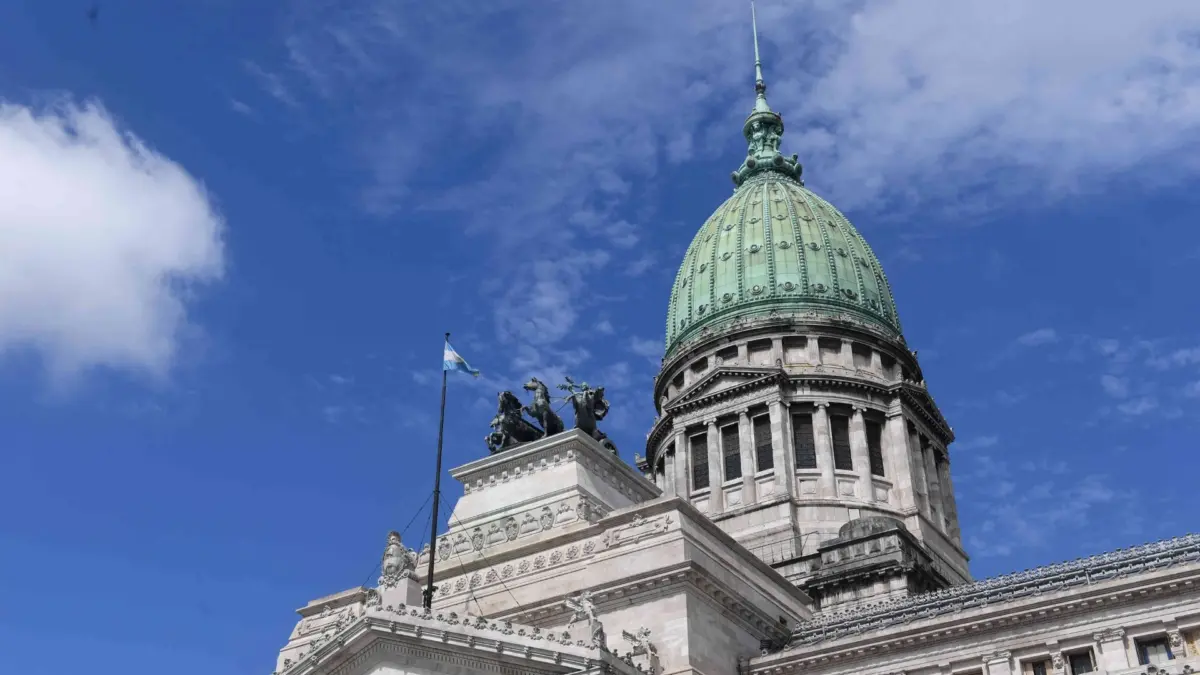
BUENOS AIRES — The Argentine Senate has given final approval to a sweeping package of modifications to the government’s “Fiscal Innocence” law, a critical legislative push spearheaded by President Javier Milei and Economy Minister Luis Caputo. The newly overhauled framework is designed to incentivize millions of Argentines to reintroduce their undeclared savings—traditionally held in cash or stashed away outside the country—back into the formal domestic financial system. By lowering regulatory barriers, offering enhanced tax benefits, and reducing supervisory oversight, the administration hopes to unlock billions of dollars to fuel national economic growth.
The legislation cleared the upper house late Thursday night following a decisive debate, securing 44 votes in favor and 23 against. The bill drew crucial legislative support not only from Milei’s ruling La Libertad Avanza party but also from key congressional allies, including the PRO and UCR blocs, alongside several smaller provincial factions. The Senate’s green light follows the Lower House’s passage of the amended text in late August, marking another significant legislative win for the administration’s broader economic reform agenda.
The original iteration of the Fiscal Innocence law was enacted last December as a cornerstone of Minister Caputo’s economic strategy. That initial framework raised the legal thresholds for tax evasion and introduced the foundational principle of innocence into tax enforcement. This mechanism was structured to shield everyday citizens from punitive measures if they chose to deposit their previously undeclared savings into domestic banks without being forced to provide exhaustive documentation regarding the historical origin of those funds.
However, despite the administration’s high ambitions, initial enrollment figures fell notably short of government projections. Savers remained wary of potential future bureaucratic complications or retroactive tax penalties. Recognizing the need to build greater confidence and inject liquidity into a starved banking sector, President Milei and Minister Caputo returned to Congress with a package of deeper tax incentives and structural adjustments, culminating in the updated legislation informally dubbed "Fiscal Innocence II."
Following the Senate vote, presidential spokesperson Adrián Ravier underscored the strategic importance of the legislative upgrade.
"The bill maintains the spirit of the current regime and incorporates technical amendments, developed in collaboration with tax specialists, to strengthen legal certainty and give Argentines greater confidence in putting their savings to work," Ravier stated. He added a broader economic appraisal of the initiative: "With clear rules, savings return to the formal economy and are transformed into credit to finance Argentina’s growth."
Independent economic estimates frequently cite that Argentine citizens hold an immense volume of capital outside the formal financial apparatus—with government estimates hovering around US$170 billion stashed away in mattress savings, safety deposit boxes, or foreign accounts. By easing compliance burdens, the administration hopes to coax a substantial portion of this capital into local credit markets to stimulate investment and business development.
Alongside the Fiscal Innocence reforms, the Senate also approved a separate reform to the nation’s biofuels law. This concurrent measure stands to directly benefit agricultural provinces specializing in the production of sugarcane, corn, and soybeans. By raising mandatory blending levels for both bioethanol and biodiesel while establishing a structured transition period for non-integrated companies, the biofuels bill aims to revitalize regional industrial output. That particular measure must now return to the Lower House for final consideration before officially becoming law.
The Main Changes to Fiscal Innocence
The newly modified Fiscal Innocence framework institutes a fundamental shift in how personal income tax and asset declarations are handled by regulatory authorities. Under the updated regulations, taxpayers are no longer required to file exhaustive statements of assets at either the beginning or the conclusion of a tax year. Instead, tax enforcement bodies must operate under the legal presumption that the individual is acting in good faith and is not engaging in tax evasion.
Under the revised parameters, the national tax authority, ARCA, is mandated to presume that assets declared for the 2025 fiscal year are fully in order, while also accepting tax declarations from 2024 and 2023 as valid baseline documents. Should ARCA harbor suspicions that a specific taxpayer is actively evading obligations, the burden of proof rests squarely on the state; the agency must actively prove wrongdoing rather than placing the onus on the citizen.
While Minister Caputo originally introduced the concept as a permanent structural fixture designed to allow the permanent formalization of hidden assets without regulatory risk, the finalized law establishes a definitive operational deadline. The amnesty and simplified regime will remain open until December 31, 2027, giving savers a multi-year window to regularize their positions.
Another notable structural adjustment broadens the scope of the Simplified Income Tax Regime initially established last December. Under the new rules, large taxpayers whose annual incomes exceed AR$1 billion—roughly equivalent to US$653,600—or whose net worth surpasses AR$10 billion, calculated at approximately US$65,359,400, are now permitted to enroll in the simplified system.
However, high-net-worth participants in this elevated bracket will not receive the blanket presumption of correctness regarding their previous income statements, leaving them subject to closer routine audits and reviews by financial regulators.
To prevent minor accounting discrepancies from triggering aggressive legal action or discouraging participation, the law places strict boundaries on what ARCA can classify as a violation. The agency can only officially declare the existence of a "significant discrepancy" between a taxpayer’s filed returns and internal regulatory databases if a numerical difference of at least 15% is detected, provided that discrepancy also represents 5% or more of the threshold legally defined as tax evasion under the Criminal Tax Law. In practical terms, this trigger represents roughly AR$5 million, or about US$3,200.
If a taxpayer’s discrepancy exceeds that specific monetary boundary, they are required to amend their tax return and pay the corresponding tax balance alongside applicable interest. Crucially, even in these instances of adjustment, the taxpayer retains the core structural protections and benefits of the broader tax regime rather than facing immediate criminal referral.
The regulatory scheme also significantly scales back mandatory reporting requirements concerning personal assets and everyday expenditures. However, the legislation incorporates strict conflict-of-interest exclusions for high-ranking public servants. Lawmakers, federal judges, and executive branch officials—explicitly including the president himself—are barred from utilizing the benefits of the simplified income system.
Furthermore, the updated law places strict limitations on political participation in the tax amnesty. It formally prohibits current public officials, as well as individuals who have held public office at any point during the preceding five years, from enrolling in the system. This marks a notable pivot from the original version of the law, which initially permitted public officials to access the regime and claim its benefits—a provision that had seen several members of the ruling La Libertad Avanza coalition take advantage of the mechanism in previous months.
With the Senate’s final approval secured, the revised modifications to the Fiscal Innocence law now await formal enactment by the executive branch before entering into full legal force across the country.