









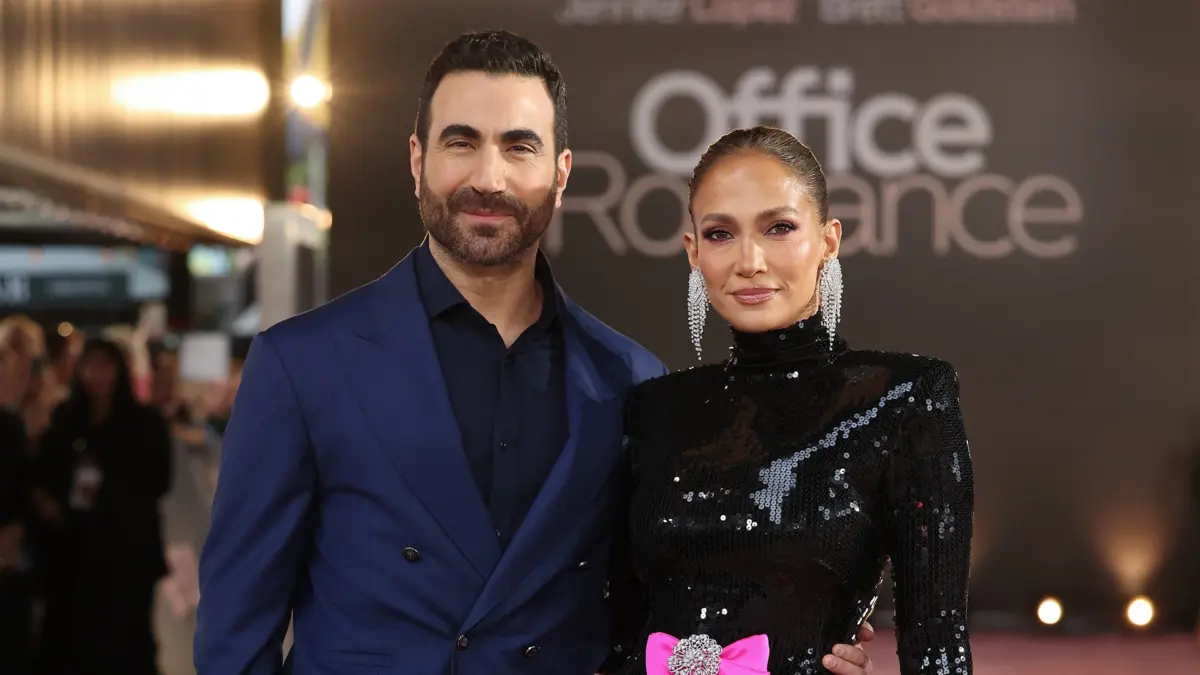
Jennifer Lopez and Brett Goldstein generated intense speculation about their on-screen chemistry while promoting their Netflix romantic comedy, Office Romance, leading to widespread rumors throughout the film’s press tour that they had translated their fictional connection into a real-life romance.
In June, the co-stars appeared on NBC’s Today program, where Goldstein acknowledged that he had written the film specifically with Lopez in mind. Show host Savannah Guthrie highlighted the romantic undertones of the project and noted that Lopez had previously singled out Goldstein as her "best kisser" among all her co-stars during an appearance on Andy Cohen’s Watch What Happens Live. While both actors denied they were romantically involved, exchanging smirks and nervous giggles during the interview, their denials were met with widespread skepticism from fans and media observers alike, drawing inevitable comparisons to the intense promotional buzz surrounding Bradley Cooper and Lady Gaga during the release of A Star Is Born.
Now, months after the press tour concluded and the film debuted on the streaming platform, Page Six reports that Lopez and Goldstein may indeed be casually dating. The pair were recently spotted leaving a Los Angeles party together in the same vehicle. Thus far, neither Lopez, Goldstein, nor their respective representatives have issued any official confirmation regarding the status of their relationship. Nevertheless, the latest sighting has immediately reignited public fascination and fueled widespread speculation across social media platforms regarding a potential off-screen romance.
This recurring cycle highlights a deeper cultural tendency to scrutinize women’s romantic lives through a uniquely demanding lens. The persistent narrative surrounding Lopez underscores a broader societal expectation that women must approach every single relationship with a man as if he is "the one." This persistent double standard unfairly expects women—particularly Latinas, regardless of age—to validate their worth by demonstrating that every new romantic connection will culminate in marriage, an expectation that is rarely, if ever, imposed upon men.
At 57 years old, Lopez has established a prominent career, raised two children, and experienced four marriages and divorces. Having navigated a very public life, she has undoubtedly accumulated significant personal insight. While there is no definitive indication of where her connection with Goldstein might lead, the immediate cultural assumption that a new relationship must signify a permanent commitment overlooks the possibility of casual dating and mutual exploration. Following her highly publicized divorce from Ben Affleck, public sentiment often projects a need for Goldstein to serve as her next permanent partner, a notion that places an unnecessary and exhausting burden on her personal life.
Society frequently treats a woman’s romantic history as an absolute reflection of her judgment, self-worth, and personal growth in a manner that rarely applies to men. Although Lopez’s romantic milestones form a visible part of her public profile, using every new social connection to question whether she has learned from her past or made poor choices in partners diminishes her autonomy. Furthermore, it reinforces the outdated notion that a woman must prove her value by ensuring her next relationship results in a lasting union.
Cultural expectations, particularly within many Latin American communities and families, continue to exert pressure on women to find enduring love. While younger generations, including Gen Z, have experienced greater cultural leniency, many millennials, Gen Xers, and older generations were raised under traditional ideals surrounding female respectability and unmarried status. Historically, terms addressing unmarried women carried heavy cultural connotations tied to virtue, modesty, and sexuality. Within numerous traditional family structures, a woman’s social standing and perceived value were frequently linked to maintaining modesty and reserving intimacy exclusively for marriage.
These entrenched viewpoints stem from historical frameworks of machismo and patriarchy. Although societal attitudes have evolved, women continue to face subtle and overt pressures to protect their reputations, avoid perceived promiscuity, and select only partners who align with traditional notions of marriage. A woman who navigates multiple relationships—even serious ones—is often expected to express regret or introspection regarding her choices.
Conversely, a man with a comparable romantic history is typically viewed through a lens of positive reinforcement, seen as experienced, worldly, or simply taking his time before deciding to settle down. Men who engage in casual dating are frequently characterized as independent, confident, and sought-after, with society readily offering excuses for successful men who delay permanent commitment. Meanwhile, an accomplished, successful, and financially independent woman like Lopez is frequently subjected to persistent public fascination regarding why she has yet to secure a permanent relationship, as though her multifaceted success remains incomplete without a husband.
The termination of a marriage or relationship does not constitute a personal failure. Lopez’s past marriages and divorces do not obligate her to prove her personal growth or worth by turning her next romance into a permanent institution. If her connection with Goldstein is entirely casual, it represents a valid personal choice to explore a dynamic that brings her excitement and companionship. Women retain the fundamental right to pursue romantic connections, chemistry, and mutual pleasure without the burden of long-term predictability.
Society routinely permits men to treat dating as a distinct, exploratory phase of life while demanding that women treat romance as a linear path toward a permanent destination. A man may openly state that he is not ready for commitment or wishes to focus on himself without facing deep psychological interrogations about his character. Yet women who make identical choices are frequently met with invasive inquiries regarding commitment phobia, pickiness, or unresolved personal issues. As women advance through various decades of life, these judgmental inquiries often intensify, demanding explanations for why they have not conformed to traditional domestic milestones.
These restrictive norms are frequently reinforced not only by external societal pressures but also through internalized conditioning. Women have often been taught to view their romantic and sexual decisions as foundational indicators of their moral character. At the same time, legitimate material and social concerns—such as the disproportionate risks of physical safety, reproductive consequences, unequal emotional labor, and reputational double standards—mean that women must navigate the dating world with heightened caution compared to their male counterparts.
These persistent double standards often manifest in subtle social behaviors, such as how adults discuss their romantic histories as metrics of personal restraint or virtue. While personal preferences regarding intimacy and celibacy are entirely valid choices when grounded in individual comfort rather than external validation, they should not be weaponized to police the autonomy of others. True solidarity among women does not require uniformity in lifestyle choices or personal standards.
Lopez owes neither the public nor herself a successful marriage to validate her personal journey or to prove that she has "figured out love." She is fully entitled to seek companionship, passion, and chemistry on her own terms, whether those connections span a single season or a lifetime. As public figures continue to navigate the intersections of fame, personal growth, and enduring cultural expectations, the freedom to experience romance without the weight of perpetual scrutiny remains an essential pursuit.