






An artist’s signature style can express their identity and music before they sing a single note. A rhinestone bustier, a leather newsboy cap, and high-waisted pants with a studded belt might immediately bring to mind the voice behind “Bidi Bidi Bom Bom.” In a similar fashion, statement sunglasses, painted nails, and a dynamic mix of gender-fluid silhouettes evoke the unmistakable presence of Bad Bunny. Throughout the history of modern popular music, visual presentation has served as an essential extension of an artist’s sonic universe.
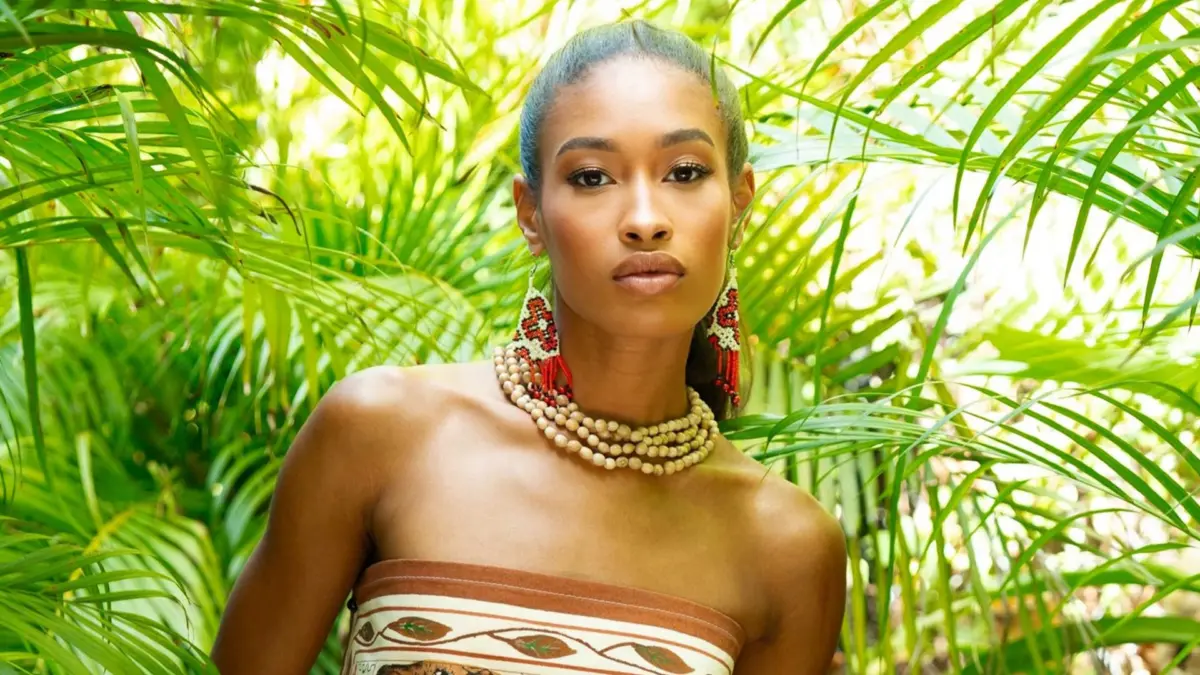
For Los Mirlos, a legendary psychedelic cumbia band hailing from Moyobamba, Peru, coordinated green, white, and orange ensembles featuring vibrant Amazonian motifs are just as recognizable as their signature guitar-driven tropical sound. Their latest visual era takes this commitment to cultural representation even further, featuring intricate embroidery and traditional Kené prints crafted in collaboration with the sustainable fashion brand Kené Kaya. Founded by Peruvian designer Alessandra Durand, the brand works hand in hand with master artist Olinda Silvano and her Shipibo-Konibo community through the Shinan-Imabo Collective, ensuring that ancestral artistry takes center stage on international platforms.
This powerful intersection of music, fashion, and Indigenous preservation was on full display during the band’s debut appearance on NPR’s renowned Tiny Desk concert series. For the intimate performance, Los Mirlos paired their custom-tailored ensembles with a meticulously curated set design that successfully brought the rich, immersive artistry of the Peruvian Amazon directly into the studio space.
As Jorge Rodríguez Grández, a founding member of Los Mirlos, explains, the visual storytelling is deeply rooted in a desire to educate and connect audiences with a region that remains unfamiliar to many. "Many people aren’t familiar with the jungle, including some people in Peru, especially if they’ve never had the opportunity to travel there," Rodríguez notes. "They may know it from movies, videos, or books, but it’s a completely different experience actually to be in that environment. We try to recreate some of that so that people who’ve never experienced it firsthand can feel the essence of the jungle when they look at us and can imagine where our music comes from."
The Tiny Desk set was rich with symbolic details carefully chosen to honor the band’s roots. Flowers placed delicately on the microphones served as a direct tribute to Moyobamba, widely celebrated as Peru’s "City of Orchids." Furthermore, the performance space featured ceramics adorned with geometric Kené patterns, handcrafted sculptures depicting Amazonian jaguars and monkeys, and a moving poetry tribute dedicated to environmental activists who have tragically lost their lives defending Amazonian lands and ancient forests.
Rodríguez elaborates further on the motivation behind the collaboration, emphasizing the profound respect the band holds for the region that inspires their catalog. "Since our songs and instrumentation pay homage to the jungle, we wanted to honor Amazonian Indigenous craftsmanship during our Tiny Desk performance through custom outfits featuring fabrics by Kené Kaya and the Madres Artesanas of the Shinan-Imabo Collective," he says.
Alessandra Durand, the visionary behind Kené Kaya, has spent more than eight years building deep, collaborative relationships with Shipibo-Konibo artists. Her work is defined by a horizontal, nonhierarchical approach designed to protect, preserve, and amplify cultural heritage rather than extract from it. By bridging ancestral techniques with contemporary fashion, Durand translates hypnotic geometric patterns into modern silhouettes ranging from tailored suits and ties to contemporary skirts and dresses.
Over the years, these distinctive garments have traveled seamlessly from high-fashion runways to major international concert stages and prestigious award shows. The label’s cultural significance has even earned official recognition from Marca Perú as an integral part of the country’s living cultural patrimony. Through their ongoing partnership with Los Mirlos, Kené Kaya’s creations have been showcased on massive global platforms, including the band’s historic performance at the Coachella Valley Music and Arts Festival and at Premio Lo Nuestro, where their elaborately embroidered suits and ties quickly landed them on international best-dressed lists.
Detailing the collaborative creative process behind these striking garments, Durand emphasizes mutual respect and artistic dialogue. "Our creative process is a dialogue rather than imposing one person’s vision," she explains. "We aim to preserve the Shinan-Imabo collective’s artistic identity while also maintaining what the music band is known for."
Because Los Mirlos first emerged in the 1970s during the golden age of tropical cumbia, Durand and her team designed specific vintage-inspired touches, such as elongated collar tips, combined with contemporary Kené embroidery designed to stand out vividly during television and camera close-ups. "Every member wore a representation of the Amazon’s ayahuasca flower on their chest, but no two were exactly alike since the artisans brought their own interpretations to each embroidery," Durand adds.
This cooperative, respectful framework directly reflects Durand’s unwavering commitment to the creative autonomy of the Shipibo-Konibo community. This includes recognizing and defending the community’s legal right to control how its traditional intellectual property is utilized, as well as ensuring that participating artisans receive fair, equitable compensation for their labor.
Such ethical standards are critically important in an industry where Indigenous designs are frequently appropriated without informed consent or financial compensation—a troubling issue mirrored in the broader political sphere, where government officials occasionally attempt to co-opt Indigenous cultural heritage while remaining implicated in local violence and territorial displacement.
Beyond high-profile music stages, Kené Kaya’s dedication to community empowerment extends to grassroots initiatives, such as their recent work with the Ucayali Shipibo FC girls’ fútbol team. During the World Cup, the brand launched a special jersey collection specifically designed to increase visibility and support for the young athletes, with 20% of all proceeds directly funding the team’s endeavors and athletic programs.
Reflecting on the broader impact of this representation, Durand expresses deep optimism for the future. "When younger generations from the community see their culture represented, it creates a sense of pride that helps preserve these art forms," she enthuses. "I think seeing Kené in different formats inspires them to find their own creative ways of expressing it, which can also motivate generations of designers and artisans to launch their own brands, which is exciting to see."
For master artist Olinda Silvano, the journey of cultural preservation is deeply personal. Silvano left her native Paoyhan community located along the Ucayali River when she was just a teenager, eventually settling in Lima’s historic Cantagallo neighborhood. There, she has spent decades tirelessly championing the rights, art, and well-being of her Shipibo-Konibo community through traditional artistic creation, singing, ancestral healing, and grassroots activism alongside the members of the Shinan-Imabo collective.
Speaking about the vital importance of international partnerships and visibility, Silvano shares her perspective on the collective’s mission. "We want to bring more visibility and opportunities to our community," she tells Hip Latina. "We love to participate in fairs and showcases around the world because selling our art is our source of income, which allows us to support our families with education, healthcare, and food, especially when many suffer from illnesses like diabetes. It’s important that the people we work with also speak about us and help open doors to international opportunities for us as artisan mothers."
For Silvano and her fellow artisans, every single embroidered and printed garment carries a tangible piece of the Amazonian ecosystem. According to the traditions surrounding Kené, the intricate patterns and the creative process generate a healing, protective energy imbued with the spiritual essence of sacred Amazonian medicinal plants, including ayahuasca and priri priri.
Reflecting on the recent collaboration with Los Mirlos, Silvano notes that it was a profound honor for the collective to craft the custom stage outfits for the beloved musicians. "We bring our talent and inspiration to our embroidery, which is made with so much love," she says.
"We hope Los Mirlos consider us family, just as we consider them our brothers from the Amazon," Silvano concludes. "Kené is a marvelous art form, and as Indigenous women, we value working with Alessandra Durand, who recognizes our hard work in the designs we create with Kené Kaya."