








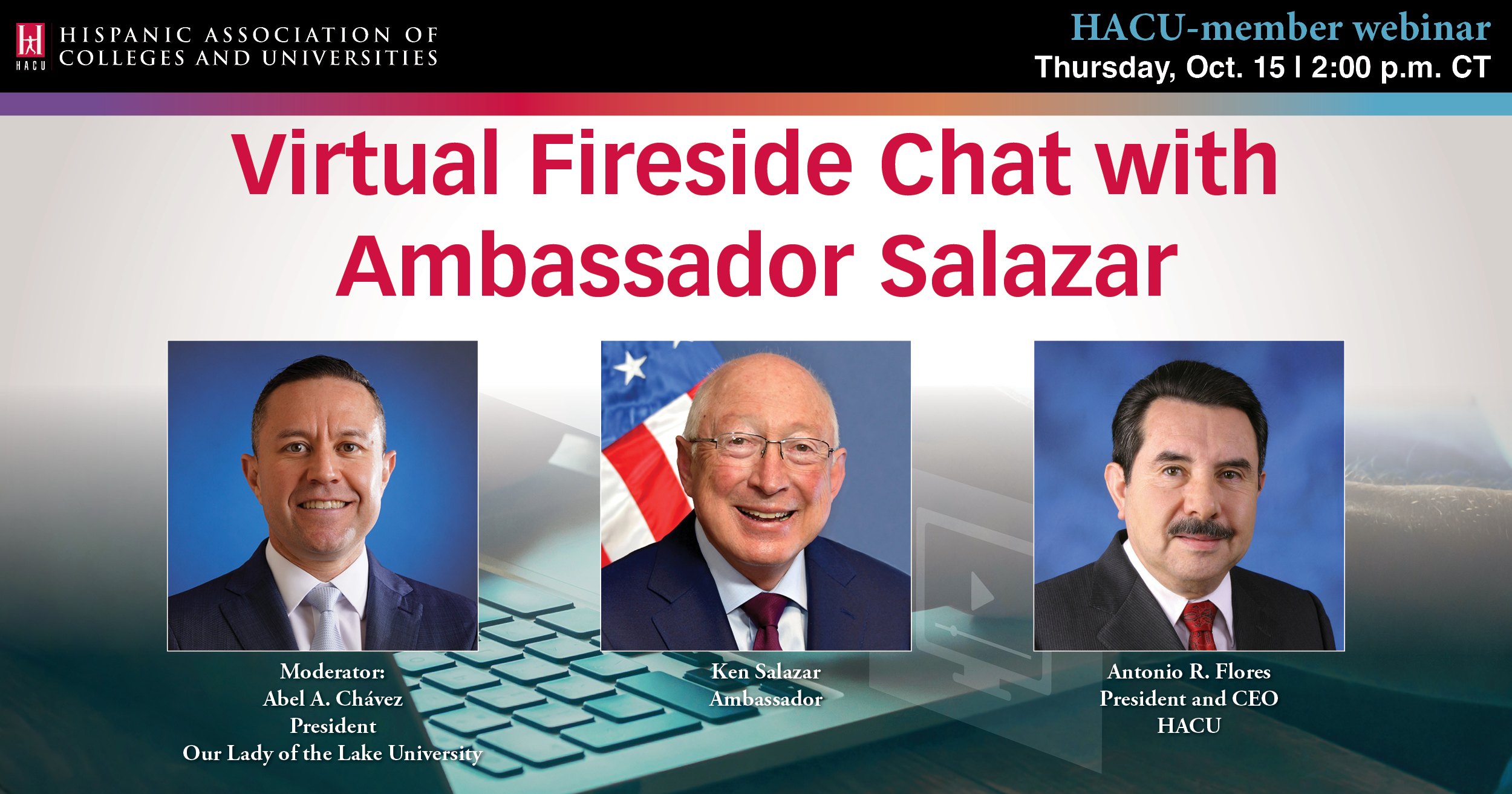
The Hispanic Association of Colleges and Universities (HACU) recently convened an engaging and far-reaching virtual dialogue, hosting Ambassador Ken Salazar for a special fireside chat on October 15, 2026. The event brought together educators, students, and leaders from across the nation to discuss themes of leadership, civic engagement, public service, and the ongoing creation of a more inclusive American society.
At the center of the conversation was Salazar’s newly released book, Borderlands: My Fight for an Inclusive America, a work that reflects upon a lifetime of groundbreaking public service and the foundational experiences that shaped his journey. The virtual session was spearheaded by HACU President and CEO Antonio R. Flores, who joined the Ambassador for the discussion. Moderating the dialogue was Abel A. Chávez, President of Our Lady of the Lake University, who guided the conversation through personal reflections, national policy questions, and the vital responsibilities currently resting on the shoulders of modern higher education institutions.
A Journey from the San Luis Valley to the Global Stage
The narrative of Ambassador Ken Salazar’s life is deeply rooted in the American West and the rich cultural heritage of the borderlands. Growing up on his family’s ranch in the remote San Luis Valley of Colorado, Salazar learned the value of hard work, land stewardship, and community resilience from an early age. These formative years instilled in him a profound dedication to public service and advocacy.
Significantly, Salazar achieved a historic milestone as the first member of his family to attend college. Breaking through educational barriers that often limit first-generation students, he pursued higher education with a determination that would ultimately propel him into some of the highest tiers of American governance and diplomacy.
Over a distinguished career spanning decades, Salazar has left an indelible mark on both state and federal administration. He served the people of Colorado as their attorney general, championing consumer protection, environmental enforcement, and public safety. He later took his extensive legal and leadership experience to Washington, D.C., representing Colorado in the United States Senate.
Salazar’s executive leadership expanded further when he was appointed as the U.S. Secretary of the Interior, where he managed vast public lands, national parks, and natural resources while advancing renewable energy initiatives on federal lands. Most recently, he stepped onto the international stage as the United States Ambassador to Mexico, navigating complex diplomatic terrain, security partnerships, and trade relationships between the two neighboring nations.
In Borderlands: My Fight for an Inclusive America, Salazar draws directly from these multifaceted experiences. Rather than merely recounting his policy achievements, the book serves as a deeply personal reflection on the state of the American identity. It makes a passionate and reasoned case for a stronger, more inclusive nation that embraces its diverse populations, honors its historical roots, and builds bridges rather than walls across cultural and geographic divides.
The Power of Education and Hispanic-Serving Institutions
During the virtual fireside chat, the dialogue naturally gravitated toward the transformative power of education and the profound influence that family and community roots have on individual success. President Flores and Ambassador Salazar explored how early access to quality education changes the trajectory of families, transforming the lives of first-generation students who, like Salazar, go on to shape public policy, law, and institutional leadership.
A central theme of the discussion was the critical role that higher education institutions—particularly Hispanic-Serving Institutions (HSIs)—play in developing the next generation of diverse leaders. As colleges and universities enroll record numbers of Hispanic and underrepresented students, institutions like those within the HACU network find themselves on the front lines of workforce development and civic preparation.
Salazar emphasized that educational institutions do more than simply impart technical skills or academic knowledge; they serve as incubators for civic responsibility and inclusive leadership. By fostering environments where diverse perspectives are valued, HSIs prepare students to navigate and lead an increasingly interconnected and multicultural world. The conversation underscored the responsibility of these institutions to ensure that young scholars are equipped with the confidence, critical thinking, and cultural competence necessary to step into leadership roles across the public and private sectors.
Bridging Divides and Strengthening U.S.-Mexico Relations
Moving beyond the domestic landscape, the fireside chat broadened its scope to address pressing international concerns, most notably the vital partnership between the United States and Mexico. Drawing from his tenure as ambassador, Salazar shared nuanced insights into the diplomatic, economic, and cultural ties that bind the two nations together.
The discussion addressed the ongoing challenges of bridging political and cultural divides in an era marked by polarization. Salazar and the academic leaders discussed how diplomacy and cross-border cooperation are essential not only for governmental relations but also for regional stability and economic prosperity.
Furthermore, the panelists explored concrete ways to expand opportunities for cross-border collaboration in education, scientific research, and workforce development. By fostering academic exchanges, joint research initiatives, and partnerships between universities on both sides of the border, institutions can help cultivate a shared vision for North American competitiveness and mutual understanding. These collaborative efforts, the discussion suggested, are vital for addressing shared environmental, economic, and social challenges in the borderlands region and beyond.
Expanding Access through the "One Book, More Voices" Initiative
As the virtual event drew toward its conclusion, Ambassador Salazar introduced a practical pathway for colleges and universities to incorporate the themes of his book directly into their campus communities. He shared details regarding One Book, More Voices, a new outreach effort established through the Borderlands New North American Alliance Fund.
This initiative is designed to help educational institutions bring Borderlands into classrooms, campus libraries, and student leadership programs by providing matching copies of the book. Through this program, HACU-member institutions and other colleges have the opportunity to engage students in meaningful campus-wide reads, panel discussions, and curricular integrations centered around the book’s core themes of inclusion, civic duty, and the American experience.
By making the text accessible to a broad audience of students, the initiative aims to spark critical conversations about citizenship, equity, and the responsibilities of leadership. The event concluded with an outlook on how empowering the next generation of students with these resources aligns with HACU’s enduring mission to champion student success and institutional excellence in higher education.