







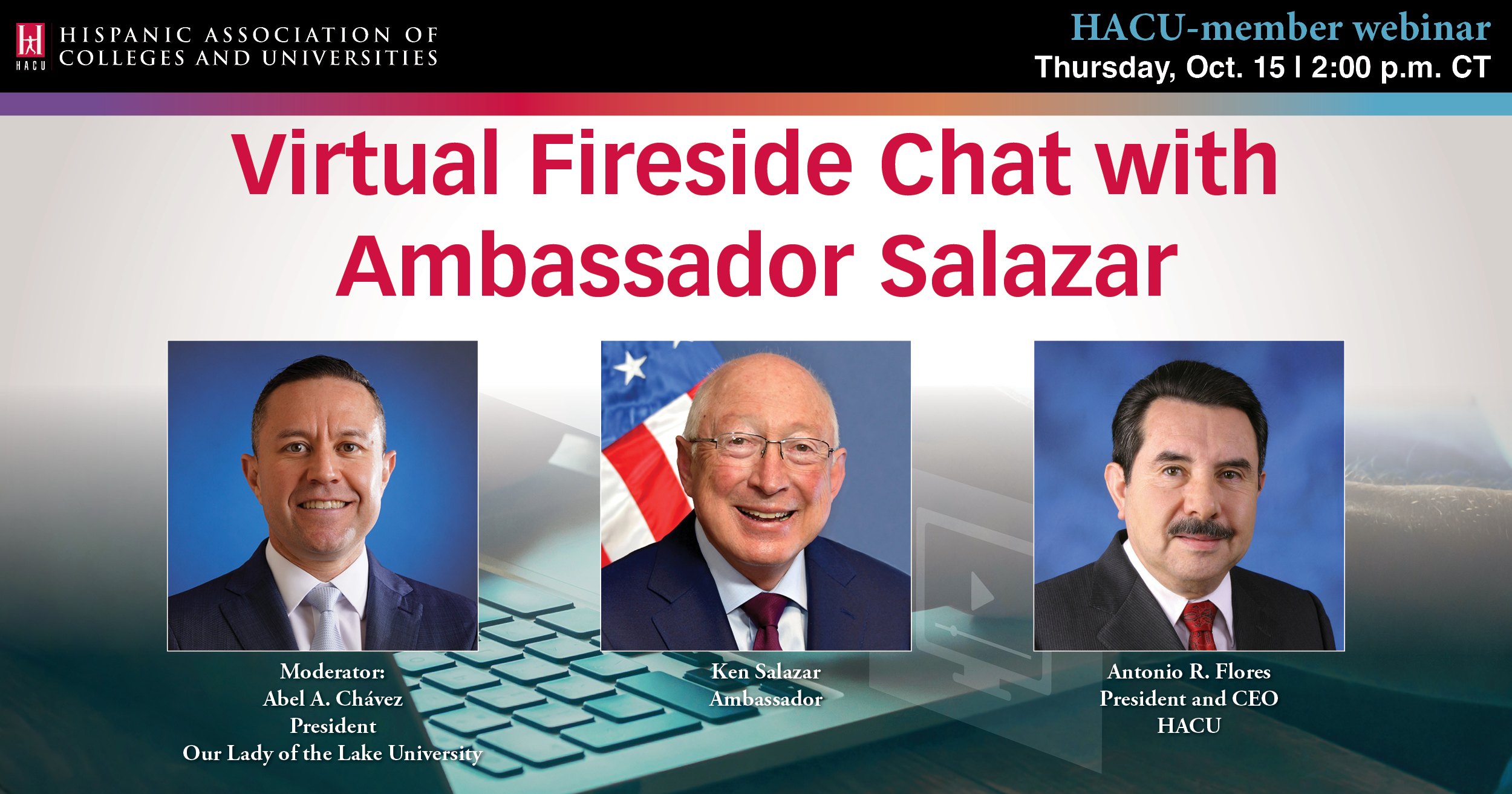
The Hispanic Association of Colleges and Universities (HACU) recently convened educators, students, and leaders from across the nation for an engaging virtual fireside chat with Ambassador Ken Salazar. Held on October 15, 2026, the special event brought together prominent figures in higher education and public service to discuss leadership, representation, and the enduring vision of an inclusive American society.
HACU President and CEO Antonio R. Flores joined Salazar for the comprehensive conversation, which centered on themes from Salazar’s book, Borderlands: My Fight for an Inclusive America. The discussion was expertly moderated by Abel A. Chávez, President of Our Lady of the Lake University, who guided the dialogue through personal anecdotes, historical reflections, and forward-looking strategies for the future of education and diplomacy.
The event offered participants a deep dive into the extraordinary life journey of Ambassador Salazar. Growing up on his family’s ranch in the remote and culturally rich San Luis Valley of Colorado, Salazar broke historical barriers as the first member of his family to attend college. His formative years in the rural American West instilled a profound appreciation for hard work, community resilience, and the power of educational opportunity. These roots ultimately propelled him into a distinguished career in public service.
Over the decades, Salazar has held some of the nation’s most influential public offices. His extensive resume includes serving as the attorney general of Colorado, a United States senator representing the state, the secretary of the interior under the Obama administration, and, most recently, the U.S. ambassador to Mexico. In his memoir, Borderlands, Salazar reflects deeply upon these experiences, utilizing his unique vantage point to make a compelling and timely case for a stronger, more inclusive America that honors its diverse cultural foundations.
During the virtual fireside chat, President Flores, President Chávez, and Ambassador Salazar explored a wide array of interconnected topics. A major focus of the dialogue was the profound influence of family background and educational access on the trajectory of public service. Salazar emphasized that his early experiences in the San Luis Valley shaped his worldview and informed his commitment to fighting for marginalized communities and equitable representation at every level of government.
The conversation naturally transitioned into the vital role that higher education plays in cultivating and developing the next generation of leaders. The panelists examined how Hispanic-Serving Institutions (HSIs)—which enroll a significant and growing portion of the nation’s college students—are uniquely positioned to prepare young people for leadership roles in civic life, business, public policy, and beyond. By fostering environments that celebrate cultural heritage while demanding academic excellence, HSIs serve as critical engines of social mobility and civic engagement.
Furthermore, the discussion addressed broader societal challenges, including the imperative of bridging deep political and cultural divides in contemporary public discourse. Drawing from his extensive diplomatic experience, Salazar shared insights on strengthening bilateral relations between the United States and Mexico. The conversation underscored the immense potential for expanding cross-border collaboration in areas such as higher education, academic research, and comprehensive workforce development, framing the U.S.-Mexico relationship not as a line of division, but as a shared space of opportunity and mutual growth.
A particularly exciting highlight of the event was the introduction of an initiative designed to bring the themes of Salazar’s book directly into academic communities. Ambassador Salazar shared details regarding "One Book, More Voices," a new collaborative effort spearheaded by the Borderlands New North American Alliance Fund. This innovative program is structured to provide matching copies of the book for college classrooms, campus libraries, and specialized student programs, ensuring that the dialogue sparked by the memoir can continue to inspire students for semesters to come.
As the virtual gathering concluded, participants were left with a renewed sense of purpose regarding the transformative power of education, the importance of civic participation, and the ongoing journey toward a more inclusive and interconnected North American society. Through events like this fireside chat, HACU continues to foster crucial conversations that empower Hispanic-Serving Institutions and elevate the voices of leaders dedicated to shaping a brighter future for all students.