








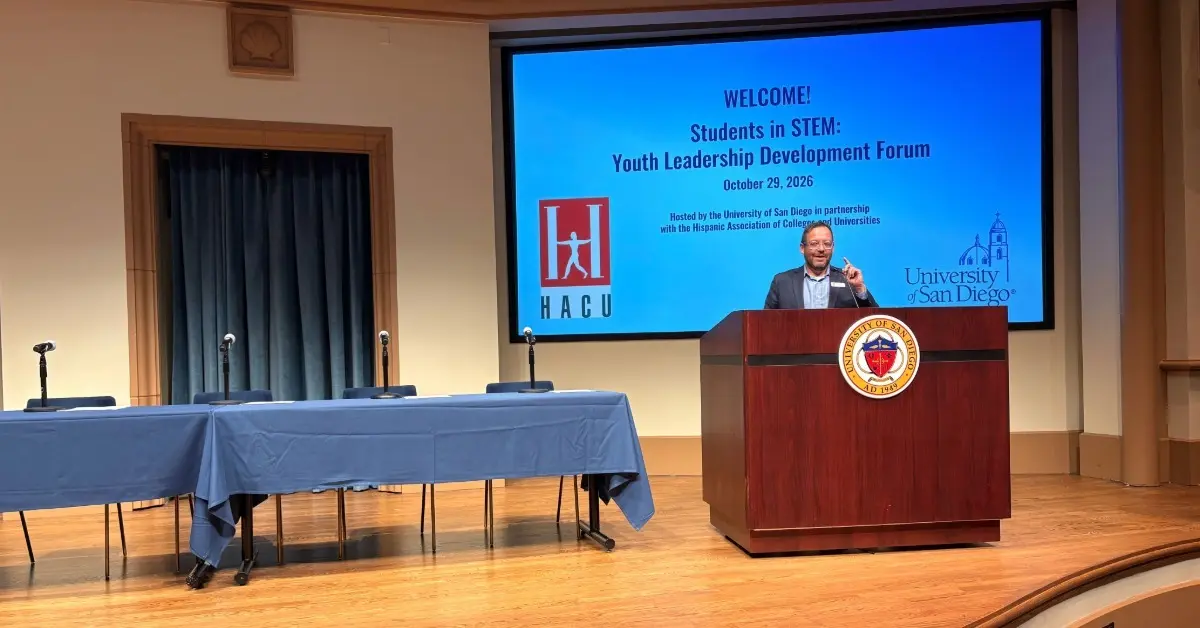
SAN DIEGO — In an effort to foster academic ambition and hands-on scientific discovery among young scholars, the Hispanic Association of Colleges and Universities (HACU), in collaboration with the University of San Diego (USD), hosted an engaging Youth Leadership Development Forum (YLDF) on October 29, 2026. The high-impact event successfully brought together more than 200 high school students for a full day dedicated to immersive learning experiences in science, technology, engineering, and math (STEM), alongside essential guidance on college readiness and higher education pathways.
The special gathering served as a dynamic pre-conference event leading into HACU’s larger Annual Conference, creating a unique bridge between secondary education and university life. By welcoming local high school participants onto a vibrant university campus, organizers aimed to demystify higher education and demonstrate how rigorous academic paths can directly translate into rewarding, impactful future careers.
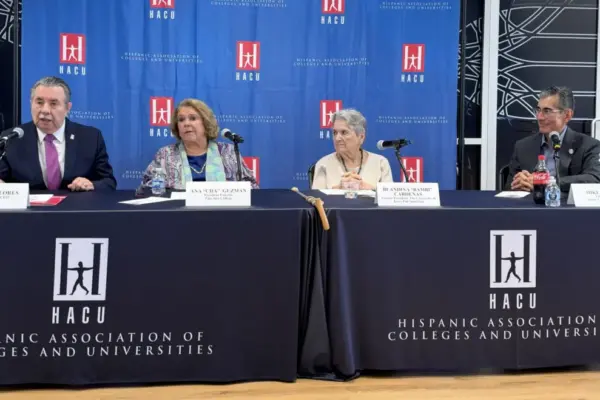
The morning kicked off with an official welcome ceremony featuring prominent institutional leaders who set an inspiring tone for the day. Students were greeted by David A. Ortiz, HACU Executive Vice President for Programs and Operations; Lissette Martinez, USD Executive Director of Public Affairs and Strategic Communications; and Reyes Quezada, USD Professor and Co-Chair of the Hispanic-Serving Institution Advisory Council. These leaders addressed the auditorium of eager students, emphasizing the vital importance of persistence, curiosity, and representation in the modern academic and professional landscapes.
Following the opening remarks, the itinerary shifted toward practical exploration and mentorship. The day’s programming featured an interactive panel discussion comprised of current University of San Diego students and faculty members. This session provided the high schoolers with a rare opportunity to ask candid questions about the transition from high school to college, what to expect from undergraduate coursework, and how to navigate campus life successfully.
In addition to academic panels, participants engaged directly with university support structures through a dedicated session hosted by USD’s Admissions and Career Development Center. Here, students received valuable insights regarding college applications, financial planning, and the various professional development resources available to undergraduates. To help the participants visualize themselves as future college students, the itinerary also included comprehensive campus tours, allowing the teenagers to experience the architecture, libraries, and common spaces of the university firsthand.
The core of the Youth Leadership Development Forum centered on intensive, hands-on academic workshops held across various specialized laboratories and facilities throughout the campus. Designed to spark intellectual curiosity and provide tangible context for abstract classroom theories, these lab sessions covered a diverse array of modern scientific and technological disciplines.
Participants rotated through specialized environments where they engaged in interactive nursing simulations and physics experiments, gaining a firsthand look at clinical healthcare practices and the physical laws governing motion and energy. Additional demonstrations focused heavily on the fascinating fields of neuroscience, cognition, and behavior, offering students a window into how the human brain processes information and influences daily actions.
Further expanding the technological scope of the day, students participated in specialized chemistry and biochemistry demonstrations, observing chemical reactions and molecular structures up close. The engineering curriculum proved to be a major highlight, introducing attendees to core concepts in energy systems, rapid prototyping, visual-spatial skills, and structured design thinking. Through collaborative group activities and problem-solving exercises, the young learners experienced the iterative nature of engineering design, working together to conceptualize and build functional models. The day’s academic explorations concluded with engaging biology demonstrations that illustrated living systems and cellular processes.
Ultimately, the overarching mission of the Youth Leadership Development Forum is to inspire California’s youth to successfully complete their high school education and confidently transition into higher learning institutions. By connecting academic concepts to real-world applications and offering direct exposure to university life, HACU and the University of San Diego continue to empower the next generation of diverse leaders, innovators, and problem-solvers in STEM fields and beyond.