









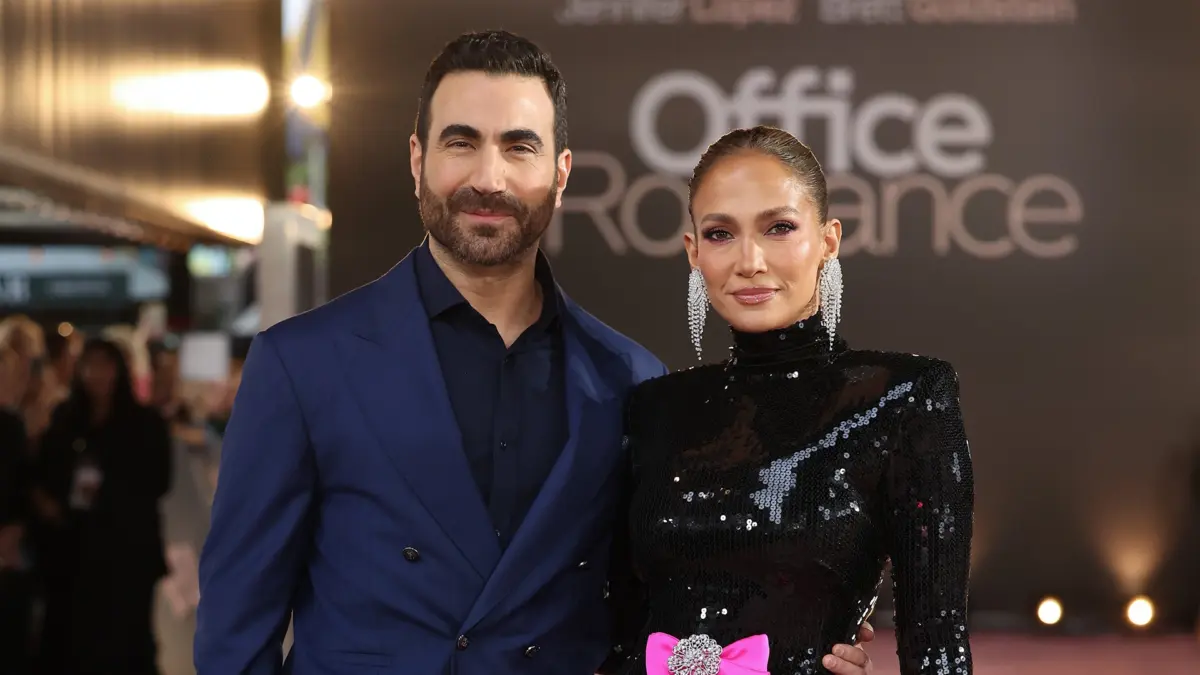
The electric on-screen chemistry between Jennifer Lopez and Brett Goldstein in their Netflix romantic comedy Office Romance was so palpable that it fueled relentless speculation throughout the film’s press tour that the two were romantically involved in real life.
Back in June, the co-stars appeared on NBC’s Today show, where Goldstein candidly admitted that he had written the film specifically for Lopez. During the segment, host Savannah Guthrie highlighted the romantic tension between them and noted that Lopez had previously named Goldstein her "best kisser" among all her co-stars while appearing on Andy Cohen’s Watch What Happens Live. While both actors denied they were dating—exchanging knowing smirks and nervous giggles along the way—hardly anyone in the audience or online believed them. The denials immediately sparked comparisons to other famous promotional-tours-turned-rumor-mills, such as the intense scrutiny faced by Bradley Cooper and Lady Gaga following the release of A Star Is Born.
Now, several months after the promotional circuit concluded and the film premiered on streaming platforms, celebrity news outlet Page Six reports that Lopez and Goldstein may actually be casually dating. The speculation reignited after the pair were recently spotted leaving a Los Angeles party together in the same car. To date, neither Lopez, Goldstein, nor their respective representatives have issued any official statements confirming or denying the relationship. Nevertheless, social media platforms have already embraced the narrative, with fans and commentators convinced that a full-blown Hollywood love story is underway.
If Lopez and Goldstein are indeed exploring a romantic connection, the reaction from supporters is largely enthusiastic. They undeniably share strong on-screen chemistry, and after weathering high-profile public splits, Lopez certainly deserves to enjoy her personal life. However, the recurring cycle surrounding these headlines raises broader questions about how society perceives women’s romantic choices. Specifically, it highlights why the public and cultural discourse continue to expect women to treat every single relationship with a man as though he must definitively be "the one."
This societal double standard places an unfair burden on women—particularly Latinas, regardless of their age—to prove that every romantic endeavor will culminate in marriage. By contrast, society rarely holds men to the same rigid expectation.
Lopez, who is 57 years old, has lived a remarkably public and full life. Having been married and divorced four times and raising two children, she has undoubtedly gathered profound self-awareness and life experience along the way. That is not to suggest that Goldstein is or isn’t what she is looking for in a partner, but rather to question why observers so quickly assume that a new connection must carry serious, long-term weight. For all the public knows, the two could simply be dating casually and taking the time to get to know one another without any pressure. The fact that her high-profile divorce from Ben Affleck drew widespread public sympathy and heartbreak does not mean that Goldstein or any other future partner needs to automatically step into the role of her next husband.
Modern culture frequently treats a woman’s romantic relationships as a direct measure of her judgment, self-worth, and personal growth—an analytical lens that is rarely applied to men with similar histories. While Lopez’s romantic timeline has undeniably become a prominent fixture of her public persona, it remains unfair to use every new connection as an opportunity for critics to suggest she has failed to learn from her past, repeatedly makes poor choices in partners, or needs to prove her enduring "value" by ensuring her next relationship lasts indefinitely.
Even in 2026, cultural expectations continue to place unique pressures on Latinas to find and maintain lasting love. Traditional family expectations and respectability politics often compound this pressure, creating a rigid framework for how women are expected to conduct their personal lives.
While Generation Z has experienced significantly more cultural grace regarding modern dating dynamics, many Latinas belonging to millennial, Gen X, Baby Boomer, and older generations were raised under the shadow of the traditional "señorita" mentality. Originally used simply as a formal address for an unmarried woman, the term eventually became closely tied to notions of female virtue and virginity through cultural expectations surrounding female sexuality. Within many traditional Latin American cultures and families, the archetype of a "good woman" was historically defined as a señorita: a young woman who strictly reserved intimacy for marriage. Many women were raised to be modest, well-behaved, and sexually inexperienced, effectively being "preserved" for a future husband. The underlying message dictated that a woman’s entire social worth was intrinsically tied to the perception of her sexual scarcity.
These deeply entrenched expectations stem directly from patriarchal and machismo structures. Although such restrictive norms may be enforced less explicitly today, women are still persistently pressured to maintain modesty, protect their reputations, avoid being labeled as promiscuous, and commit exclusively to partners who offer a clear trajectory toward marriage. A woman who accumulates multiple partners—even if every past relationship was serious and committed—is frequently expected to feel regret for her choices. This scrutiny is precisely what public figures like Lopez face on a regular basis.
Meanwhile, a man with an identical romantic history is routinely viewed through an entirely different lens. He is typically celebrated as experienced or praised for simply taking his time before deciding to settle down. Men who date casually are frequently characterized as independent, confident, and proactive in keeping their options open. Furthermore, the more successful a man is professionally, the more society tends to excuse and validate his reluctance to commit.
Yet someone as successful, professionally accomplished, attractive, and desirable as Lopez is frequently scrutinized through a cynical framework that frames her as someone who "can’t keep a man." Observers remain endlessly fascinated by the paradox that, despite possessing beauty, immense success, wealth, fame, and endless romantic options, she has not yet secured a permanent, lifelong relationship.
However, the conclusion of a marriage does not equate to a failure at love. Lopez’s previous relationships and divorces do not mean she is obligated to prove her worth by ensuring her next romance leads to the altar. If her relationship with Goldstein is purely casual, she is entirely within her rights to embrace it. She holds every right to explore a connection that excites her, even if she has no intention of making it a permanent arrangement.
Men are routinely granted the social permission to treat dating as a distinct, flexible phase of life, whereas women are expected to treat every relationship as a direct march toward a permanent destination. A man can spend years openly stating that he is not ready for commitment, wishes to focus on his career, or prefers to keep his options open. Even if critics view him as emotionally unavailable or self-absorbed, society generally accepts that he is simply dating.
Conversely, women who make similar lifestyle choices are forced to endure endless public cross-examinations. Observers routinely question whether she is afraid of commitment, overly picky, or plagued by poor judgment in partner selection. They speculate about unresolved trauma or childhood issues. As women approach milestone decades—be it their 40s, 50s, or 60s—these inquiries often grow increasingly harsh, revolving around why she hasn’t settled down, why her past relationships dissolved, and whether she secretly regrets her lifestyle.
It is worth noting that women themselves can sometimes reinforce these very boundaries. Society has conditioned many to internalize the notion that romantic and sexual decisions serve as a profound reflection of moral character. At the same time, women navigate very real, legitimate reasons to approach dating with heightened caution. The tangible risks of sexual violence, reproductive health concerns, asymmetrical emotional labor, and professional or social exploitation disproportionately impact women. Double standards surrounding sexuality can severely damage a woman’s reputation and livelihood in ways that rarely affect men.
Discussions surrounding personal histories often reflect these underlying anxieties. While personal preferences regarding intimacy vary wildly from person to person—ranging from strict celibacy and a desire for deep emotional exclusivity to casual dating arrangements—the fundamental takeaway remains clear: personal choices regarding romance and intimacy are individual decisions, not metrics of human worth.
Ultimately, Jennifer Lopez does not owe the public a successful, lifelong marriage to prove that she has "figured out love," nor does she owe such a milestone to herself. She is not required to treat her romantic history as a cautionary tale or demonstrate personal healing by locking down a high-profile partner like Goldstein. She is entirely permitted to seek love, companionship, physical chemistry, and personal joy on her own terms. She retains the freedom to discover that a connection might only serve a single season of her life rather than decades, enjoying the present without needing to predict the future.