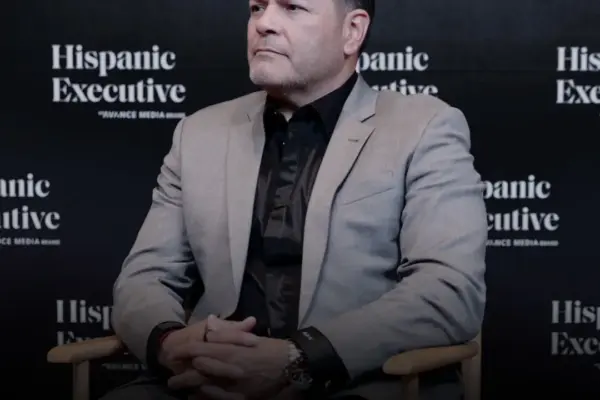












Martin Cabrera Jr. was originally supposed to design buildings, not balance sheets. Growing up in Chicago’s vibrant Little Village neighborhood as the son of Mexican immigrants, his early world was shaped by the concrete reality of hard work, family ties, and the persistent, everyday anxieties familiar to many working-class immigrant households. Financial conversations around the dinner table rarely drifted toward equity markets, venture capital, or portfolio diversification; instead, they were grounded in the immediate pressures of making mortgage payments and keeping a roof overhead.
Yet, life has a way of pivoting on a single, unexpected moment. During his high school years, a dedicated economics teacher introduced Cabrera to an interactive stock market simulation. What began as a routine classroom exercise—manipulating hypothetical portfolios and tracking corporate earnings—ignited a profound intellectual curiosity. That initial spark fundamentally altered his trajectory, steering him away from architecture and toward the intricate, high-stakes world of modern finance.
Decades later, that pivot has matured into a formidable career. In 2001, Cabrera founded Cabrera Capital Markets, a firm that has steadily grown to become one of the most prominent Latino-owned investment banks and institutional brokerage firms in the United States. Operating at a high level within competitive financial markets, the firm has established a reputation for navigating complex transactions, municipal finance, and institutional investments.
Yet, for Cabrera, building a successful financial institution is only a fraction of a much larger equation. While personal and corporate growth remain important milestones, the more consequential and enduring question centers on systemic access—specifically, who gets to participate in the wealth and opportunities that capital ultimately creates. During a wide-ranging conversation recorded at the AVANCE Global conference in Las Vegas, Cabrera laid out a clear philosophy regarding economic empowerment, community intentionality, and structural change.
"And I tell folks, we need to control the capital because that’s how you control the agenda and control the purse strings," Cabrera told audiences, emphasizing that true parity requires more than just professional presence; it demands structural ownership of financial resources.
To illustrate this principle, Cabrera pointed to a massive $550 million real estate development project currently underway in Chicago. The ambitious urban initiative is expected to yield approximately 750 residential units alongside vital commercial space, injecting significant economic activity into the metropolitan area. But for Cabrera, the headline-grabbing figures of the development are less important than the intentional choices being made behind the scenes regarding who benefits from the project.
Rather than defaulting to traditional corporate pipelines, the project serves as a prime example of an operational approach he believes more Latino-owned businesses and investors should actively embrace. It is a matter of calculated, deliberate resource allocation.
"We’re using our Latino attorneys, Latino contractors, Latino engineers," Cabrera explained, highlighting the deliberate effort to circulate capital within the community. "We’re being intentional about circulating those dollars within our community."
For Cabrera, this strategy transcends individual enterprise or isolated business success. A development project of this magnitude possesses a powerful multiplier effect, capable of opening doors for specialized contractors, structural engineers, legal professionals, and various small-to-mid-sized businesses that might otherwise face systemic barriers when attempting to access projects of scale. By consciously directing professional mandates toward qualified Latino-led service providers, leaders can help foster a self-sustaining ecosystem of economic resilience and institutional competence.
Of course, navigating the upper echelons of the financial sector has rarely been straightforward. Cabrera knows firsthand what it means to continually fight for a legitimate seat at the corporate table. Despite Cabrera Capital Markets maintaining a robust track record and executing complex transactions alongside major market players, the firm has occasionally encountered institutional skepticism driven by preconceived notions and implicit bias.
Reflecting on the hurdles still faced by minority-owned financial institutions, Cabrera candidly addressed the lingering prejudices harbored by some prospective corporate clients. These entities, he noted, have at times questioned the firm’s operational capabilities and technical expertise purely on the basis of its Latino ownership and cultural identity.
"Sometimes they look at us and they say, hey. They’re a brown firm. Their quality might not be that good," Cabrera shared, shedding light on the subtle yet persistent headwinds that confront minority entrepreneurs even after achieving notable market standing.
Rather than engaging in counterproductive friction, Cabrera’s institutional response has consistently been to let the quality of the firm’s work dismantle those assumptions piece by piece. By delivering rigorous financial execution, maintaining strict compliance, and competing effectively on performance, Cabrera Capital has continually proven its mettle in demanding markets.
However, Cabrera stresses that individual excellence alone is not enough to dismantle systemic barriers. He believes that the broader corporate and financial ecosystem must undergo a fundamental shift in perspective, moving past superficial engagement to recognize Latino communities for their economic substance.
"Those companies need to look at Latinos not as consumers, but as entrepreneurs," Cabrera asserted, pointing to a vital blind spot in contemporary corporate strategy. While mainstream brands and financial institutions aggressively target the Latino demographic as a lucrative consumer base, they frequently overlook the immense potential, technical capability, and leadership capacity embodied by Latino business owners, founders, and capital allocators.
Addressing the executives, investors, and entrepreneurs gathered at the AVANCE Global event in Las Vegas, Cabrera moved past abstract macroeconomic theory to offer a grounded, practical challenge. He urged the attendees to make a concrete commitment to mutual support by pledging to actively conduct business with at least two professional contacts they made during the conference over the ensuing year.
It is a modest, highly actionable proposition coming from a seasoned executive accustomed to navigating financial markets worth billions of dollars. Yet, this pragmatic challenge encapsulates his broader, overarching argument: long-term wealth creation and community empowerment are determined not solely by the sheer volume of capital a demographic generates, but equally by the deliberate, intentional care with which that capital is deployed, shared, and reinvested.