










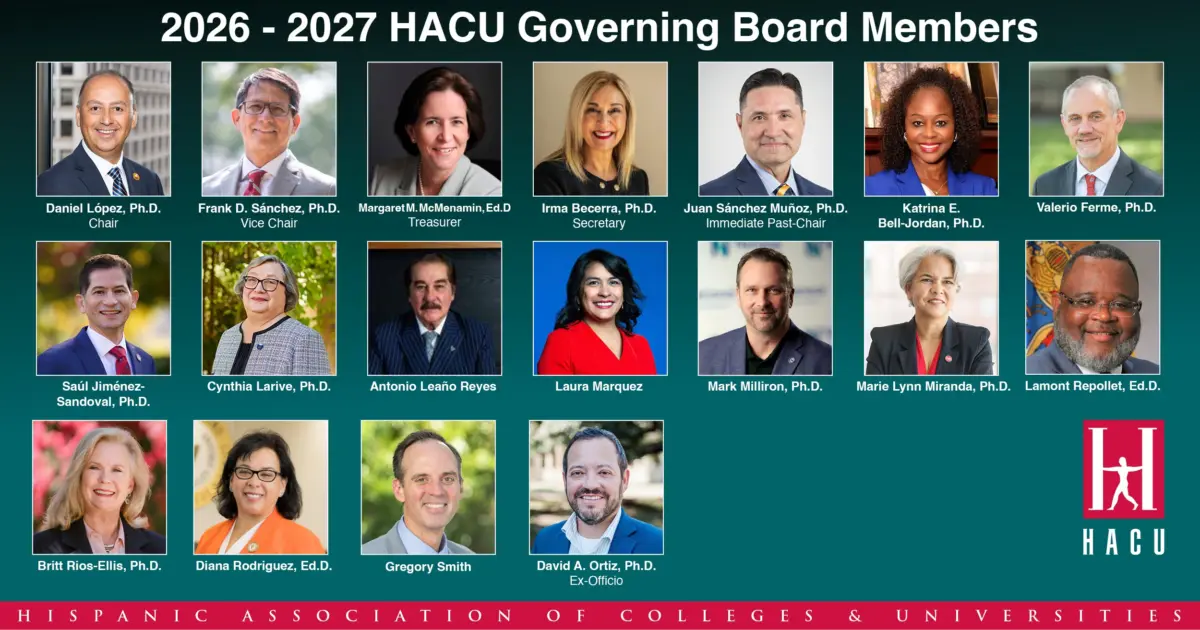
In addition to the arrival of the new board members, HACU announced key leadership updates within its executive structure. Daniel López, president of Harold Washington College, has been named the new chair of the HACU Governing Board. López steps into the role backed by more than 30 years of extensive higher education experience within the state of Illinois. His academic credentials include a bachelor’s degree from the University of Illinois at Springfield, a master’s degree from Loyola University Chicago, and a doctorate from Illinois State University.
Alongside López’s appointment, Frank D. Sánchez, president of Manhattanville University, has been named vice chair of the board. Meanwhile, Juan Sánchez Muñoz, chancellor of the University of California, Merced, transitions into the role of Immediate Past Chair, ensuring continuity and experienced oversight as the organization moves forward with its strategic initiatives.
The leadership changes arrive at a pivotal time for HACU as it continues to advocate for Hispanic-Serving Institutions (HSIs) and expand educational access and equity for students nationwide. David A. Ortiz, interim president and CEO of HACU, emphasized the indispensable value of the board’s collective leadership in advancing the organization’s overarching mission.
“HACU’s Governing Board members are essential to the success of our mission, and we owe a great deal to their dedication and commitment to ensuring the Association’s work is accomplished,” Ortiz said. He further expressed the organization’s appreciation for outgoing leadership while welcoming the fresh perspectives of the incoming officials. “We extend our deepest gratitude to those members ending their roles on the board, and welcome new members who will be key to providing the guidance and direction necessary to serve our member institutions and their students.”
The newly appointed Governing Board members, who will each serve their first two-year terms, represent a diverse and accomplished cross-section of American higher education leadership. The incoming class includes Lamont Repollet, Valerio Ferme, Britt Rios-Ellis, Diana Rodriguez, and Gregory Smith. Each brings decades of institutional leadership, a deep commitment to student advocacy, and a proven track record of expanding academic opportunities to the national stage.
Lamont Repollet, Ed.D., currently serves as the president of Kean University and brings more than three decades of professional experience spanning public and private pre-K through post-secondary education systems. During his tenure at Kean University, Repollet has overseen major institutional milestones, including the attainment of a prestigious Carnegie R2 research designation. Under his leadership, the university has successfully launched targeted programs designed to strengthen workforce pipelines, established innovative dual-degree pathways, and significantly expanded global exchange opportunities for students.
Repollet’s extensive career in education also includes high-profile public service. Prior to assuming the presidency at Kean, he served as New Jersey’s Commissioner of Education, where he was tasked with overseeing a massive educational ecosystem comprising 2,493 schools and a $12.3 billion state education budget. His grassroots background in education encompasses roles as a public-school superintendent, principal, teacher, and athletic coach, grounding his administrative philosophy in practical classroom and district experience. Repollet earned his bachelor’s degree from The College of New Jersey, a master’s degree from Kean University, and a doctorate from Nova Southeastern University.
Valerio Ferme, Ph.D., serves as the president of the New Mexico State University System, leading the state’s comprehensive public research and land-grant university, which maintains a dual focus on excellence in teaching, research, and public service. Prior to taking the helm at New Mexico State, Ferme built a distinguished academic administrative career at the University of Cincinnati, where he served as executive vice president for academic affairs and provost, as well as dean of the College of Arts and Sciences.
Throughout his career, Ferme has been a steadfast
advocate for student success, supporting numerous financial and programmatic investments centered on student access and retention. During his tenure as provost at the University of Cincinnati, his office spearheaded initiatives that more than doubled the hiring of underrepresented faculty members. He also championed the creation of a post-doctoral program designed to attract diverse prospective faculty candidates, provided permanent professional development funding for employee resource groups, established a provost faculty fellow program, and successfully addressed salary minimums for advising staff and adjunct faculty members.
A native of Italy who holds dual citizenship, Ferme’s academic journey reflects a deep international and multidisciplinary perspective. He earned his bachelor’s degree from Brown University, a master’s degree from Indiana University, and a doctorate from the University of California, Berkeley, where his academic excellence was recognized with prestigious Fulbright and Chancellor’s Fellowships.
Britt Rios-Ellis, Ph.D., is the president of California State University, Stanislaus. She is a recognized bilingual and bicultural educational and community health expert who brings more than 35 years of experience in higher education and public health advocacy to the HACU board. Before her appointment at CSU Stanislaus, Rios-Ellis served as the executive vice president of academic affairs and provost at Oakland University in Michigan. Her extensive California higher education background includes pivotal leadership roles at California State University, Monterey Bay and California State University, Long Beach.
At CSU Monterey Bay, she served as the founding dean of the College of Health Sciences and Human Services and co-founded the institution’s Master of Science Physician Assistant program. Earlier in her career at CSU Long Beach, she was a professor of health sciences and served as the founding director of both the Center for Latino Community Health, Evaluation and Leadership Training and the community-based Centro Salud es Cultura. Rios-Ellis earned her bachelor’s, master’s, and doctoral degrees from the University of Oregon.
Diana Rodriguez, Ed.D., serves as the chancellor of the San Bernardino Community College District in Southern California’s Inland Empire, providing administrative leadership for an educational network that serves approximately 30,000 students annually across Crafton Hills College and San Bernardino Valley College. The district plays a vital role in regional workforce development, preparing students for university transfer while offering specialized career and technical training programs in fields such as firefighting, nursing, and the skilled trades. The district also operates KVCR Public Media, the regional NPR and PBS broadcasting station.
As a first-generation college graduate, Rodriguez has consistently been a vocal advocate for student equity, championing policies that address basic needs such as food and housing security, as well as broader college affordability initiatives. Her advocacy extends to legislative arenas; she recently collaborated with California State Senator Eloise Gómez Reyes and fellow education leaders to help secure the passage of SB 1255, making California the first state in the nation to establish its own official HSI state designation alongside existing federal recognition. Nationally and regionally active, Rodriguez serves as president-elect of the California Community Colleges CEO Board and previously lent her expertise to HACU’s Commission on International Education. With over 30 years of experience in higher education—including a five-year tenure as president of San Bernardino Valley College—Rodriguez holds bachelor’s and master’s degrees from California State University, San Bernardino, and a doctorate from National University.
Gregory Smith is the chancellor of the San Diego Community College District, where he oversees an expansive district serving approximately 90,000 students across four distinct colleges. Smith brings more than 20 years of dedicated public sector service to the HACU Governing Board. His professional background includes service within the U.S. Department of Labor, where he was responsible for enforcing Equal Employment Opportunity and affirmative action regulations across various sectors.
Like several of his fellow board appointees, Smith is a first-generation college graduate who began his higher education journey at Cerro Coso Community College in California. He went on to earn bachelor’s degrees in Political Science and English Literature from Arizona State University, followed by a master’s degree in Public Administration from the University of Southern California.
As the newly constituted board assumes its responsibilities, HACU formally expressed its appreciation to the outgoing board members whose terms have concluded. The organization extended its sincere thanks for their dedicated service, leadership, and contributions during their time on the HACU Governing Board.
The departing board members include Ted Alejandre, superintendent of the San Bernardino County Superintendent of Schools; Mordecai Brownlee, Ed.D., president of the Community College of Aurora; Mike Flores, Ph.D., chancellor of the Alamo Colleges District; Gary May, Ph.D., president of the University of California, Davis; Christopher Reber, Ph.D., president of Hudson County Community College; and Abel Antonio Chávez, Ph.D., president of Our Lady of the Lake University.