










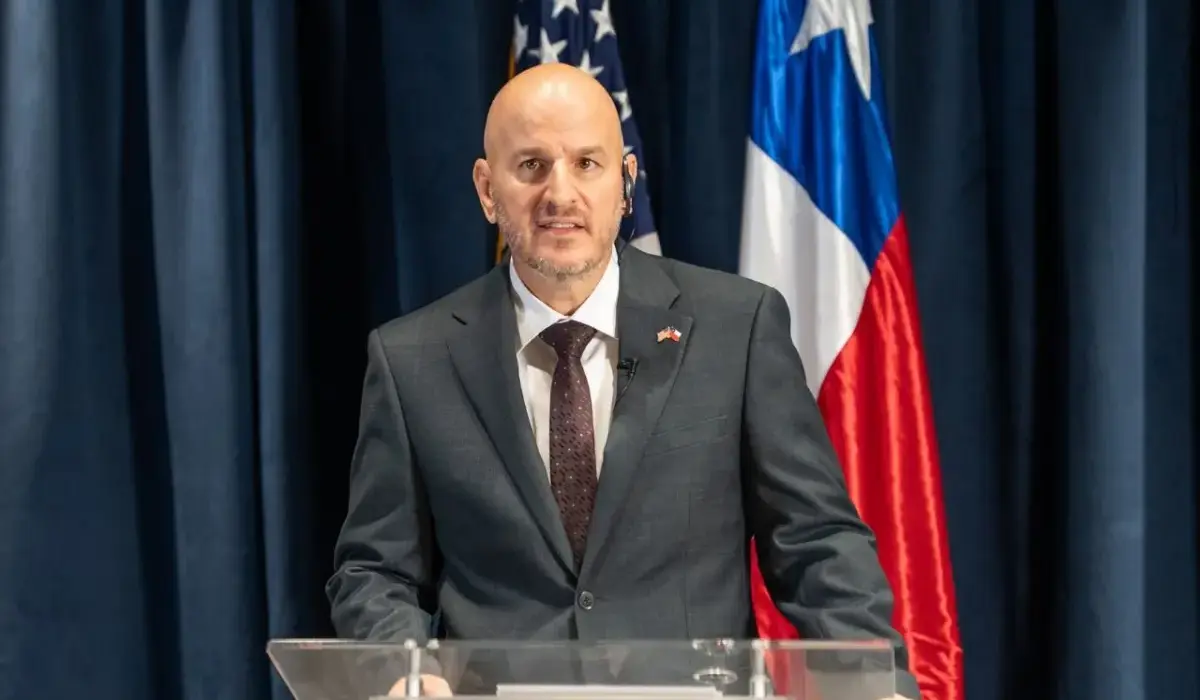
SANTIAGO DE CHILE — Chilean authorities summoned United States Ambassador Brandon Judd on Wednesday following remarks in which he suggested that U.S. backing for Chile’s sovereignty over the Strait of Magellan was contingent upon bilateral cooperation regarding issues of primary importance to Washington.
The ambassador’s controversial statements have abruptly revived sensitivities surrounding the Strait of Magellan, a vital maritime passage under Chilean jurisdiction that connects the Pacific and Atlantic oceans at the southern extremity of the American continent. Amid a mounting public outcry and fierce bipartisan condemnation from across the Chilean political spectrum, Ambassador Judd walked back his comments late Wednesday night, asserting that his words had been misinterpreted and taken out of context.
The diplomatic friction began earlier in the day during a speech delivered by Ambassador Judd at a Global Trade Day event held in Santiago de Chile. While addressing attendees on broader regional partnerships, the ambassador made remarks that quickly drew scrutiny from local observers and government officials alike.
"If they want that relationship to continue, if they want the resources we have to combat organized crime, if they want a country that will help them protect their rights over the Strait of Magellan… if they want all those things, then they’ll also have to work with us on the issues that are important to us," Ambassador Judd said during the event.
He further elaborated on the strategic dimensions of the bilateral ties, adding, "We will always be very concerned about sovereignty because we have a relationship with Chile that goes beyond trade."
The remarks struck a raw nerve in Santiago, reopening a geopolitical nerve center that had only recently been quieted. Just months prior, in August, controversy regarding Chile’s undisputed sovereignty over the Strait of Magellan had triggered a separate diplomatic spat between Chile and neighboring Argentina. That friction arose after the head of the Argentine Air Force suggested that Buenos Aires needed to maintain a continuous military and operational presence along the critical sea route to protect its own conception of sovereignty.
That particular disagreement was ultimately smoothed over through direct diplomatic channels. Authorities from both countries engaged in talks, and Argentine officials swiftly reassured their Chilean counterparts that Chile’s sovereignty over the strait was entirely clear and undisputed. Against this backdrop, Ambassador Judd’s unexpected linkage of U.S. security backing to political quid pro quo instantly reignited national anxieties regarding foreign interference or conditional recognition of territorial integrity.
Harsh Reaction and Political Fallout
The response from the Chilean government and legislative leaders was swift, unyielding, and overwhelmingly critical. Foreign Minister Francisco Pérez Mackenna took to the press on Wednesday to issue a firm and unequivocal rejection of the ambassador’s premise, emphasizing that the maritime passage remains non-negotiable.
"The Strait of Magellan is and always will be Chilean," Pérez Mackenna told reporters. "We can defend our sovereignty on our own; we do not need anyone’s support to defend our sovereignty — we have been doing so for 200 years."
The foreign minister indicated that the Ministry of Foreign Affairs would thoroughly analyze the ambassador’s comments to determine the appropriate diplomatic response. Specifically, the government is assessing whether to issue a formal diplomatic note of protest to the United States government or to pursue other diplomatic measures.
"I am not ruling anything out until the evaluation is complete. We will decide on our formal response based on the substance of what has been said," the minister announced, maintaining a measured tone while underscoring the gravity of the incident.
At the same time, Pérez Mackenna sought to contextualize the broader bilateral relationship, noting that Chile’s historical ties with the United States "has always been good" and that Ambassador Judd’s controversial remarks "will not change that" fundamental foundation.
Legislative leaders joined the chorus of disapproval. The top authorities of the Chilean Senate issued a formal communiqué strongly rejecting the ambassador’s statements. The legislative body declared that the nation’s sovereignty "is not under debate and does not depend on the support, backing or acknowledgment of any foreign nation."
The rhetoric grew sharper among individual lawmakers. Socialist Deputy Nelson Venegas went a step further, arguing that the diplomatic rupture had reached an untenable threshold. Venegas stated that it was time for President José Antonio Kast to formally request that U.S. President Donald Trump recall Ambassador Judd from his post, asserting that the envoy’s remarks had "crossed every line."
"Chile does not take orders from any foreign ambassador," Deputy Venegas added.
The friction over the Strait of Magellan is not the first time Ambassador Judd has found himself at the center of political controversy since assuming his diplomatic post in Santiago last November. Throughout his tenure, the ambassador has periodically drawn criticism for stepping into domestic political debates, including instances where he commented on internal affairs and publicly questioned former President Gabriel Boric, who was leading the country at the time.
In another recent flashpoint, Ambassador Judd suggested that the United States possessed specific intelligence reports regarding the massive and socially transformative civil unrest that swept Chile in 2019. He later clarified those remarks, explaining that his country had not actively conducted a formal intelligence investigation within the South American nation.
Judd’s Response and Clarification
Facing mounting pressure and the prospect of formal diplomatic reprimands, Ambassador Judd issued a public clarification late Wednesday night. He argued that his daytime remarks had been "clearly taken out of context" and insisted that he had no intention of calling Chile’s territorial rights into question.
"I enjoy a good TV series just like anyone else, but this drama is being misrepresented," the ambassador said in his written statement, wherein he reaffirmed his "longstanding support for Chile’s sovereignty."
Ambassador Judd framed his initial speech as an expression of solidarity and mutual strategic interest rather than a conditional threat. "My remarks today were a firm and positive endorsement of our bilateral relationship and of everything the United States and Chile are doing — and can do — together to make our countries and the hemisphere we share safer, stronger, and more prosperous," he stated.