






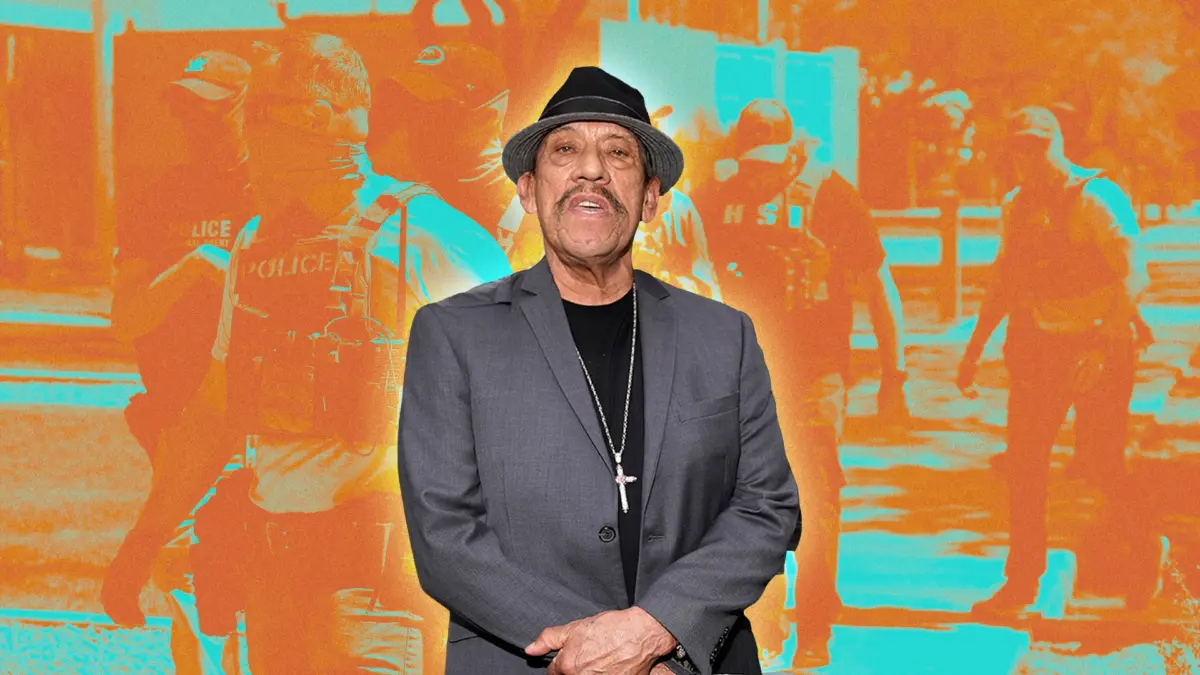
Mexican-American actor Danny Trejo, a towering figure in contemporary cinema and a cherished icon for generations of moviegoers who grew up watching him in gritty action films and family blockbusters alike, has suddenly found himself at the center of a swirling national controversy. The 82-year-old actor, whose illustrious career spans decades with memorable performances in features such as Blood In, Blood Out, Desperado, Spy Kids, and his star-making turn in Machete, is facing intense public scrutiny and online backlash. The source of the friction is his participation in Pawn Shop, an upcoming feature film described by media watchdog outlets as having a distinctly pro-immigration enforcement perspective. The production, which has quickly become a lightning rod for political and social tensions, recently hit significant operational roadblocks during its on-location shoot in the scenic mountain town of Livingston, Montana.
The project itself is a collaborative effort co-produced by Bonfire Legend and the Daily Wire, a prominent right-wing digital media company established by conservative political commentator and author Ben Shapiro. Principal photography for Pawn Shop kicked off in late September, transforming parts of the historic Montana community into an active movie set. However, the film’s underlying themes and narrative direction soon spilled out from behind the scenes and into the public eye. According to a detailed report published by The Bulwark, which managed to obtain and review an early draft of the screenplay, Pawn Shop takes a direct look at immigration enforcement operations in Minneapolis alongside anti-ICE demonstrations, framing these complex and politically charged events explicitly through a pro-immigration enforcement lens.
Furthermore, The Bulwark assessment pointed out that the script incorporates a dramatic sequence that the publication asserts bears striking parallels to the tragic, fatal shooting of Renee Nicole Good. It is important to note, however, that this perceived connection represents the outlet’s analytical assessment of the written material rather than an officially confirmed statement of intent from the filmmakers, producers, or screenwriters. Nonetheless, the mere association with these sensitive themes proved enough to ignite immediate local resistance and national media attention, setting the stage for a dramatic showdown between the production team and the residents of Livingston.
The arrival of the film crew and the simulated law enforcement operations quickly drew sharp criticism from members of the local community, who felt blindsided by the scale and nature of the production taking place in their neighborhoods. Capturing the raw sentiment of several local residents, one anonymous protester pulled no punches when speaking to The Bulwark, delivering a blunt message regarding the film’s presence: “We want them to know: Don’t come do this sh[—]t in our town.” The mounting local frustrations reached a boiling point on October 3, when the Livingston City Commission took decisive action. Citing widespread complaints from citizens regarding severe disruptions to the local food pantry, unexpected road closures, and a noticeable lack of adequate safety warnings concerning hazardous stunts, the commission voted to temporarily suspend the film’s production permits.
The friction on the ground was far from abstract for the people living in the immediate vicinity of the shoot. Livingston resident Alecia Jongeward detailed her unsettling encounters with the production to the Bozeman Daily Chronicle, explaining that the sight of actors dressed in full tactical gear rushing through her residential street left her genuinely terrified. “I was like, ‘Why are you running at me with guns?’ It was scary,” Jongeward recounted. She added further context to the community’s distress, noting that the production failed to communicate its activities to the neighborhood beforehand. “Someone later pointed out the guns aren’t real. It would have been nice to know. Everyone’s dogs [are] freaking out: gunshots, loud mobs, screaming heard for blocks at a time. They didn’t tell any of us about this production.”
The administrative standoff did not last indefinitely, however. Following a marathon public meeting that stretched for nearly seven hours, the Livingston City Commission voted on October 5 to reinstate the filming permit. The reversal came with specific, newly enforced conditions designed to address community concerns, requiring stricter security protocols, advance neighborhood notifications, and guaranteed, unhindered public access to the local food pantry. Throughout the administrative battle, the production’s backers vocally opposed the temporary shutdown. Ben Shapiro publicly characterized the commission’s initial suspension as an act of “content discrimination” and a direct “violation of the First Amendment.” These characterizations were the conservative commentator’s own allegations and legal arguments rather than a formal judicial ruling. Meanwhile, the city attorney carefully framed the core issue for the commissioners, advising them that their deliberations and decisions needed to remain strictly focused on whether the production company was in compliance with the established conditions of their municipal permit, rather than passing judgment on the political or ideological content of the film itself.
Amidst the municipal debates and community protests, Danny Trejo’s involvement in the project drew profound surprise and confusion from fans and observers across the internet. The actor’s casting struck many as an unexpected career choice given his previous public stances and community advocacy. As recently as November 2025, Trejo had used his platform to speak out in support of families directly impacted by immigration enforcement actions. In an interview with TMZ at the time, the veteran actor offered a compassionate message to those living in fear of raids, encouraging the public by stating: “Help your neighbor and do whatever you can for people in need.”
Because details regarding Trejo’s specific character arc, screen time, and role within the narrative of Pawn Shop have been kept under tight wraps, his exact contribution to the film remains unclear. Furthermore, industry observers note that an actor’s participation in a commercial feature film does not automatically establish or endorse their personal political views on the subject matter depicted in the script. Recognizing the widespread public interest and the apparent contradiction with his past statements, the Los Angeles Times reached out directly to Trejo and his representatives on October 5 seeking comment and clarification regarding his decision to join the cast. As reporting on the unfolding controversy continues to develop, no public explanation or statement from the actor regarding his role in the production has been provided.