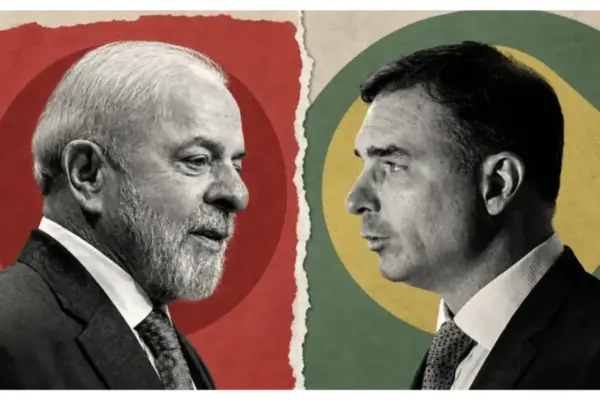












The unexpected electoral success of Senator and Liberal Party leader Flávio Bolsonaro in the opening round of the Brazilian presidential elections on Sunday has sent an immediate wave of optimism across regional financial markets. Financial analysts and investors responded favorably to the results, driving a strong appreciation of the Brazilian real and a sharp upward movement in Brazilian equities. The positive momentum quickly crossed the border, providing a notable lift to Argentine stocks and sovereign dollar-denominated bonds as well.
This early market reaction highlights a broader trend that financial forecasters and economic analysts have anticipated for weeks: if the conservative opposition candidate secures a victory in the upcoming runoff election at the end of the month, President Javier Milei and his administration stand to emerge as key secondary beneficiaries. The alignment of market-friendly economic policies across South America’s two largest economies could redefine the regional financial and political landscape.
According to Sergio González, head of the investment office at the brokerage firm Cohen Aliados Financieros, the market’s enthusiastic response is driven by what he describes as a compression of the region’s risk premium. This financial phenomenon stems from the growing expectation that a more fiscally disciplined Brazilian government, characterized by a decidedly capital-friendly stance, will naturally attract robust capital flows back toward Latin American emerging assets.
"That favors Argentine sovereign bonds in dollars, local stocks with exposure to Brazil, and Brazilian cedears," González told the Herald, outlining the immediate asset classes positioned to gain from the shifting political tide.
Not all market experts, however, believe the spillover effect will be uniform or overwhelmingly dominant for Argentina. Martín Cordeviola, an international market analyst at the brokerage firm Portfolio Personal Inversores (PPI), suggested that while the regional sentiment is undeniably positive, the actual impact on Argentine equities, sovereign debt, and the country risk index will likely remain contained.
"A better climate in Brazil can attract flows toward the region and improve the general tone of Latin American assets, but in the Argentine case, local factors weigh much more," Cordeviola noted, emphasizing that domestic macroeconomic variables continue to dictate Argentina’s ultimate financial trajectory.
A stronger real works in Argentina’s favor
Beyond the immediate portfolio adjustments in Buenos Aires and São Paulo, the appreciation of the Brazilian real represents the most economically significant transmission channel of a potential Bolsonaro victory. Brazil remains Argentina’s single most important trading partner, forming the backbone of regional commerce and industrial supply chains.
Data compiled by INDEC, Argentina’s national statistics and census bureau, illustrates the deep economic entanglement between the two neighbors. Between January and August 2026, bilateral trade reached a staggering US$19 billion, broken down into US$8.5 billion in Argentine exports to Brazil and US$10 billion in imports from the northern neighbor.
Honorio Zabaleta, an economist at the consulting firm Eco Go, emphasized the critical nature of this commercial relationship, pointing out that industrial goods make up the vast majority of what Argentina sells across the border. Approximately 64% of Brazilian imports from Argentina during the first eight months of 2026 originated from industrial manufacturers, accounting for roughly US$5.4 billion in trade volume.
"A very relevant part of our industrial exports go there," Zabaleta explained. "An appreciation of the real created a greater advantage for [Argentina], as our exports would become cheaper for them. This would lead to an improvement in the trade balance."
At the same time, the macroeconomic shift will have immediate practical implications for everyday consumers on both sides of the border. "This, in turn, means that vacationing in Brazil is going to become more expensive," Zabaleta added, highlighting how a stronger real alters consumer purchasing power for Argentine tourists heading to Brazilian beaches.
Cordeviola expanded on this economic dynamic, noting that if Bolsonaro’s potential victory is underpinned by a credible fiscal adjustment program, it will successfully compress Brazil’s risk premium and provide sustained structural support to the real. This strengthening of the currency would directly improve Argentine competitiveness against its largest neighbor.
"It is not a minor detail: the real accounts for 28% of Argentina’s multilateral real exchange rate," Cordeviola emphasized.
Analysts at investment firm Max Capital echoed these sentiments, pointing out that fiscal deterioration has long been diagnosed as the single greatest vulnerability for the Brazilian economy. Under Bolsonaro’s platform, the candidate is proposing a brand-new fiscal rule, backed by an economic team expected to feature prominent figures from his father’s past administration.
According to Max Capital’s econometric projections, the Brazilian real is expected to appreciate by approximately 5% if the Liberal Party candidate triumphs in the October 25 runoff. Simultaneously, projections indicate that the Central Bank of Brazil could implement substantial monetary easing, with interest rates potentially falling between 20 and 30 percentage points from their current baseline of 13.75% annually.
González argued that a firmer real, operating alongside a Brazilian macroeconomic environment anchored by strict fiscal discipline and falling interest rates, would significantly boost foreign and domestic demand for Argentine products. He singled out manufactured goods, noting that demand would rise "especially those from the automotive sector and regional economies."
Political affinity and geopolitical alignment
Beyond the purely macroeconomic and monetary calculations, analysts are closely monitoring the geopolitical ramifications of a potential shift in Brasília. Cordeviola pointed out that another vital dimension to consider is the enhanced political alignment between President Javier Milei, Flávio Bolsonaro, and the United States administration under President Donald Trump. This ideological and diplomatic convergence could substantially facilitate the bilateral and regional political agenda.
Analysts at Max Capital similarly observed that the emergence of a natural ideological and political ally for President Milei constitutes favorable news that should accelerate the broader global integration of Mercosur. González reached a remarkably similar diagnosis, suggesting that the underlying political affinity between the two prospective administrations could finally unlock stalled elements of the Mercosur trade agenda, most notably the long-negotiated and frequently delayed trade agreement with the European Union.
Zabaleta concurred that the political thaw could trigger a cascade of constructive bilateral events. Among the most promising possibilities, he highlighted potential energy trade agreements—such as supplying Brazil with natural gas extracted from Argentina’s massive Vaca Muerta shale formation—alongside coordinated diplomatic efforts to amplify South America’s economic presence and negotiating leverage in Washington and global multilateral forums.
Doubts about the fiscal program and trade competition
Despite the broadly positive outlook and the immediate enthusiasm witnessed in regional financial markets, economic observers have injected notes of caution regarding the potential execution risks of Bolsonaro’s platform. Zabaleta pointed to significant uncertainty surrounding the structural details of Bolsonaro’s proposed fiscal program, which could create cross-currents for Argentina’s export-driven sectors.
"Why does this matter? Because a large austerity plan can initially generate a negative impact on Brazilian demand," Zabaleta warned. "A lower Brazilian income can depress demand for Argentine products."
Thomas Haugaard, a portfolio manager at global asset management giant Janus Henderson, reinforced this perspective, noting that Brazil’s medium-term fiscal credibility will remain the definitive variable for international institutional investors.
"A disciplined fiscal framework could reduce sovereign risk premiums, improve debt dynamics, and favor capital flows," Haugaard said, adding an important caveat that the market will ultimately demand concrete execution of structural reforms rather than merely welcoming favorable electoral signals.
Zabaleta identified a second major risk factor lurking in the fine print of Bolsonaro’s potential economic policy: the exact nature of the trade policy the incoming administration might pursue.
"If he carries out a process of greater trade openness, expanding the number of markets with which Brazil can trade, Argentina will face greater competition," he cautioned.
This concern takes on heightened relevance within the framework of the pending trade pact between Mercosur and the European Union. Increased openness could expose domestic industries to intense international competition, heightening rivalries not just within traditional manufacturing sectors like the automotive industry, but also across high-value agribusiness supply chains and the pharmaceutical sector.