
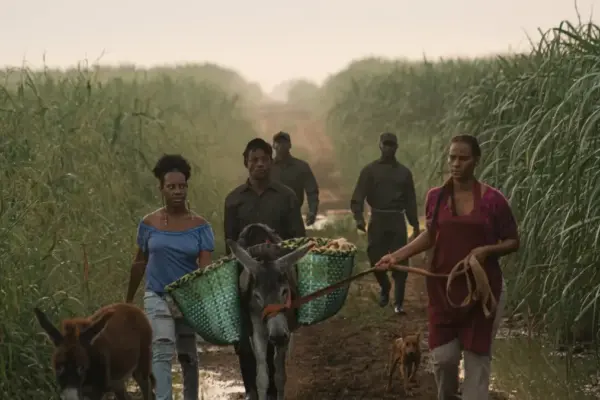


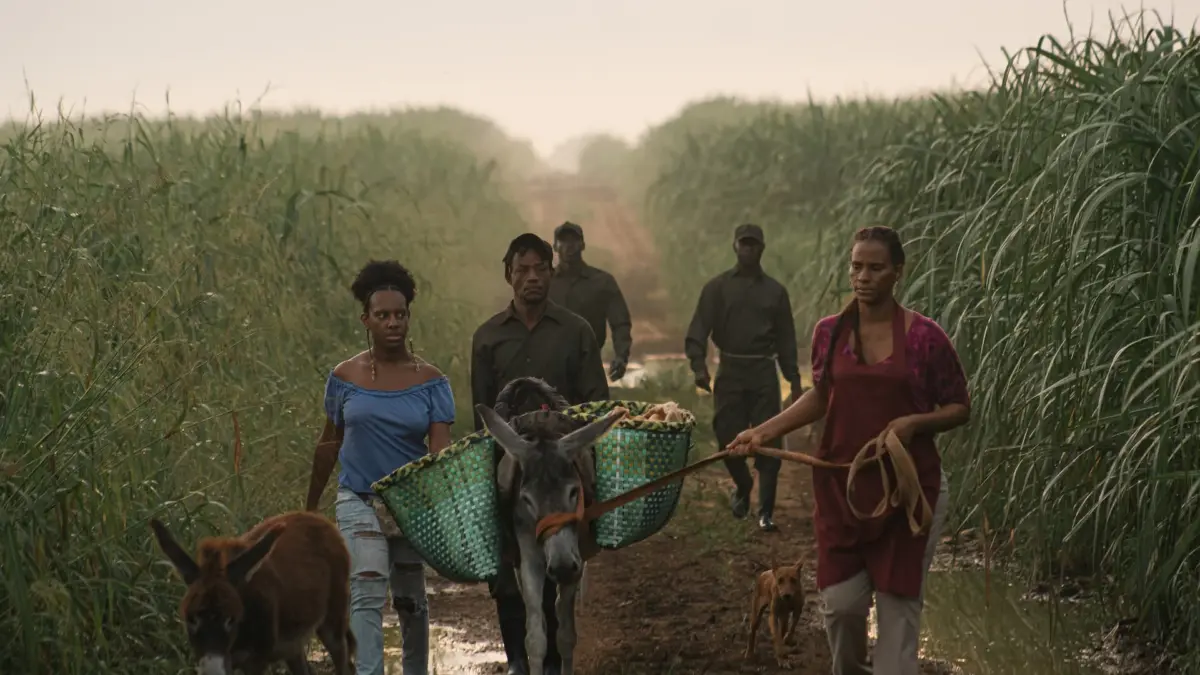
A story told by few but experienced by many unsung girls, director Johanné Gómez Terrero captures the raw, political, and spiritual journey of a Dominican-Haitian teen pregnancy in her powerful new coming-of-age film, Sugar Island. The film follows 14-year-old Makenya as she navigates a sudden and life-altering pregnancy while living within a historically marginalized sugarcane community. Terrero recently spoke about the making of the project, highlighting the dynamic ways that bodily autonomy, documentation, labor rights, and spirituality function as interconnected pillars throughout the narrative. In the world of Sugar Island, these crucial themes do not simply coexist; they reinforce one another, revealing how one young girl’s unexpected pregnancy serves as a window into the larger structural inequalities that shape everyday life on the island of Hispaniola.
As an Afro-diasporic artist who firmly positions her creative work within a Caribbean and decolonial framework, Terrero roots the film deeply in personal lineage and lived experience. The first spark for the story, she explains, came from the sobering realization that teenage pregnancy was by no means an isolated event within her own family circle. Her niece became pregnant at the tender age of 13, and both her mother and her grandmother had likewise given birth while they were still young. This unbroken generational thread pushed Terrero to rigorously interrogate how girlhood, personal agency, and societal expectations of womanhood collide in the Caribbean. What she perceived within her own family circle was a profound pattern: the lives of women change radically and instantaneously the moment they become mothers, pushing their personal desires into the background or causing them to disappear entirely.
This striking observation mirrors the stark daily reality for countless young Dominican and Haitian girls. While Hispanic teen pregnancy rates in the United States experienced a significant decline of 65% between 2008 and 2018, the socio-legal landscape across Latin America and the Caribbean remains vastly different. The Dominican Republic stands today as one of only 24 countries worldwide—and one of just six in Latin America—with a total, unyielding abortion ban. This sweeping legal restriction permits no exceptions whatsoever, not even in cases involving rape, incest, or when the life of the mother is in imminent danger. For young women like Makenya, unexpected parenthood is therefore never simply a question of personal choice, but rather an inevitability heavily shaped by rigid laws, pervasive poverty, and entrenched cultural norms.
Terrero reflects on this profound contradiction vividly within the film. In one fleeting, vibrant moment, Makenya is seen dying her eyebrows blond, blasting dembow music through the speakers, and savoring the carefree playfulness that genuine adolescence should rightfully allow. In the very next moment, a missed period completely rewrites the trajectory of her young life. Teenage motherhood has become especially complex in the modern era, Terrero notes, largely because the traditional sense of communal mothering has eroded, leaving the entire physical and emotional weight to fall squarely on a developing body that has not yet reached full adulthood.
This crushing burden is further compounded by Makenya’s fractured family structure. She lives in a modest household shared only with her mother and her grandfather, an environment shaped heavily by personal loss and the racialized borders deeply embedded in Dominican life. Her grandfather is Haitian, while her late grandmother was Dominican. This blending of identities, which was once common and organic within historical sugarcane communities, now sits directly at the center of the Dominican Republic’s fraught and politically charged relationship with citizenship, identity, and belonging. Sugarcane built the foundation of modern Dominican wealth, but it did so squarely on the backs of exploited Haitian laborers who were recruited decades ago to work in rural bateyes, frequently operating without legal papers, basic labor rights, or foundational state protections.
Makenya’s grandfather embodies this painful history. After decades of relentless labor cutting cane in the fields, he finds himself transformed into a pension activist, fighting tooth and nail for financial compensation that the rapid mechanization of the agricultural industry has rendered increasingly precarious. As heavy machinery replaces human bodies, older workers are routinely discarded, threatened with deportation, systematically denied official paperwork, or left entirely without earned wages. Makenya articulates this harsh truth directly in the film, noting that her grandfather was only viewed as useful as long as his physical hands were useful. Bodies that can no longer be exploited for manual labor are cast aside and deported without any guarantees of their fundamental human rights. His ongoing fight is therefore not merely economic, but fundamentally existential; without proper documentation, he—like countless other individuals of Haitian descent living in the Dominican Republic—is rendered legally invisible.
This profound invisibility quickly becomes another heavy inheritance passed down directly to Makenya. Throughout the course of the film, in brief yet intensely potent moments, audiences watch the young protagonist confront the daunting reality that her unborn child may very well inherit her grandfather’s precarious, undocumented status—a lifelong existence defined by heavily limited mobility, constant state surveillance, and a total lack of official recognition. Terrero sees this systematic erosion of human dignity with crystal clarity, pointing out that poverty is inherited just as great fortunes are inherited, serving as a primary mechanism to maintain the entrenched social status quo. Denying official documents and perpetuating statelessness is a deliberate way to prevent marginalized people from climbing the social pyramid, because without identity and without documents, true human dignity is systematically denied.
This persistent question of inheritance naturally leads the narrative into its rich spiritual dimension. In social spaces where oppressive state power systematically strips people of their basic rights and legal recognition, Afro-spirituality emerges as a vital site of resilience, communal connection, and self-definition. While Catholicism remains the dominant religious practice in the Dominican Republic, Makenya’s family actively practices las 21 divisiones, a vibrant syncretic spiritual tradition that seamlessly blends traditional African cosmologies, Catholic saints, and indigenous Taíno influences. These spiritual guides, known locally as "Misterios," serve as steadfast protectors and teachers throughout the film, grounding the family in ancient rituals that openly defy the rigid colonial hierarchies still deeply embedded in contemporary Dominican society.
Every spiritual tradition represents a unique worldview or "cosmosentir," Terrero explains, emphasizing her artistic goal to dissolve the lingering veils of coloniality and reveal the profound beauty inherent within Caribbean ancestry and traditional ways of imagining the world. Embracing Blackness, she asserts, is a form of cultural and personal expansion. The film offers precisely that—an authentic extension of Dominican and Haitian Blackness within the broader African Diaspora. Through this compassionate lens, Sugar Island transcends being merely a localized portrait of Dominican-Haitian girlhood; it functions as a meaningful restoration of Black Caribbean spiritual knowledge that is far too often dismissed or treated as a taboo subject within mainstream Dominican culture.
Despite the profound heaviness that inevitably accompanies explorations of teenage pregnancy, state-enforced statelessness, and deep-seated colorism, Sugar Island tells a vital story that desperately begs to be heard—one that is frequently overlooked in broader geopolitical conversations concerning Dominican-Haitian relations. Terrero could easily have chosen to tell a narrow, singular story, but the parallel narratives of Makenya’s unexpected pregnancy and her grandfather’s relentless fight for labor rights effectively underscore the harsh geopolitical reality of existing as a darker-skinned Dominican or Haitian within the Dominican Republic. It is a daily reality indelibly marked by centuries of border violence that unfortunately remains active and present today. There is currently a tremendous amount of noise surrounding Dominican-Haitian relations, Terrero observes, expressing her earnest desire to encourage healing conversations that revisit shared history so that communities can ultimately heal and imagine a liberated future. What she wants most for her audience, above all else, is radical tenderness.
A narrative like Makenya’s could easily be mischaracterized as a purely tragic tale, but Sugar Island successfully offers audiences both the painful wounds and the breathtaking beauty of the shared island of Hispaniola—capturing the rich fertility of the earth and the enduring vibrancy of local tradition. Terrero manages to capture these contrasting elements vividly, bringing the extreme fragility of youth and girlhood—a conversation that society typically only initiates once it has already been lost—firmly to the forefront of contemporary cinema.
Sugar Island is scheduled to screen at the African Diaspora International Film Festival in New York City through December 14.