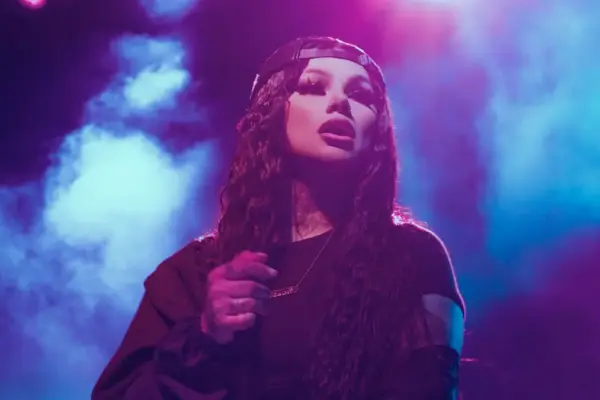







Before Lorely Rodriguez, known professionally as the acclaimed Honduran-American singer, songwriter, and producer Empress Of, could even begin to process the arduous physical and emotional reality of rebuilding her family’s long-standing home in Altadena, California, she had to build a new one entirely in song.
Sitting at a piano in the raw aftermath of the devastating Los Angeles wildfires that reduced her family home to rubble, Rodriguez penned a delicate, resolute promise to her mother. That single line of lyric would soon echo across her artistic output and serve as the emotional bedrock for her latest studio album: "I want to build a dream for you just the way you did for me."
Released on September 18, her new full-length record, Dream House, traces the tumultuous and transformative journey that followed that devastating loss. It is an exploration of grief, the mechanics of physical and emotional rebuilding, and a radically altered understanding of what constitutes a home when its four walls are suddenly stripped away.
For Rodriguez, the house her family lost was never merely a financial asset or a collection of architectural materials. Her family had inhabited the space since she was just six years old, making it a sprawling repository of her childhood, her formative memories, family history, and the tight-knit, diverse community that wrapped around them. For the singer-songwriter, the neighborhood of Altadena carried a profound and deeply personal cultural significance. It was a space where her Honduran mother—a single parent raising four children while working tirelessly as a house cleaner and nanny—was able to achieve the American dream of buying a home and forging a stable, secure foundation for her family.
The stark contrast between public perceptions of Los Angeles and the reality experienced by working-class immigrant communities became glaringly apparent to Rodriguez in the wake of the disaster. While mainstream media coverage often conflated the Los Angeles fires with the glamorous enclaves of celebrities and Hollywood hills, it frequently bypassed the historical realities of places like Altadena.
Reflecting on this disconnect, Rodriguez shared in an interview with HipLatina how the neighborhood stood out as a beacon of diversity and working-class achievement. "When the fires first happened, I think a lot of people that don’t live in LA equated LA with celebrity and Hollywood," Rodriguez explains. "And so a lot of people didn’t know the history of Altadena, and Altadena being so diverse, a place where my mom, who was a nanny and a house cleaner, could buy a house. Our neighbors—everyone—came from different backgrounds and different histories."
That profound sense of community, rooted in mutual struggle and shared immigrant experiences, became even more starkly visible in the aftermath of the catastrophe. While Rodriguez and her family grieved the loss of the physical structure where she grew up, the tragedy forced a realization that home had always existed far beyond the physical boundaries of a house. For many Latine communities, the concept of home is inherently diasporic and fluid. It is carried forward through the intangible threads that connect generations: the specific aromas and preparation of comfort foods, the languages and dialects spoken within the walls, the music that soundtracked familial milestones, and the presence of loved ones who serve as living mirrors, reminding individuals of who they are and where they came from.
Rodriguez notes how easily these grounding rituals can be taken for granted during the fast-paced demands of a professional music career. The whirlwind of international tours, high-profile red carpets, glossy magazine photoshoots, and relentless public visibility can easily fracture a person’s sense of self. Returning to her mother’s kitchen always offered an immediate, visceral antidote to the pressures of the entertainment industry.
"Whenever I’d be on tour, at a red carpet, or at a photoshoot or whatever, when I would come home in the past, I’d eat my mother’s food, and if she made a baleada or caldo, it’s like I immediately knew who I was again," Rodriguez reflects. "I am this artist. I am this entertainer. But when you strip all that away, and I’m just home—it’s a very grounding experience. So, not having had that for the last year, I’ve had to find home."
With that physical grounding temporarily obliterated, Rodriguez was forced to look elsewhere for sanctuary. She found it anchored firmly within her community, her immediate family, and, ultimately, the creative process of making new music. Dream House evolved into a necessary repository—a container built to hold the heavy, complex memories tied to the lost house while simultaneously making ample room for whatever future might emerge from the ashes.
The creative journey of the album brought unexpected gifts of self-discovery and gratitude for the artist. Rather than viewing the record solely as a document of pain, Rodriguez regards it as a collaborative blessing that ultimately invited listeners into a deeply private narrative of survival.
"I’ve been actually thinking about this. I’m like, ‘Wow, I’ve already been gifted so much by the album that releasing it and having other people hear it is just added blessings,’" she says. "Just a lot of gratitude and learning a lot about myself and making this album feel like home."
In a poignant artistic choice, Rodriguez went beyond merely writing about the experience; she physically incorporated authentic audio snippets of her mother speaking throughout the tracklist. This production decision transformed Dream House into a rich, multigenerational record. It serves as a dual reflection, capturing not only Rodriguez’s personal grief over losing the physical anchor of her identity, but also honoring the relentless, indomitable resilience of the woman who constructed that life from scratch decades prior.
"I use this album as a way to share a multigenerational experience of not only my experience of losing my home and things I identified with my entire life, but also to share my mom’s story," she shares. "It’s just the resilience and the determination that she’s always had her entire life. There are just moments where we talk about believing in ourselves, and my mom believes in herself so much."
That very same determination proved essential to the family’s literal, brick-and-mortar rebuilding efforts. Demonstrating the exact grit that defined her initial migration and decades of domestic labor, Rodriguez’s mother didn’t simply wait for contractors or bureaucratic ease. In the wake of the fire, she returned week after week to local government permit offices, navigating red tape with unwavering persistence, and ultimately took on the formidable role of serving as the primary contractor for the new house herself. The woman who had originally carved out a sanctuary for her children in Altadena was now literally rebuilding their physical world from the ground up—providing Rodriguez with a living, breathing model of how to engineer a future in the absolute face of total loss.
Before reaching that optimistic horizon, however, the creative process demanded an initial period of unvarnished grief. Rodriguez recounts how the first wave of songwriting born from the disaster was raw, agonizing, and entirely private—material that was never intended for public consumption. She had to give herself full permission to mourn before she could pivot toward themes of renewal.
"And when I decided to start making music about this experience, I wrote a bunch of songs that nobody should ever hear, and it’s just me just crying into a microphone," she says. "And then I started to write songs about the optimism of rebuilding, which felt more in line with the energy that I wanted to give myself."
That hard-won optimism pulses directly through the heart of the album’s title track, "Dream House." Written at the piano before a single beam of the new house had been raised, the song captured Rodriguez’s aspirations for her mother. It was an act of imaginative reclamation, conceptualizing everything she wanted her mother to possess after a lifetime of sacrifice for her children. The track quickly crystallized, becoming the emotional and conceptual blueprint for the entire musical project.
"When I wrote the song ‘Dream House,’ we hadn’t built our house yet, and I was sitting at a piano, and I was thinking about all of the things I wanted my mom to have, and how she had built a dream for me already," she explains. "The opening lyrics of that song are, ‘I want to build a dream for you just the way you did for me.’ And I think a dream house is all the possibilities."
Through this composition, Rodriguez successfully bridged two profound acts of creation: the foundational home her mother had tirelessly constructed for her children decades ago, and the expansive, hopeful future that Rodriguez was now capable of imagining for them both.
Although the physical house has since been successfully rebuilt, the trauma and subsequent recovery taught Rodriguez a permanent lesson about human vulnerability. She observes that the elements of life that grant a deep sense of rootedness often reveal their true, irreplaceable value only when they are abruptly taken away.
"I mean going back to that earlier feeling of what those familiar things that make you remember your identity, specifically to my Latinidad, is just those things," she notes. "In the moment you know how comforting they are, but you know even more when they’re not. So it’s like everything means more now. Everything has a bigger smile, a bigger affinity, a bigger familiarity, because I understand what it meant not to have it."
Ultimately, Dream House poses a universal question to anyone navigating profound loss: What remains when the physical markers of an entire life disappear into smoke, and what have we actually been carrying inside us all along? For Rodriguez, the recording studio and the microphone became instruments of transmutation, turning a terrifying, isolated experience into a communal, hopeful offering.
While she acknowledges that listeners will bring their own interpretations and emotional needs to the music—whether looking for deep introspection or simply seeking an escape—she hopes the vulnerability embedded in the record resonates with others facing their own fears.
"I can never control what someone’s going to get out of this music," she says. "Because they could just be like, ‘Oh, I need to have a good time.’ But for me to use music as a healing tool and to talk about something that was a scary experience for me, it took a lot of bravery, and I hope that someone can see that and be like, ‘Well, if she did something she was afraid to do, I can as well.’"
Emerging from a grueling year spent learning how to locate home in places far beyond a single geographical coordinate, Rodriguez leaves her audience with the foundational philosophy that guided her family through the darkest hours of rebuilding. Summarizing the resilience inherited from her mother and articulated through her art, she holds fast to a simple truth: there is always tomorrow.
This feature is part of our 2026 Latina Heritage Month series, Latina Maxxing.