










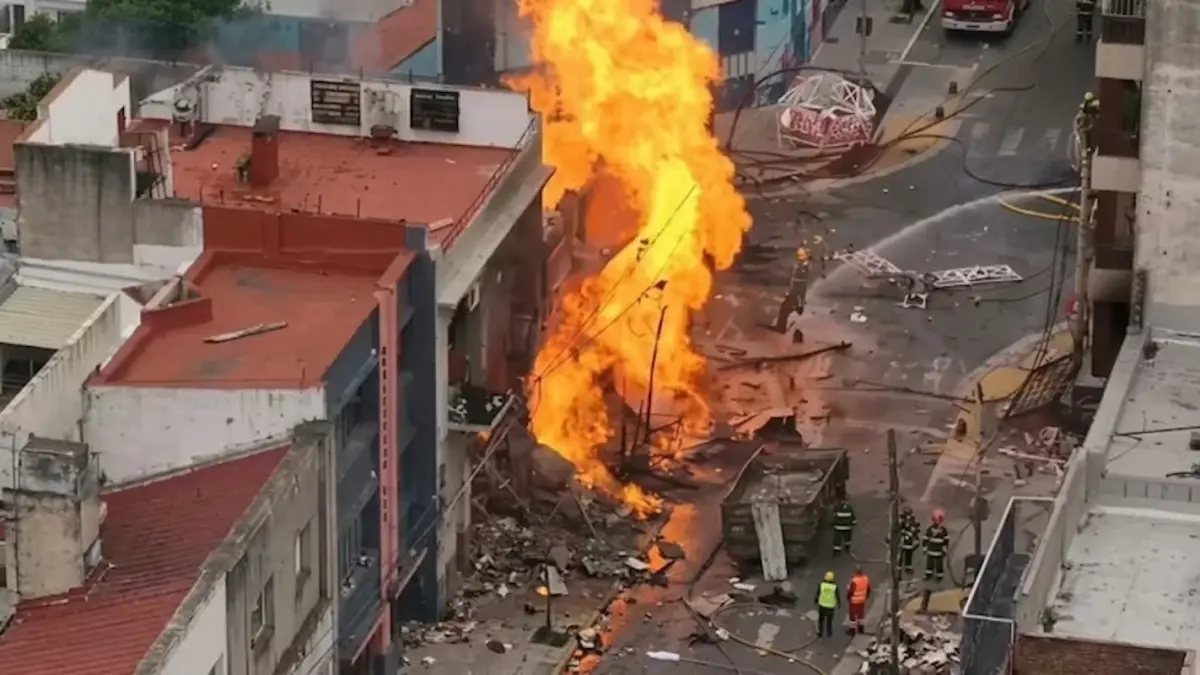
A powerful gas explosion followed by a massive and destructive fire left one person dead and thirty individuals injured in Remedios de Escalada, located within the jurisdiction of Lanús in Buenos Aires Province, on Friday. Among the thirty injured victims, authorities confirmed that at least seven are currently in serious condition, receiving intensive medical care at local healthcare facilities. Compounding the tragedy and keeping emergency responders on high alert, search and rescue teams reported that two people remain unaccounted for, prompting frantic efforts to locate them amid the rubble and debris.
According to official information released by the Municipality of Lanús, the catastrophic sequence of events began during routine maintenance operations in the area. A third-party contractor identified as Exaget—which had been officially hired by the major gas provider MetroGAS—was operating heavy machinery when disaster struck. Investigators established that a tunnel-boring machine being used by the contractors accidentally struck and ruptured a critical pipe within the local gas distribution network. The rupture, which initiated the dangerous leak, reportedly occurred at 9:44 a.m. local time, which was more than an hour before the final, devastating explosion rocked the commercial district.
The prolonged window between the initial pipe rupture and the eventual blast highlights critical questions regarding protocol and emergency response times. Municipal authorities and eyewitnesses noted that in the moments leading up to the explosion, a heavy, unmistakable odor of gas hung thickly in the air, causing immediate alarm among residents, pedestrians, and local business owners who smelled the hazard drifting through the streets.
Swift Action Amid Looming Danger
Realizing the extreme peril posed by the uncontained gas leak, local authorities and emergency personnel initiated emergency protocols to clear the immediate vicinity. All residents living in the immediate impact zone were promptly evacuated from their homes, while nearby commercial establishments, offices, and public spaces were cleared of people to prevent an even greater loss of life.
Among the evacuated locations was a specialized care home for individuals with disabilities. In a coordinated and precautionary effort, caregivers and emergency responders safely transported all residents of the facility away from the danger zone to a nearby municipal swimming pool, where they could be sheltered temporarily while emergency crews tackled the escalating crisis.
The explosion itself took place in a densely populated commercial district during a time of heavy morning traffic, compounding the potential for widespread devastation. When the accumulated gas finally ignited, the force of the blast sent shockwaves through the neighborhood, shattering windows, buckling structural walls, and causing extensive property damage throughout the corridor. Initial post-incident assessments conducted by municipal inspectors revealed that at least twenty-nine vehicles parked along the streets or caught in traffic were completely destroyed or severely damaged by the intense heat and concussive force of the explosion.
Firefighters and emergency response teams rushed to the scene, battling towering flames and thick smoke. Through coordinated efforts, the fire was eventually brought under control, preventing it from spreading further to adjacent residential and commercial structures. However, city officials on the ground reported that firefighters had to exercise extreme caution, waiting patiently for the gas supply lines to be completely and securely shut off at the source before they could fully extinguish the remaining pockets of fire and begin a comprehensive, structural assessment of the damage.
The Aftermath and Regulatory Investigation
As the smoke cleared and emergency workers continued their meticulous search for the two missing individuals, government and regulatory bodies stepped in to address the systemic failures that allowed the disaster to occur. The government issued an official statement through the National Gas and Electricity Regulatory Agency, known in Spanish as ENReGE. The agency formally addressed the alleged causes of the accident, expressed deep regret over the loss of life and injuries, and announced the launch of an immediate, thorough investigation to establish accountability.
Quoting the preliminary findings submitted by the utility provider, an ENReGE statement detailed the timeline of the accident: “According to the company, a tunnel-boring machine reportedly damaged a pipeline in the distribution network, which reportedly caused a gas leak. While repair work was being carried out, an explosion reportedly occurred; the causes are under investigation.”
The regulatory communique went on to emphasize the agency’s profound regret regarding the “consequences of this type of accident on public services.” Furthermore, ENReGE assured the public that it will conduct all corresponding accident investigations with rigorous oversight, promising to make its final findings fully available to the courts to ensure that justice is served and that systemic vulnerabilities within public utility operations are addressed.
Questions Over Emergency Reporting Protocols
As investigators dig deeper into the chronology of Friday’s tragedy, a major point of contention has emerged regarding how the incident was initially reported to authorities. According to municipal authorities in Lanús, critical minutes may have been lost due to a failure in communication protocols immediately following the initial pipe strike.
The municipality stated that after detecting the rupture and the subsequent gas leak, company personnel initially reported the emergency exclusively to MetroGAS’s internal hotline. Officials argue that this internal notification bypassed the city’s mandatory municipal emergency protocols, which strictly dictate that any gas leak posing a public hazard must be reported directly and immediately to official emergency services, civil defense, and local firefighters. Investigators are expected to examine whether notifying internal corporate channels instead of municipal responders delayed the evacuation and containment efforts, potentially contributing to the severity of the disaster.
Local authorities, emergency management teams, and judicial investigators are continuing their work at the site in Remedios de Escalada, gathering forensic evidence, interviewing witnesses, and reviewing safety logs as the community begins the long and painful process of recovery.