
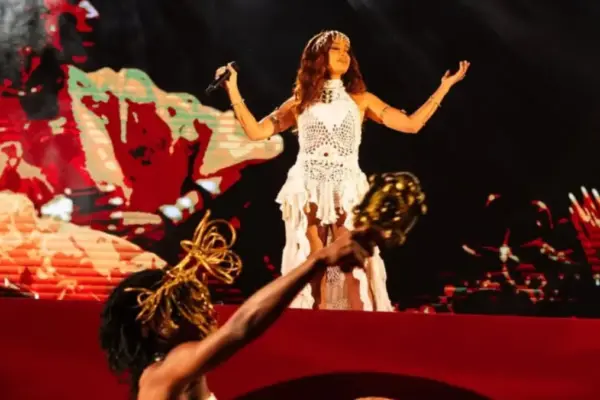









Daniela Avanzini has found herself at the center of an intense online debate, becoming the latest public figure asked to prove she is “Latina enough.”
The KATSEYE member has recently faced heavy scrutiny across social media platforms, with critics questioning whether she is only now leaning into her Venezuelan and Cuban roots as a calculated branding move. For many vocal social media users, this sudden or more visible alignment feels overly convenient at a historic moment when Latinidad is more culturally visible, marketable, and embraced globally than ever before.
The discourse around the young pop star intensified following recent comments made by her father, Rafael Avanzini. His controversial remarks suggested that the global girl group should continue with scheduled performances despite bandmate Manon Bannerman taking a health-related hiatus. While the father’s comments drew immediate backlash, the core grievance directed at Daniela appears to be rooted in perceptions of her past visibility. Critics argue that she did not publicly embrace her Latina identity early on, allowing her to benefit from the privileges of passing as a white Latina and blending into mainstream spaces, only to highlight her heritage more prominently now to appeal to a broader international audience.
Conversely, Daniela’s supporters have mounted a strong defense, arguing the exact opposite. Fans point out that she has consistently identified as an American-born Latina from Atlanta, proudly acknowledging her heritage through past interviews, bilingual live streams, and even her vocal performances. For many in her corner, the online backlash feels less like genuine community accountability and more like harsh, unwarranted identity policing.
At its core, this controversy taps into a much larger, ongoing cultural conversation. Over the past decade, as identity politics has gained prominence in mainstream media and public figures face heightened scrutiny for their words and actions, communities of color have increasingly wrestled with internal policing. Within Latine communities specifically, this dynamic has long existed.
Many individuals born or raised in the United States have been told at some point that they are not “Latina or Latino enough.” This exclusion often stems from a lack of fluency in Spanish, specific differences in upbringing, or how an individual is racially perceived. While these community-driven conversations are frequently framed as a form of collective accountability, they have arguably evolved into something much more rigid: a strict policing of who is permitted to identify as Latine and who receives full acceptance from the community.
This dynamic becomes even more complex within a group like KATSEYE. As a K-pop-adjacent global girl group featuring members from diverse backgrounds and ethnicities, it naturally attracts an audience that is quick to investigate, analyze, and police authenticity. But this phenomenon ultimately raises a critical question: who gets to define identity, and by whose standards?
A review of Daniela’s public background shows that she has previously identified as a Latina from Atlanta with Venezuelan and Cuban parents. This raises fair questions about whether it is accurate to assume she hid her identity previously, and whether individuals are allowed to reconnect with, explore, and embrace their heritage later in life.

The tension surrounding diaspora identity and performance is deeply multifaceted. On one hand, Daniela is part of a global pop group designed for cross-cultural appeal. On the other hand, she navigates the world with the privilege of being able to present as white in a society historically rooted in white supremacy. While it is unfortunate that any individual young artist must bear the weight of a diaspora’s collective historical pain, this debate extends far beyond one pop star. It speaks directly to deep-seated questions about who gets to claim Latinidad. People of color living in the United States are constantly pressured to prove their loyalty to their communities and demonstrate their cultural connections in ways that white Americans are rarely, if ever, required to do.
This entire conversation exposes deeper realities about history, power, and how identity is regulated in the United States. In American society, whiteness is rarely treated as a distinct ethnicity; instead, it functions as the default baseline. White Americans are not routinely asked whether they are "Irish enough" or "Italian enough," because their fundamental Americanness is assumed rather than questioned.
Because whiteness has historically occupied the position of the cultural norm, everyone else is categorized as "something else"—an identity that apparently requires explanation or proof. Meanwhile, communities of color have historically been denied a sense of unconditional belonging. From the legacies of slavery, segregation, and immigration restrictions to genocide, cultural erasure, and intense assimilation pressures, the identities of Black, Latine, Asian, and Indigenous communities have constantly been shaped under systems that actively questioned their legitimacy.
Consequently, identity for people of color has often transformed into something that must be defended, preserved, and continually proven. In the United States, opportunities for authentic representation in media, music, film, television, and politics remain limited. When a public figure is positioned to represent a specific marginalized group, the stakes immediately feel much higher.
This creates immense pressure for individuals to serve as perfect embodiments of an entire culture. White Americans largely escape this burden because the sheer abundance and normalization of white representation mean no single white person is ever expected to carry the weight of representing all white people.
When examining Latinidad specifically, race remains a central factor. Colorism and varying degrees of proximity to whiteness heavily influence how individuals are perceived and treated both inside and outside the community. There is a common misconception that Black and brown Latines who react with suspicion when white or white-presenting public figures suddenly claim their heritage are simply acting out of jealousy or petty gatekeeping.
However, these reactions are typically rooted in very real, lived patterns of race, power, and visibility within Latinidad. The Latine diaspora possesses its own internal racial hierarchy that often mirrors broader societal structures of white supremacy. Lighter skin, straighter hair, and Eurocentric features have historically been rewarded, while darker skin, Afro-textured hair, and Indigenous or African features have been marginalized, overlooked, or erased.
This legacy of colonialism and colorism means that proximity to whiteness frequently equates to greater social access—a reality that persists today. Therefore, when a white or light-skinned Latine person suddenly places a heavy emphasis on their cultural identity, that expression does not happen in a vacuum. It interacts with a system where that individual has likely already benefited from not being visibly perceived as an outsider, whereas many darker-skinned Latines never had the luxury of opting out.
For brown and Black Latines, identity is frequently visible whether they actively claim it or not. Lacking the privilege of blending seamlessly into white society, they experience external racism and internal colorism simultaneously, meaning they cannot simply move through the world as "just white" or selectively showcase their Latinidad when it becomes convenient.

This reality fuels a persistent question among marginalized communities: Where were you when Latines were being targeted or politically marginalized? Where were you when our communities suffered under systemic power structures?
When public figures—whether musicians or politicians—suddenly display outward pride after previously downplaying their heritage, it can easily read as selective participation, cultural opportunism, or a trend-driven branding pivot. While this may not always be the individual’s intention, it mirrors historical patterns of convenience.
At the heart of the criticism lies an underlying inequity: the suspicion that an individual is benefiting culturally from something that others are still actively penalized for. The underlying sentiment is often less about denying someone’s ethnic background and more about the recognition that they have not had to carry the burdens of that identity in the same way. This tension is experienced even more acutely by Black Latines, whose historical and ongoing exclusion both inside and outside the broader Latine community has had profound consequences.
For darker-skinned Latines, watching a white or light-skinned artist prominently embrace their Latinidad can feel less like a genuine personal journey and more like a familiar cycle where Spanish-language music becomes globally profitable and pop culture suddenly makes Latinidad trendy.
At the same time, acknowledging these systemic power dynamics does not mean that Daniela’s recent public embrace of her culture is inherently inauthentic. It does not mean she is not Latina enough, nor does it mean individuals are barred from growing into their identity later in life, particularly if they were not raised directly within the culture.
Instead, it highlights the reality that how she expresses her identity is inevitably interpreted through a historical lens she did not create, yet still benefits from as a white Latina. Historically, Latinidad achieves greater visibility and celebration when embodied by individuals in close proximity to whiteness, and Daniela sits precisely at that intersection.
Navigating this reality requires finding a balance between acknowledging structural truths and extending grace to individuals. Using this current debate as a case study, the broader question is how a community can protect its cultural integrity without devolving into rigid exclusion or immediate condemnation.
Offering the benefit of the doubt does not require ignoring history or the power dynamics still at play. It simply calls for pausing before assigning malicious intent and resisting assumptions until the full context is understood. Rather than immediately accusing a public figure of embracing their heritage solely for trendiness, observers can consider the individual’s broader relationship with their identity over time.
If Latinidad is a culture meant to be embraced, the community must make space for how and when its members arrive at that connection, rather than rigidly policing how convincingly they perform it once they do. The goal is not to lower standards of accountability, but to stop confusing accountability with exclusion. Maintaining a vibrant and resilient community requires ensuring there is always room for its people to come home to.