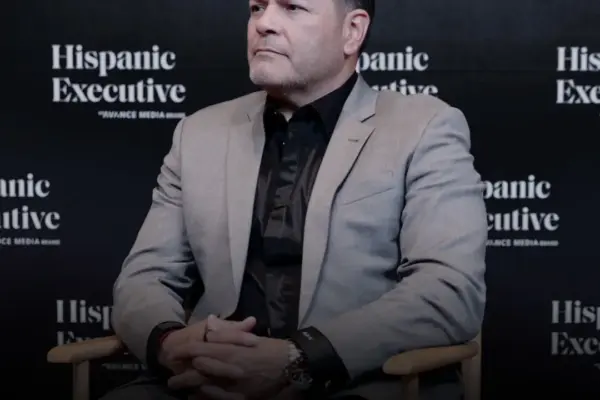












At the AVANCE Global event in Las Vegas, filmmaker Dito Montiel looked back at his formative years in New York City’s gritty hardcore punk scene with a sense of practical nostalgia. His band wasn’t particularly good at playing Led Zeppelin covers, he joked to the audience, so they quickly realized they needed a different approach. Instead of trying to master complex arrangements belonging to other artists, they decided to write their own songs, organize their own underground shows, and figure out the mechanics of the industry along the way through sheer trial and error.
Decades and ten feature films later, that raw, do-it-yourself mentality continues to shape his creative output and his perspective on modern art.
“You could make a movie on your iPhone,” Montiel said, reflecting on how remarkably accessible filmmaking tools have become in the digital age. His advice to aspiring artists and creators was refreshingly simple: stop waiting for a major Hollywood studio to call and start creating work independently.
His lived experience and practical advice raise a profound question that extends far beyond the soundstages of Hollywood and the boardrooms of major corporations: Can having fewer options actually make us more creative?
Decades of psychological and organizational research suggest that, under specific and well-defined conditions, the answer is a resounding yes.
When Limits Become an Advantage
In modern culture, we tend to associate true creativity with absolute freedom—unlimited time, generous budgets, and endless possibilities. Yet, complete freedom is not necessarily the ideal environment for sparking innovative thinking. When everything is possible, the sheer volume of choices can sometimes lead to paralysis rather than inspiration.
In a comprehensive 2019 review published in the Journal of Management, researchers Oguz Acar, Murat Tarakci, and Daan van Knippenberg examined the intricate ways in which constraints influence individual creativity and organizational innovation. Their extensive work suggests that certain restrictions can actually encourage creative thinking by narrowing the overwhelming range of possibilities and directing human attention toward alternative, unconventional solutions.
Consider a corporate marketing team tasked with developing a new national advertising campaign. If management provides no clear parameters, the potential directions are virtually endless, making it difficult to align on a cohesive vision. However, introduce a specific target audience, a strict format, or a distinct production requirement, and the team suddenly has a sharply defined problem to solve.
The restriction ceases to be an obstacle and instead becomes an integral part of the creative challenge itself.
However, the researchers also discuss a nuanced, inverted-U relationship regarding the nature of limitations. While some constraints certainly help focus the mind and spur ingenuity, excessive restrictions can quickly undermine creativity and morale. There is no universal formula or exact measurement for how much limitation produces the absolute best results.
Not All Constraints Work the Same Way
It is important to recognize that not all limitations are created equal. A limited budget, a tight deadline, and a specific creative brief are all forms of constraints, but they do not necessarily affect the human creative process in the same way.
Research conducted by Brent Rosso and published in Organization Studies in 2014 closely examined how various restrictions shape the creative processes of research and development teams. His work highlights a crucial distinction in organizational psychology: constraints can successfully help structure a complex challenge, but they can also interfere with a team’s ability to freely explore diverse solutions.
To illustrate this dynamic, consider two distinct workplace scenarios. Asking a creative team to communicate a complex organizational idea within a strict thirty-second video format creates a focused, engaging creative problem that demands clever distillation. Asking that exact same team to produce an entire multi-platform campaign with insufficient staff and unrealistic deadlines creates an entirely different operational environment.

The first scenario may encourage inventive, out-of-the-box thinking. The second scenario may simply make good, sustainable work much harder to achieve.
Furthermore, foundational research on organizational creativity by Teresa Amabile reinforces the critical importance of intrinsic motivation and a healthy work environment. For modern leaders and executives, the practical implication of these findings is straightforward: define the core challenge clearly for your team, but avoid prescribing every single step of the solution.
The Danger of Romanticizing Scarcity
Inspiring stories about visionary entrepreneurs building multinational companies inside humble garages and independent filmmakers crafting masterpieces with borrowed equipment are undeniably compelling. They capture our imagination and highlight the triumph of human ingenuity over adversity. However, these romanticized narratives can also create a misleading cultural impression that fewer resources automatically and invariably produce better ideas.
Research focusing on workplace time pressure offers a useful and sobering counterpoint to the myth of perpetual scarcity.
In the influential article “Creativity Under the Gun,” published in the Harvard Business Review, Teresa Amabile, Constance Hadley, and Steven Kramer examined how strict deadlines and pressure affect everyday creative work within organizations. Their empirical findings challenge the common assumption that urgency universally improves creativity. While time pressure can occasionally encourage sharp focus and urgency, it can just as easily interfere with the deep exploration and quiet reflection that truly original thinking requires.
This distinction matters deeply in practical applications. A smaller financial budget might inspire a creative production team to adopt a different, more imaginative artistic approach. Conversely, a budget that is far too small to adequately test or execute an idea can completely prevent that concept from becoming anything meaningful or viable in the real world.
True creativity under constraints is fundamentally not the same thing as creativity driven solely because of constraints.
Give People Boundaries, Not Roadblocks
For modern executives, business leaders, and creative directors, the primary lesson derived from this research is not to deliberately slash resources or manufacture artificial crises. Rather, the goal is to carefully identify which specific limitations help teams maintain focus while actively preserving enough operational room to experiment and take risks.
Dito Montiel’s eclectic career illustrates this delicate balance in action. His early roots in the aggressive DIY punk scene taught him an invaluable lesson: creating art does not always require institutional permission, industry connections, or expensive, high-end tools. Yet, as a seasoned veteran of the entertainment industry, he also readily acknowledges that commercial filmmaking ultimately depends heavily on collaboration, substantial financing, and a deep sense of responsibility toward the cast, crew, and investors who make the projects possible.
Both of these realities can be true at the same time.
An artist or entrepreneur does not need unlimited resources to begin the journey of creation. But to truly scale an idea and bring it to life, they do need sufficient freedom, institutional support, and structural backing to turn a fleeting concept into something of lasting value.
Ultimately, the most useful constraints are those that make the underlying problem much clearer without dictating the final answer, allowing human ingenuity to bridge the gap between limitation and achievement.