











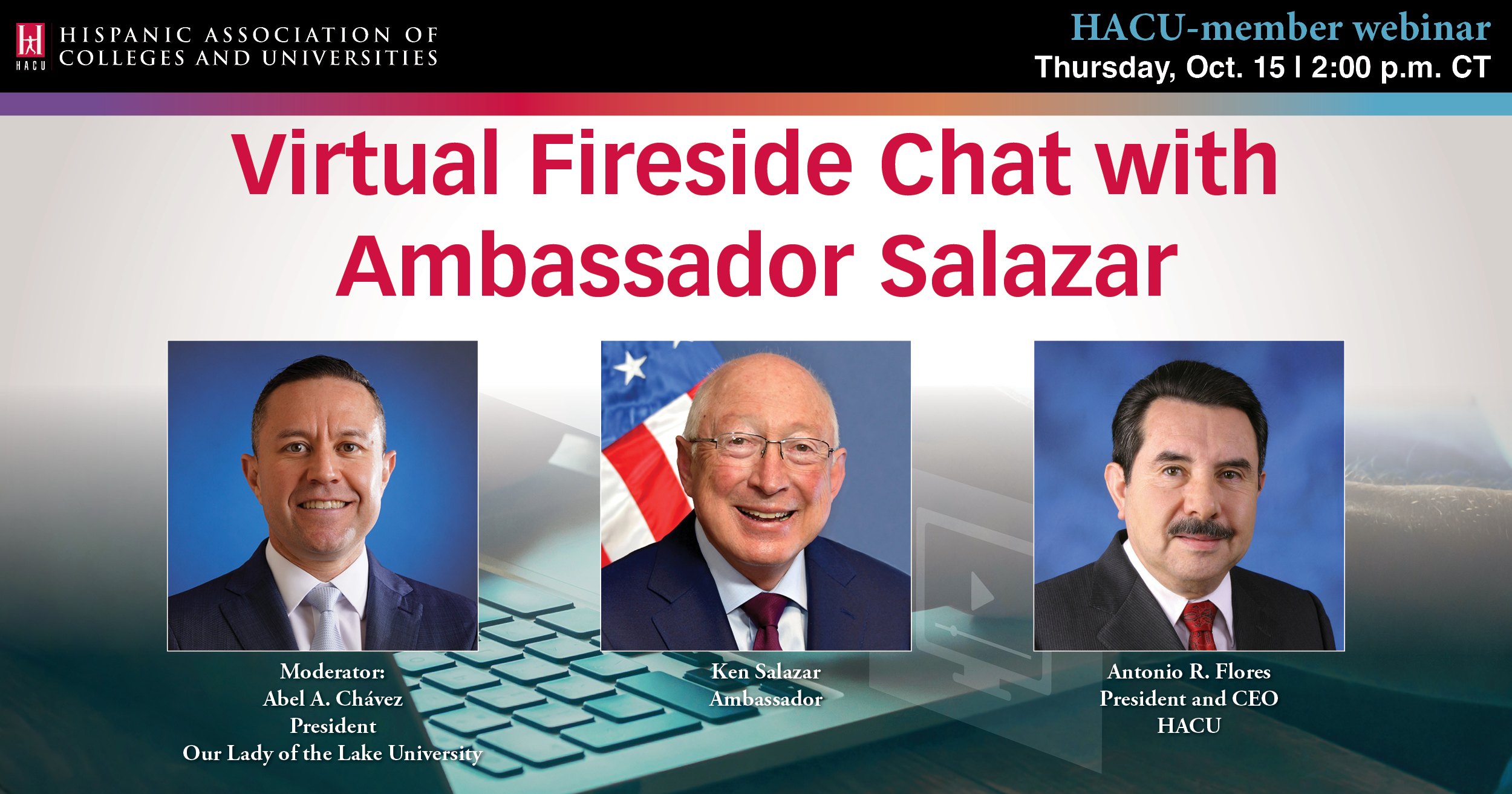
The Hispanic Association of Colleges and Universities (HACU) recently brought together educators, students, and public service leaders for a compelling virtual fireside chat with Ambassador Ken Salazar. Held on October 15, 2026, the online event centered on Salazar’s newly published memoir and manifesto, Borderlands: My Fight for an Inclusive America, offering a profound exploration of leadership, identity, and the enduring quest for a more equitable society.
The high-profile conversation was led by HACU President and CEO Antonio R. Flores, who joined Ambassador Salazar for the discussion. Moderating the dialogue was Abel A. Chávez, President of Our Lady of the Lake University, who guided the conversation through a wide range of pressing themes, including the state of higher education, cross-border diplomacy, and the vital pathways to civic leadership for the next generation of Americans.
A Life Rooted in the American West and Public Service
Ambassador Salazar’s journey to the upper echelons of American governance and international diplomacy is deeply rooted in the rural landscapes of the American West. Growing up on his family’s ranch in Colorado’s picturesque San Luis Valley, Salazar experienced firsthand the challenges and values of rural working-class life. As the first member of his family to attend college, his trajectory broke traditional barriers and set the stage for a lifetime of trailblazing public service.
Over a distinguished career spanning decades, Salazar has held some of the most influential positions in state and federal government. He served as the attorney general of Colorado, representing the legal interests of the state’s residents before winning election to the United States Senate. Following his tenure in Congress, he answered the call to executive leadership as the U.S. Secretary of the Interior under the Obama administration, where he oversaw the management and conservation of vast federal lands and natural resources. Most recently, he stepped onto the international stage as the United States Ambassador to Mexico, navigating complex geopolitical dynamics and fostering crucial bilateral cooperation.
In his book, Borderlands, Salazar draws directly from these transformative experiences. Rather than a standard political memoir, the text serves as a reflective examination of his life in the public eye, weaving personal anecdotes with broader arguments for the preservation and strengthening of an inclusive American democracy. During the HACU fireside chat, he elaborated on these themes, emphasizing that the diverse cultural landscapes of the United States and its borders are not points of division, but rather sources of immense national strength and cultural richness.
The Role of Higher Education and Hispanic-Serving Institutions
A central pillar of the discussion between Salazar, Flores, and Chávez was the indispensable role that higher education plays in shaping the future of the nation. The dialogue closely examined how foundational experiences in family and education serve as the primary catalysts for a life dedicated to public service. For an organization like HACU, which champions the advancement of Hispanic-Serving Institutions (HSIs), the conversation struck a resonant chord.
President Flores and Ambassador Salazar explored how HSIs are uniquely positioned to serve as engines of social mobility and leadership development. Because these institutions enroll significant populations of Hispanic and first-generation college students—much like Salazar himself decades ago—they carry a profound responsibility to nurture talent, build confidence, and open doors to leadership roles that have historically been out of reach for marginalized communities. The conversation highlighted actionable ways that colleges and universities can actively prepare their students to step into leadership positions across government, business, science, and the non-profit sector.
Furthermore, the panel addressed the pressing need to bridge deepening political and cultural divides within the United States. In an era marked by polarization, the speakers discussed how academic institutions can foster environments of rigorous, civil discourse and mutual understanding. By equipping students with the critical thinking skills and intercultural competencies necessary to navigate complex societal issues, universities can help heal fractures in the national fabric and promote a more cohesive, inclusive civic culture.
Strengthening U.S.-Mexico Relations and Cross-Border Collaboration
Given Ambassador Salazar’s extensive diplomatic tenure as the U.S. Ambassador to Mexico, the virtual fireside chat naturally expanded into the critical realm of international relations. The dialogue underscored the deep, inextricable ties between the United States and Mexico, emphasizing that cooperation between the two nations is essential for economic prosperity, regional security, and cultural vitality.
The conversation ventured into specific areas of cross-border collaboration, focusing particularly on how educational institutions, research facilities, and workforce development initiatives can bridge geographical and political boundaries. Salazar and the university leaders discussed how partnerships between universities on both sides of the border can drive innovation, facilitate the exchange of scholarly and scientific expertise, and build a unified workforce equipped to tackle shared challenges in the North American region. These collaborative educational efforts are seen as vital mechanisms for transforming border regions from zones of tension into dynamic hubs of mutual growth and opportunity.
Bringing Borderlands to Classrooms Through New Initiatives
Towards the conclusion of the event, Ambassador Salazar introduced an exciting new avenue for academic institutions to engage students directly with the themes of his book. He shared details regarding One Book, More Voices, an innovative effort established through the Borderlands New North American Alliance Fund.
This initiative is designed to help colleges, universities, and high schools integrate Borderlands into their academic curricula and campus programming. Through the fund, participating institutions can access matching copies of the book, making it easier to distribute texts to classrooms, campus libraries, and specialized student programs. By bringing the book into academic settings, the initiative aims to spark meaningful campus-wide conversations about identity, civic responsibility, and the ongoing American experiment.
The virtual event concluded with a renewed sense of purpose among the attending educators and administrators, reinforcing HACU’s ongoing mission to champion Hispanic success in higher education and foster the next generation of visionary leaders inspired by the principles of an inclusive America.