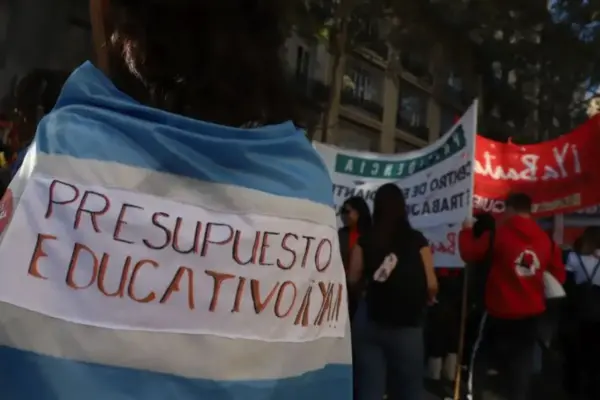





BUENOS AIRES — The Argentine government filed a formal criminal complaint on Friday against demonstrators who participated in a mass protest held the previous day in support of public universities. The legal action, spearheaded by the Security Ministry’s legal team, alleges property damage, assault on public officials, and violations of the constitutional order during what marked the fifth major demonstration of its kind since President Javier Milei took office.
The complaint specifically targets individuals within the crowd who allegedly hurled broken fragments of sidewalks and other heavy objects directly at police officers. According to the filing, these targeted protesters deliberately concealed their faces to avoid identification, initially damaging public infrastructure to unearth materials they could use as projectiles against law enforcement.
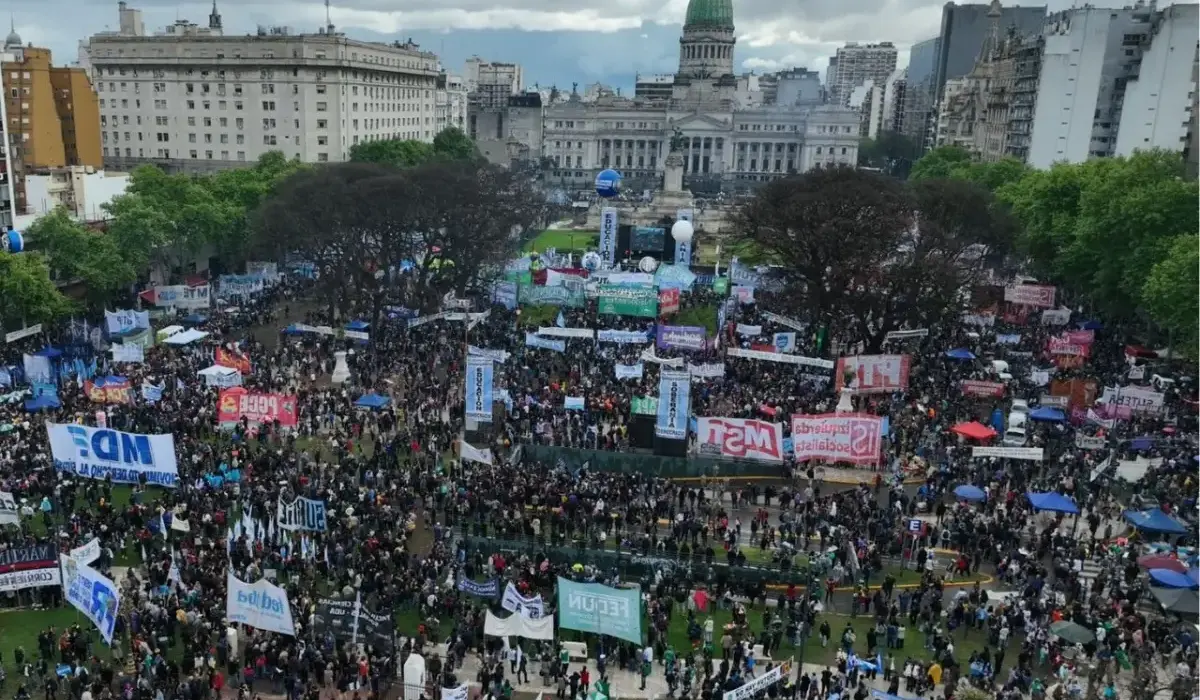
The demonstrations, which drew university rectors, deans, professors, students, and administrative staff from across the country, were organized to demand that the government comply with a 2025 law guaranteeing adequate funding for public higher education institutions. These universities have faced a prolonged and critical operational period characterized by severe salary stagnation and acute resource shortages under the current administration.
Protest Ends in Violence
The march, which had gathered significant momentum throughout Thursday, ended abruptly amid heavy evening rainfall and a widespread police crackdown. Security forces from multiple jurisdictions deployed tear gas, rubber bullets, and pressurized water cannon trucks to disperse the crowds gathered outside the heavily fenced National Congress building.
The security response extended far beyond the immediate groups engaged in clashes, affecting hundreds of peaceful demonstrators who had gathered to hear academic leaders read a formal document outlining their demands.
Emiliano Yacobitti, Vice President of the University of Buenos Aires, spoke with news channel TN following the abrupt conclusion of the event, explaining that participants were forced to evacuate the area due to the dense clouds of tear gas deployed by police. Yacobitti emphasized that the actions of a small faction of violent individuals should not overshadow the peaceful, massive nature of the turnout in Buenos Aires and other regions.
"The crackdown that took place was completely excessive," Yacobitti stated during the interview, underscoring the stark contrast between the broad academic mobilization and the aggressive police response.
Authorities confirmed that at least 30 people were arrested during Thursday’s operations. Among those detained were two minors, aged 14 and 17, who were subsequently released following processing.
Injuries Caused by the Crackdown
The Provincial Commission for Memory, a public human rights organization operating in the region, released a preliminary assessment indicating that more than 550 people suffered injuries or adverse effects from tear gas, rubber bullets, and high-pressure water streams during the march. The organization characterized the police intervention as "excessive and brutal."
According to the human rights group’s documentation, law enforcement personnel fired more than 120 tear gas grenades, hundreds of rubber bullets, Byrna chemical pellets, and pepper spray. Additionally, two water cannon trucks were deployed, requiring at least three separate refills during the operations. The commission also asserted that six specific arrests executed by the Buenos Aires City Police, including those involving the two minors, constituted arbitrary detentions.
Journalists covering the demonstration also found themselves in the line of fire. Photoreporter Guido Piotrkowski, working for the newspaper Página/12, captured photographic evidence of a Federal Police officer aiming and firing rubber bullets directly at him. Piotrkowski reported being struck twice, noting that while the impacts hit his chest, the trajectory could easily have caused more catastrophic injury. Writing in an Instagram post, Piotrkowski added that a colleague standing nearby had also been shot in the legs. Another reporter, Lula González, reported being grazed by a rubber bullet while working at the scene.
While members of the press covering Argentine demonstrations routinely wear specialized press vests and often carry gas masks, reporters have increasingly adopted additional protective gear, such as helmets, in the wake of severe injuries sustained by photojournalist Pablo Grillo.
Grillo suffered critical skull fractures and brain damage in March 2025 while covering a pension reform protest, when a military police officer discharged a tear gas canister directly at his head. Following more than a year of intensive rehabilitation at a specialized public hospital to recover from severe speech and mobility impairments, Grillo returned home in April to continue his ongoing care. The military police officer responsible for the incident was subsequently charged with causing serious injuries and is slated to stand trial.
Official Response and Legal Proceedings
The Security Ministry defended the aggressive police deployment, maintaining that the state has a fundamental obligation to preserve public order and protect infrastructure.
During the demonstration, Security Minister Alejandra Monteoliva took to the social media platform X to address the unfolding events, writing, "The same violent actors as always. They want to impose chaos, defy the Security Forces, and turn the streets into a liberated zone."
In a subsequent statement, Monteoliva added, "The right to protest does not grant permission to commit acts of violence. Those who attack our officers, destroy public property, or commit crimes will be held accountable by the courts."
The criminal complaint filed on Friday formalizes this stance, setting the stage for judicial scrutiny of the protesters identified in the government’s evidence. Meanwhile, university authorities and human rights organizations continue to denounce the severity of the police response, deepening an ongoing national debate regarding the limits of state power, the protection of peaceful assembly, and the funding crisis plaguing Argentina’s public educational institutions.