








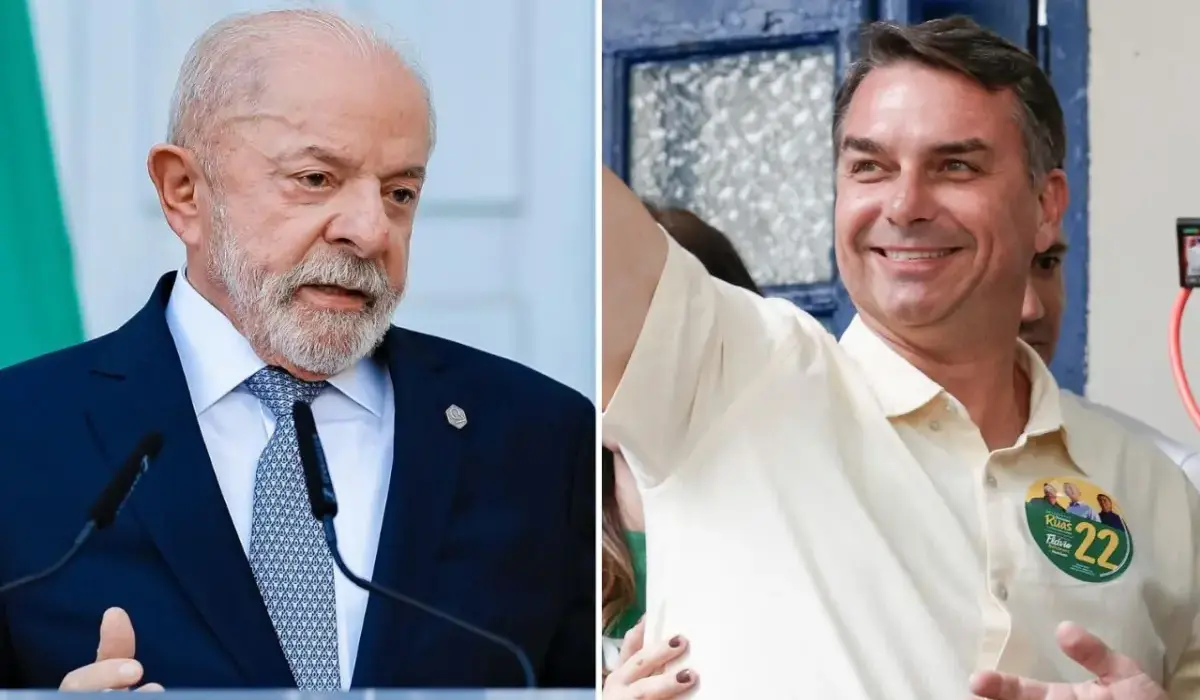
Brazil is officially headed for a high-stakes presidential runoff between center-left incumbent President Luiz Inácio “Lula” da Silva and far-right Senator Flávio Bolsonaro. The electoral landscape shifted dramatically after the challenger secured a surprise lead in the first round of voting, capturing nearly two percentage points more than the sitting president.
Ahead of the crucial vote, most major pre-election polls had consistently pointed to a leading position for Da Silva. However, when the final ballots were tallied, the incumbent garnered 45.1% of the vote. Meanwhile, his primary rival—Flávio Bolsonaro, the eldest son of former right-wing President Jair Bolsonaro, who governed from 2018 to 2022—outperformed expectations by pulling in 47%. While it was a remarkably strong showing for the conservative senator, it fell just short of the absolute majority required to secure an outright victory in the first round, forcing the contest into a decisive second phase.
The two political adversaries are now scheduled to face each other again in a runoff election on October 25. Early indicators suggest the momentum may favor the challenger; the first post-election survey published by the prominent polling agency Datafolha showed Bolsonaro leading the prospective runoff with 49% of voter intentions, compared to 45% for Lula.
To dissect the implications of these surprising results, several leading Brazilian political analysts spoke with reporters to break down what the first-round outcome means for the candidates, their respective parties, and the broader future of the South American nation.
A Stunning Electoral Surprise
The outcome of the first round caught political observers across the country completely off guard.
“Flávio Bolsonaro’s victory in the first round was a huge surprise,” said Creomar De Souza, a political analyst and the CEO and founder of Dharma Political Risk and Strategy, a prominent consulting firm. “The prevailing belief here was that Lula would be the winner,” he added, pointing to the multitude of public opinion surveys that had predicted a very different trajectory for the incumbent.
Cláudio Couto, a political scientist and professor at the Fundação Getulio Vargas Business School, offered a nuanced perspective on the surprise. He noted that what caught his attention was not merely the fact that Bolsonaro came out ahead in the presidential tally, but rather the unexpected, massive victory achieved by Bolsonaro’s Liberal Party (PL, by its Portuguese initials) in concurrent congressional and gubernatorial elections across the country.
The Liberal Party dominated regional contests, winning the most gubernatorial races nationwide with outright first-round victories in five states. That tally could potentially climb to seven states depending on the outcomes of upcoming runoff races in Amazonas and Rio de Janeiro.
For Paulo Niccoli Ramirez, a political science professor at the Higher School of Advertising and Marketing (ESPM) and the São Paulo School of Sociology and Politics Foundation (FESPSP), Bolsonaro’s impressive showing highlights the deep-rooted organizational power of the conservative movement. It also underscores their adept utilization of social media platforms like Instagram, Twitter, and Facebook to directly influence and shape voter sentiment.
Can Lula Turn the Election Around?
Despite the narrow gap of less than two percentage points between Da Silva and Bolsonaro in the first round, local analysts largely agree that it will be an uphill battle for the incumbent to reverse the trend and secure another term. Historical precedent in Brazilian presidential politics shows that no runner-up from a first round has ever successfully managed to come from behind and win the subsequent runoff.
Furthermore, political analysts anticipate that the vast majority of votes cast for minor right-wing candidates during the first round will naturally consolidate behind Bolsonaro in the runoff phase.
“It is possible that Lula could make a comeback, but it’s very difficult,” Couto said. “It’s not impossible, but it’s not the most likely outcome.”
Even so, experts point out that the incumbent does have narrow pathways to expand his electoral base. His campaign’s primary opportunity lies in mobilizing citizens who chose not to participate in the October 4 first-round vote.
“There has never been such a narrow margin between the first and the second place. And this gives Lula’s voters hope,” De Souza noted.
Statistical data shows that at least 21% of eligible voters abstained from casting a ballot in the initial election. Recognizing this untapped pool, Lula, his political allies, and a coalition of figures from outside the traditional left—all united by a shared concern over the potential return of the far right—have launched a sweeping mobilization campaign. Utilizing word-of-mouth networks and extensive social media outreach, they are actively appealing to abstainers as well as those who cast blank or spoiled ballots.
Ramirez highlighted the sheer scale of the abstention figures, pointing out that nearly 37 million Brazilians sat out the first round of voting. This massive number far eclipses the narrow 2.3-million-vote gap that currently separates the two leading presidential candidates.
“I get the impression that many people may vote for Lula or choose not to vote for Bolsonaro out of fear of losing social and political rights, especially since Flávio Bolsonaro has threatened to change the constitution,” Ramirez said. He added that while votes from minor right-wing contenders would likely flow to Bolsonaro, those minor pools “don’t even reach 4 million votes combined.”
De Souza suggested that the prospect of what many view as an extreme conservative government might ultimately galvanize the electorate. The fear of such an administration “might transform Lula into a kind of popular leader embodying democratic resistance, and this could be enough for a comeback,” he said, while reiterating that Flávio Bolsonaro remains the clear frontrunner heading into the October 25 runoff.
Breaking Down Bolsonaro’s Win
To understand the current political landscape, observers must look closely at the background of the challenger. Flávio Bolsonaro is the eldest son of former right-wing President Jair Bolsonaro. The elder Bolsonaro is currently serving a lengthy 27-year prison sentence following his conviction for orchestrating a coup plot and an assassination conspiracy targeting Lula, designed to prevent Lula from taking office after his triumph in the 2022 presidential election.
During the 2002 election cycle, the elder Bolsonaro was a sitting president seeking reelection when he was defeated by Da Silva. Lula, who previously led the country from 2003 to 2011, is now seeking a historic fourth presidential term. His political longevity is notable; he was constitutionally and legally barred from running in the 2018 race due to a corruption conviction, which was subsequently annulled by the courts.
Although Flávio Bolsonaro possesses significant political experience as a lawmaker, he had not traditionally been viewed as the primary gravitational center of national politics until this current cycle. Analysts emphasize that the factors driving his strong electoral performance are multifaceted.
Couto attributes the result partly to lingering public dissatisfaction with the current administration. Polling data indicates that roughly 40% of the population currently views Da Silva’s administration in a negative light, reflecting a broader, pervasive anti-establishment sentiment across the electorate.
The Bolsonarists, Couto explained, effectively project an anti-establishment image. In contrast, “Lula is a traditional left-wing politician, a social democrat,” making him deeply associated with the established political system—including figures like Supreme Federal Court Justice Alexandre de Moraes, who has recently faced intense scrutiny amid a corruption scandal.
De Souza believes that Bolsonaro also benefited from a remarkably disciplined strategic campaign. This strategy successfully persuaded right-leaning voters to cast their ballots directly for Bolsonaro in the first round rather than splitting their votes among alternative conservative candidates—a common pattern in Brazilian politics, where voters often back minor candidates initially before consolidating in the runoff.
“At the end of the day, Lula didn’t lose any votes. But Flávio has gained votes from people who didn’t reveal this preference in previous polls,” De Souza observed.
A Far-Right Congress Awaiting the Victor
Regardless of which candidate ultimately wins the presidency, the incoming executive branch will be forced to govern alongside a newly empowered legislative branch. Beginning in February 2027, the conservative movement will wield immense authority in Brasilia. Bolsonaro’s Liberal Party is set to hold nearly a quarter of the seats in the Chamber of Deputies while simultaneously claiming the position of the largest single bloc in the Senate, controlling roughly one-third of the upper house.
The legislative leverage of the PL will be even more formidable when combined with allied right-wing lawmakers, bringing the conservative coalition extraordinarily close to securing an absolute majority in the Senate.
“This is far more than one might have imagined,” Couto remarked regarding the congressional sweep.
Ramirez warned that such an overwhelming legislative majority would grant a victorious Bolsonaro unprecedented power. It would enable him to unilaterally push through sweeping constitutional amendments rooted in a deeply conservative platform—one characterized by traditional evangelical values, a hardline stance on crime, and positions that critics argue could pose risks to broader social freedoms and religious expression.
Demonstrating his legislative ambitions, Bolsonaro announced specific plans to reform the national constitution. Among his stated goals if elected are lowering the age of criminal responsibility from 18 to 16 and enacting constitutional bans on presidential reelections.
Furthermore, Ramirez noted that a cooperative legislative majority would likely clear the way for aggressive fiscal and structural reforms, including significant rollbacks in public funding for science, technology, public healthcare systems, higher education, and social security, alongside a rapid acceleration of the privatization of state-owned enterprises.
Parallels and Divergences with Argentina
The ideological alignment of the emerging Brazilian right has drawn frequent comparisons to neighboring nations. “Flávio Bolsonaro’s victory would crown the triumph of the far right and pave the way for them to implement all the changes they desire, while the left will be in the minority in the next legislature,” Ramirez observed.
Bolsonaro has openly embraced the political model of Argentine President Javier Milei, who is internationally recognized for implementing aggressive austerity measures designed to drastically slash state spending and dismantle bureaucratic state structures.
Reflecting on this alignment during a campaign event earlier this year, Bolsonaro praised Milei’s approach. Using a Portuguese colloquialism—tesouração, which evokes the aggressive use of giant shears to cut things down—he contrasted his vision with Milei’s famous "chainsaw" policy. “If Argentina had a chainsaw, Brazil will have a massive cut in taxes, bureaucracy, and corruption!” Bolsonaro said in June, thanking the Argentine leader for his public support.
The comparison has not gone unnoticed by the current administration. Lula took to social media platform X to draw a critical contrast between the economic strategies, warning ordinary citizens about the real-world impact of sweeping state cutbacks.
“There, they promised ‘chainsaw.’ Here, it’s tesouração. The result is always the same: against the people,” the Brazilian president wrote.
Political analysts caution that if Lula manages to pull off a historic comeback and win the October 25 runoff, he will nevertheless face an extraordinarily difficult path toward governance. With his Workers’ Party holding a distinct minority in Congress, a triumphant Lula could quickly find himself confronting severe legislative gridlock, a heightened risk of ungovernability, and potential threats of institutional confrontation.