










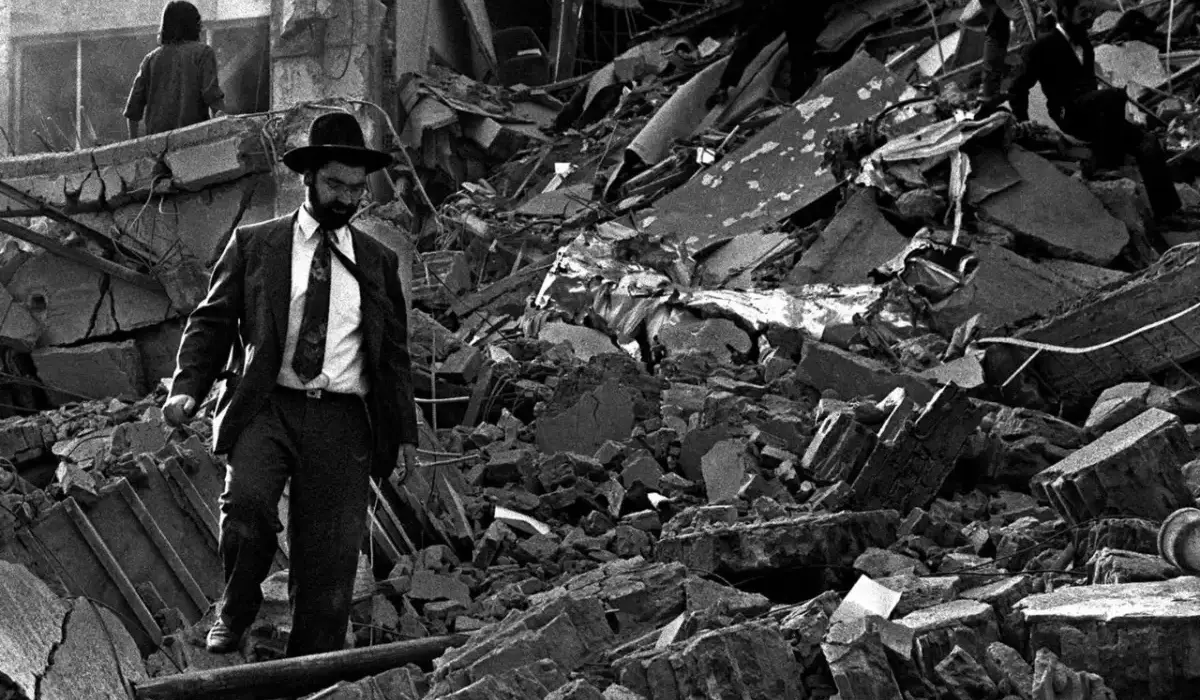
Federal Judge Daniel Rafecas on Monday formally charged eight Iranian and Lebanese nationals in connection with the devastating 1994 bombing of the Argentine Israelite Mutual Association (AMIA), a Jewish community center located in Buenos Aires that was reduced to rubble in an attack that killed 85 people and injured hundreds more.
In addition to issuing the formal charges, Judge Rafecas ordered the seizure of US$500 million in assets from each of the eight defendants. This sweeping judicial decision marks a major development in an ongoing trial in absentia that officially commenced in June 2025. The legal framework making these proceedings possible stems from Law 27,784, a piece of legislation approved by the Argentine Congress in February 2025 that authorizes trials in absentia for severe crimes under international law, including genocide, crimes against humanity, and acts of terrorism.
Among the high-profile defendants is Ahmad Vahidi, the current commander-in-chief of the Islamic Revolutionary Guard Corps (IRGC), who at the time of the 1994 bombing served as the commander of Iran’s elite Quds Force. Other prominent figures charged by the federal judge include Mohsen Reza, the former commander of the Revolutionary Guard; Ali Fallahijan, who served as Iran’s intelligence minister during the period of the attack; and Ali Akbar Velayati, who held the position of foreign minister.
According to Argentine judicial authorities, all of the defendants remain fugitives living abroad. They were formally notified of the charges filed against them and the corresponding extradition requests, but they failed to appear before Argentine courts to answer for the allegations, triggering the legal mechanisms required for the trial in absentia to proceed.
In his comprehensive ruling, Judge Rafecas established that the ultimate decision to execute the terrorist attack was made in August 1993 by the highest echelons of the Iranian regime. The court found that the operational execution of the plan was subsequently entrusted to the Lebanese militant group Hezbollah.
The judicial reconstruction of the conspiracy details a sophisticated regional and local support network utilized by the perpetrators. According to the findings, one of the primary operational hubs for the logistics of the attack was established in the volatile Triple Frontier region, which encompasses Ciudad del Este in Paraguay, Foz de Iguazú in Brazil, and Puerto Iguazú in Argentina.
The ruling meticulously outlines the preparations leading up to the tragedy. Investigators determined that those responsible acquired a white Renault Trafic van on Sunday, July 10, 1994. The vehicle was subsequently loaded with approximately 300 kilograms of explosives. On Friday, July 15, the bomb-laden van was parked just a few blocks away from the AMIA building on Pasteur Street. According to the reconstruction included in the ruling, the vehicle remained parked in the vicinity until the morning of Monday, July 18, when it was driven directly to the community center and detonated at a time of day when the bustling facility was at its peak capacity, maximizing casualties.
The defendants
Within his ruling, Judge Rafecas laid out distinct categories of responsibility for the individuals involved in the conspiracy. He accused Iranian state officials Ahmad Vahidi, Ali Fallahijan, Ali Akbar Velayati, and Mohsen Rezai of acting as indirect perpetrators of the attack.
The judicial document argues that these four men utilized their respective positions within the institutional structures of the Iranian state to participate directly in the decision-making process, the strategic organization of the plot, and the provision of necessary backing that enabled the operatives on the ground to successfully carry out the bombing.
Furthermore, Rafecas indicted Hadi Soleimanpour, who previously served as Iran’s ambassador to Argentina; Mohsen Rabbani, who at the time held the post of cultural adviser at the Iranian Embassy and operated as a religious figure based in Buenos Aires; and Ahmad Asghari, who has been identified as an intelligence agent working for the Revolutionary Guard. These three men were charged as necessary accomplices, with the ruling asserting that they made critical contributions to the criminal plan by leveraging diplomatic channels and exploiting the local infrastructure connected to the Iranian state.
The eighth defendant named in the ruling is Salman Raouf Salman, also known under the alias Samuel El Reda. According to the court’s findings, Salman coordinated the final, critical operational stage of the attack on behalf of Hezbollah.
While the court moved forward against these eight individuals, Judge Rafecas determined that there was insufficient evidence currently available to proceed with criminal charges against Abdallah Salman and Hussein Mouzannar. Additionally, the court chose not to examine the legal status of former Iranian Supreme Leader Ali Khamenei or prominent Hezbollah military commander Imad Mughniyeh, noting that both men had passed away—in 2026 and 2008, respectively. The legal status of Ali Hussein Abdallah, who died in 2020, was similarly excluded from the analytical scope of the current ruling.
Crime against humanity
A foundational element of Judge Rafecas’s ruling is the severe legal classification applied to the atrocities committed on July 18, 1994. The judge formally determined that the AMIA bombing constituted a crime against humanity and explicitly classified the events as genocide under international law.
The formal charges encompass repeated counts of homicide and bodily harm, with the severity of the offenses aggravated by racial and religious hatred, as well as by the employment of explosive methods capable of generating widespread public danger.
This comprehensive judicial determination draws heavily upon the extensive, multi-year investigation conducted by UFI AMIA, the specialized prosecutor’s office headed by prosecutor Sebastián Basso. The Prosecutor’s Office had previously submitted formal requests for the indictment of the fugitives and advocated for the implementation of trials in absentia to ensure accountability in cases where suspects refuse to submit to the jurisdiction of Argentine courts.
Another critical element incorporated into the judicial analysis is the established investigative hypothesis linking the AMIA tragedy to another devastating attack against the Jewish community that occurred in Panama just one day later.
According to the ruling, on July 19, 1994, a suicide operative detonated an explosive device aboard a commercial airliner in Panamanian airspace, resulting in the deaths of the three crew members and 17 passengers on board. Among the victims, 12 belonged to Panama’s local Jewish community.
The ongoing investigation maintains that both the Buenos Aires and Panama attacks were jointly claimed four days after the AMIA bombing by Hezbollah from Lebanon, operating under the cover name "Ansar Allah."
While the legal proceedings concerning the aircraft bombing in Panama remain open in that nation, the ruling notes that relevant judicial information and investigative leads continue to be actively exchanged between Panamanian and Argentine authorities.