





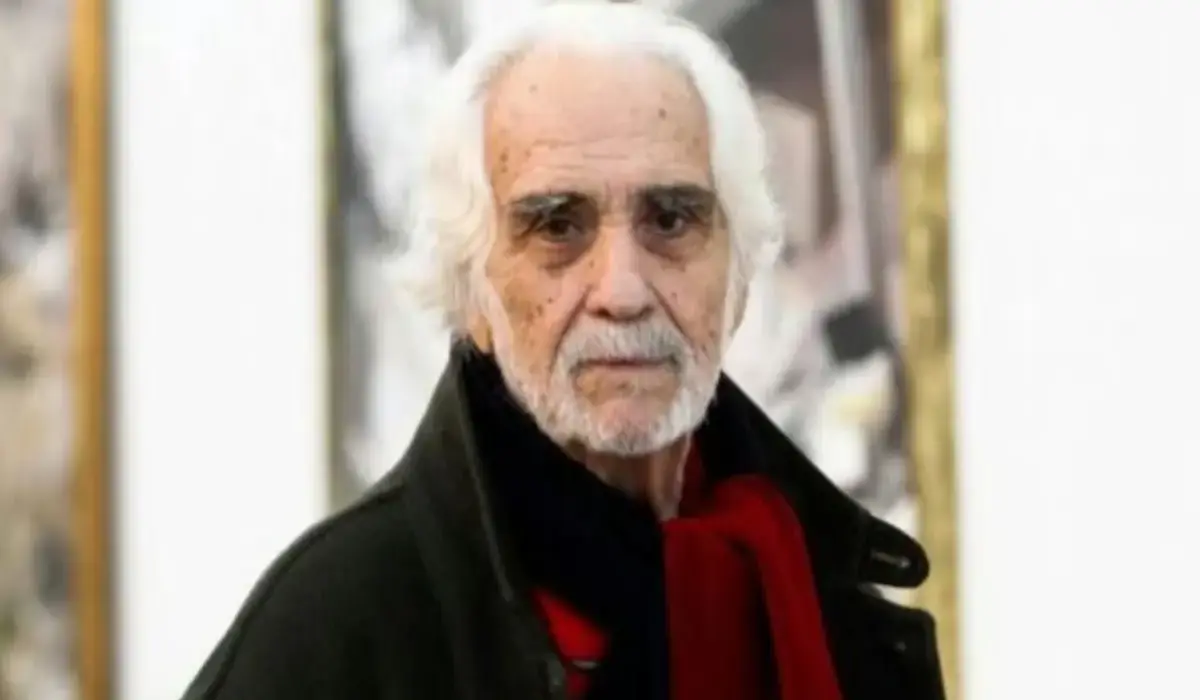
Carlos Alonso, celebrated as one of the most profound and influential Argentine painters and draftsmen of the 20th century, has died. He passed away on Monday in the central Argentine province of Córdoba, according to a brief and poignant statement released by his family on social media. He was 97 years old.
"With deep sorrow, we announce the death of Carlos Alonso. His family bids him farewell with profound grief and gratitude, accompanied by the affection of those who loved and admired him throughout his life. His work and legacy will remain forever," the family wrote on the artist’s official Instagram account, paying tribute to a man whose life was inextricably bound to the artistic, political, and social fabric of Argentina.
Throughout a career spanning decades, Alonso’s immense body of work remained deeply anchored in themes of historical memory, political resistance, and exile. Defined by an expressive, visceral technique rooted in his exceptional mastery as a draftsman and illustrator, his art reflected an unwavering commitment to social justice and the realities of the human condition.
Born Humberto Carlos Alonso on February 4, 1929, in the western province of Mendoza, his artistic journey began in his late teens. In 1944, he enrolled at the Academy of Fine Arts at the National University of Cuyo, where he honed the foundational skills that would later make him a titan of Latin American art.
Recognition for his extraordinary talent came early in his professional life. In 1951, Alonso swept multiple prestigious accolades, winning first prize at the San Rafael Painting Salon in Mendoza, the Salón del Norte in Santiago del Estero, and securing the drawing prize at the Salón del Norte in Tucumán. These early achievements signaled the arrival of a major new voice in Argentine visual arts.
The momentum continued when, in 1953, he held a critically acclaimed exhibition at Buenos Aires’ Viau Gallery. The financial success of the show enabled him to travel abroad the following year, embarking on a transformative journey to Europe where he exhibited his work in the cultural capitals of Paris and Madrid, absorbing the broader currents of international modern art.
Upon returning to Argentina, Alonso sought to ground his artistic vision in the stark realities of his homeland. He spent a formative year studying under the renowned artist Lino Spilimbergo in Tucumán, followed by another year living and working in Santiago del Estero. During this time, he encountered children suffering from acute hunger, witnessing firsthand the crushing weight of rural poverty and the daily difficulties of survival in Argentina’s marginalized regions.
That profound encounter fundamentally transformed his artistic language and his understanding of an artist’s role in society, a shift he reflected upon decades later in a 2018 interview with Argentina’s Ministry of Culture.
"I believe an artist has a degree of responsibility to the community to which he belongs, that language has the ability to communicate," Alonso said in the interview. "I chose the need to reflect what was happening in situations of emergency, in situations of poverty, in situations that did not correspond to the capacity, possibility, image or desire that one had for one’s own country."
Illustrating Literary Giants: Martín Fierro and Don Quixote
Alonso’s formidable drafting skills naturally drew him toward major literary illustration projects, where his dramatic visual style breathed new life into classic texts.
In 1957, he won a competitive contest organized by the Emecé publishing house to illustrate the second part of Miguel de Cervantes’ literary masterpiece, Don Quixote. He followed this major achievement by illustrating José Hernández’s quintessential Argentine epic, Martín Fierro, in 1959. Two years later, his mastery was further validated when he received the Chantal Prize from the Buenos Aires Watercolorists and Engravers Salon.
His international reputation as an illustrator soared in 1963, when the Soviet Union published postcards featuring his Don Quixote artwork. In a testament to his global standing, his illustrations were selected and published alongside masterworks by legendary artists Gustave Doré, Honoré Daumier, and Pablo Picasso.
Continuing his engagement with monumental literature, Alonso traveled to Florence in 1968 to work on a series of illustrations for Dante Alighieri’s The Divine Comedy. The profound themes of damnation, human suffering, and moral inquiry in Dante’s work resonated deeply with his evolving artistic worldview.
A year later, in 1969, he embarked on Lección de anatomía (The Anatomy Lesson), a powerful series directly inspired by Rembrandt’s famous painting but heavily infused with contemporary political violence, including implicit and explicit references to the execution of revolutionary leader Che Guevara.
This series emerged as a cornerstone of his mature oeuvre. Within these works, a recurring symbiosis between cattle and humans, alongside stark depictions of violence inflicted upon the physical body, served as a harrowing metaphor to address and critique the turbulent political reality of Argentina.
Alonso’s work was widely exhibited across the globe during this period. In 1967, he mounted a massive exhibition at Buenos Aires’ Art Gallery International, presenting approximately 250 works inspired by Dante and The Divine Comedy. His international profile expanded further with major exhibitions at Mexico’s National Museum of Fine Arts and Cuba’s Museum of Art in Havana, where he showcased striking tapestries and collages. By 1971, his art had reached European galleries, with solo exhibitions at the Giulia Gallery in Rome, the Eidos Gallery in Milan, and London’s Bedford Gallery.
Art in the Shadow of Dictatorship
As political turmoil deepened in Argentina, culminating in the military coup of March 1976, Alonso’s art became increasingly prophetic and urgent.
On April 26, 1976—just one month after the military junta seized power—Alonso opened a landmark exhibition titled “El ganado y lo perdido” (“The Cattle and the Lost”) at the Art Gallery on Florida Street. The exhibition brought together 45 powerful works produced between 1972 and 1976.
The collection chillingly anticipated the state-sponsored violence, terror, and disappearances that would soon engulf the entire country. The canvases featured haunting images of victims with blindfolded eyes, erased and ghostly figures, and compositions incorporating photographs of missing relatives. The social tension surrounding the show was palpable; a bomb threat eventually forced the complete evacuation of the gallery.
Around the same period, Alonso conceived Manos anónimas (“Anonymous Hands”), an ambitious papier-mâché installation composed of life-size, three-dimensional figures intended for an exhibition at the National Museum of Fine Arts. However, the establishment of the military dictatorship led to the immediate cancellation of the exhibition. The installation was left behind in Alonso’s studio, where it slowly deteriorated over the years. The concept behind the suppressed work eventually resurfaced in 1981 as a powerful series of paintings and pastel drawings, and the original piece was finally reconstructed decades later in 2019.
The personal toll of the dictatorship struck Alonso directly the following year, when his daughter, Paloma, was abducted and forcibly disappeared by the military regime. In the wake of this devastating personal tragedy, Alonso joined the ranks of the exiled, fleeing to Italy in 1977 before relocating to Madrid in 1979.
Return, Legacy, and Later Years
Following the eventual collapse of the military regime and the return of democracy, Alonso returned to Argentina in 1981, choosing to settle in the province of Córdoba, where he would live and work for the remainder of his life.
His return inaugurated a prolific era of public recognition, retrospectives, and continued creation. He maintained a steady schedule of major exhibitions across the country, including prominent shows at Buenos Aires’ Galerías Palatina between 1982 and 1996, and expansive retrospectives at the National Museum of Fine Arts from 1990 to 1995, alongside numerous other gallery presentations throughout Argentina.
Alonso’s immense contributions to national culture earned him some of the country’s highest artistic honors. He was twice awarded the prestigious Konex Platinum Award, first in 1982 and again in 1992, recognizing him as Argentina’s best draftsman of the decade. In 2012, the Konex Foundation bestowed upon him a Special Mention for Visual Arts Achievement in honor of his lifetime body of work.
Decades into his long career, his creative energy showed no signs of waning. In 2018, at the age of 89, Alonso was awarded the National Award for Artistic Achievement at the 107th National Visual Arts Salon, cementing his status as a towering and enduring pillar of Argentine culture whose brushstrokes and sketches documented the soul, the trauma, and the resilience of a nation.